
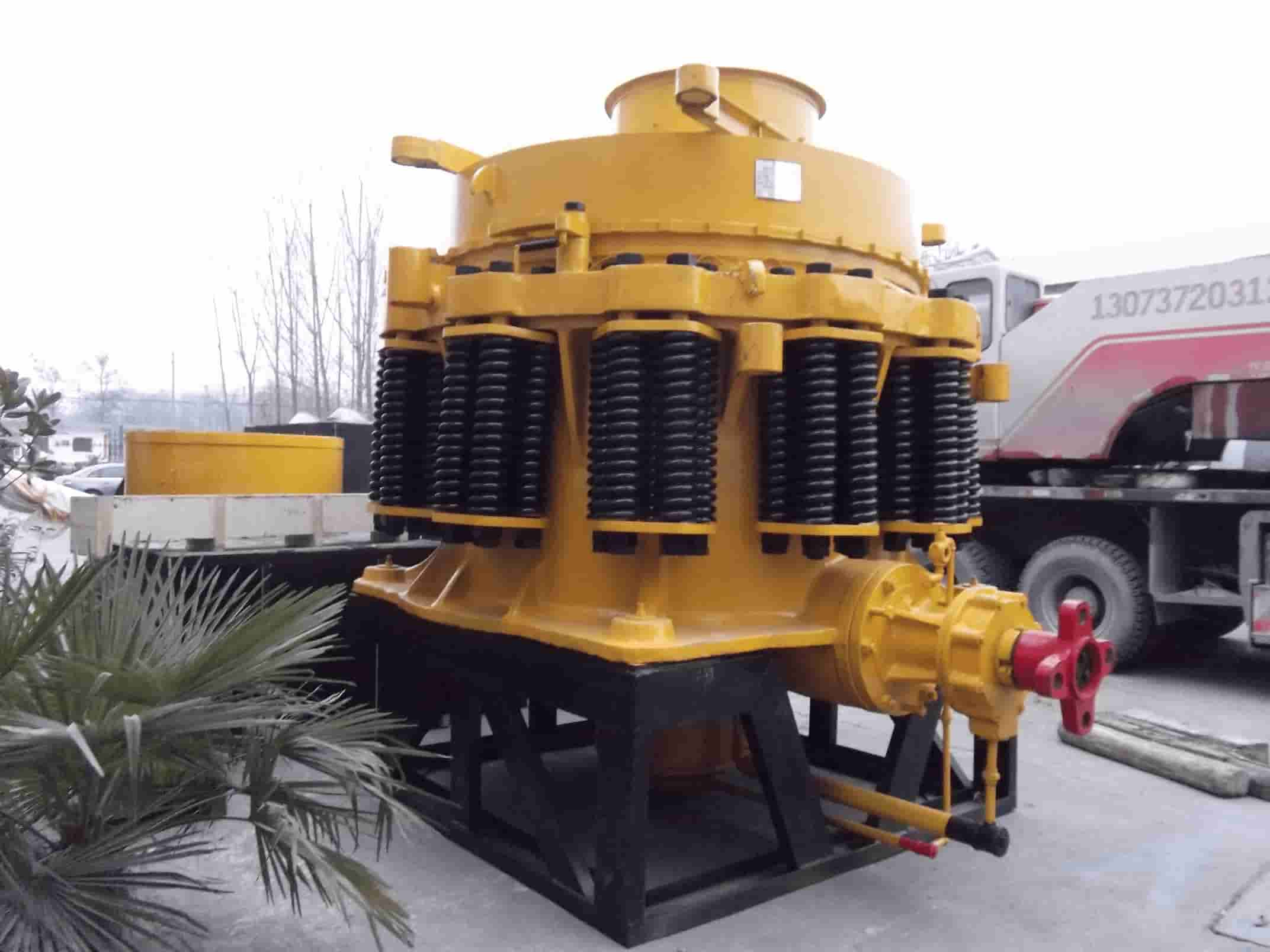
HP Cone Crusher for Hard Rock and Ore
Four sizes, HP300 to HP800, for the second and third crushing stages. We supply them for quarries, aggregate plants and mines that need a consistent, well-shaped product from hard or abrasive rock.
- Output range115–1,200 t/h
- Motors200 / 315 / 355 / 600 kW
- Largest feedup to 353 mm
- Setting range5–32 mm discharge
Figures are indicative. Final parameters are confirmed in the quotation.
Where an HP cone crusher fits in your plant
A typical hard-rock line, in the order the rock travels.
1. Primary stage
A jaw crusher (or gyratory) breaks run-of-mine rock down to roughly 150–300 mm.
2. Cone stage
The HP cone crusher takes that product and reduces it to the size your screens and customers need.
3. Screening and shaping
Screens return oversize to the cone. A vertical shaft impact crusher can follow if you make manufactured sand.
The cone works best in closed circuit with a screen. It needs a primary crusher ahead of it when the feed is large.
Pick a model by the output you need
Based on the published output ranges at a 25 mm closed-side setting. Real output moves with your rock and feed grading.
| Target output | Suggested model | Output at 25 mm setting |
|---|---|---|
| up to about 280 t/h | HP300 | 230–280 t/h |
| about 280–370 t/h | HP400 | 295–370 t/h |
| about 370–455 t/h | HP500 | 365–455 t/h |
| about 455–730 t/h | HP800 | 495–730 t/h |
| above 730 t/h | Two machines in parallel, or ask us for a larger option | |
Specifications
Output in t/h at the closed-side setting (CSS) shown.
| Model | Motor (kW) | Approx. weight** | Largest feed* | CSS 19 mm | CSS 25 mm | CSS 32 mm | CSS 38 mm |
|---|---|---|---|---|---|---|---|
| HP300 | 200 | ~18 t | 233 mm | 200–240 | 230–280 | 250–320 | 300–380 |
| HP400 | 315 | ~25.6 t | 299 mm | 255–320 | 295–370 | 325–430 | 360–490 |
| HP500 | 355 | ~37 t | 335 mm | 320–400 | 365–455 | 405–535 | 445–605 |
| HP800 | 600 | ~69 t | 353 mm | 435–545 | 495–730 | 545–800 | 600–950 |
*With the coarsest cavity; finer cavities take smaller feed. **Approximate weight for machines in this class; actual weight and dimensions are confirmed in the quotation. Figures are indicative; final parameters are confirmed in the quotation.
What decides your real output
The same machine can give very different numbers on two sites. These are the factors we check with you first.
Feed grading
Too many fines in the feed fill the cavity and cut throughput. Screening ahead of the cone usually pays for itself.
Moisture and clay
Wet, sticky feed packs the chamber and lowers output. It is the most common reason a cone underperforms.
Hardness and abrasiveness
Harder, more abrasive rock reduces output slightly and wears liners faster. It also decides your spare-part budget.
Setting and circuit
A tighter setting means finer product but lower output. Closed circuit with a screen gives the most consistent size.
Is a cone crusher the right choice?
A short honest check before you ask for a price.
Good fit
- Hard or abrasive rock: granite, basalt, iron ore, gold ore, river pebbles.
- You want a rounder, more cubical product for aggregate or sand-making.
- A primary crusher is already in place.
- You need to change product size without rebuilding the crusher.
Look at other machines if
- Feed is large run-of-mine rock: start with a jaw crusher.
- Rock is soft or medium-hard (limestone, coal): an impact or hammer crusher may be cheaper.
- Feed is wet and clay-rich: wash or scalp it first.
- Budget is tight and product shape does not matter.
What operating one is like
What your maintenance team will deal with.
- Tramp metal: a hydraulic system lets uncrushable steel pass through, so a stray bolt or tooth does not have to stop the plant.
- Adjusting size: the setting is changed hydraulically, and the same control makes up for liner wear.
- Wear parts: the mantle and concave are the main consumables. Plan a spare set from the start.
- Servicing: the main parts come out through the top or side of the machine, which keeps liner changes short.
- Investment: a cone costs more than a jaw or impact crusher of similar capacity. The return is in product shape and in durability on hard rock.
- Operators: the hydraulic and lube systems need regular checks by trained staff.
What we need to quote
Send what you know on WhatsApp or by email. Rough numbers are enough to start.
- Rock type and, if known, hardness
- Feed size, ideally with a photo
- Product size you want
- Output required (t/h)
- Moisture and clay content
- What crusher comes before it
- Power supply (voltage and frequency)
- Site altitude and destination country
Buying through CNEIG INDUSTRIAL
We are a trading and project-coordination company, not the factory.
- We agree the model and parameters with the manufacturer and write them into your quotation.
- Lead time depends on whether the machine is in stock, has to be produced, or is customised. It is stated in the contract.
- Payment, warranty and delivery terms are set in the contract.
- Read how we handle pre-shipment inspection.
Common questions
How large can the feed be?
It depends on the model and cavity. With the coarsest cavity the limit is about 233 mm on the HP300 and 353 mm on the HP800. Finer cavities take smaller feed.
HP300, HP400, HP500 or HP800?
Choose the smallest one whose output covers your target at the setting you need. The tables above give a starting point; we check it against your feed before quoting.
Cone crusher or impact crusher?
For hard, abrasive rock a cone usually gives better shape and lower wear cost per ton. For softer rock an impact crusher costs less up front. Tell us the rock and we will say which suits you.
What wears out first?
The mantle and concave liners. How fast depends on the abrasiveness of the rock. We can quote wear parts together with the machine.
What about lead time, payment and warranty?
They are agreed in the contract before the order is confirmed. Lead time depends on stock, production or customisation.
Machines used with it
Tell us about your project
Send the rock type, feed size and the output you want. We will come back with a suitable model and a quotation.
Request a Quotation
Tell us the material and the output you want. We reply within 1–2 business days.