
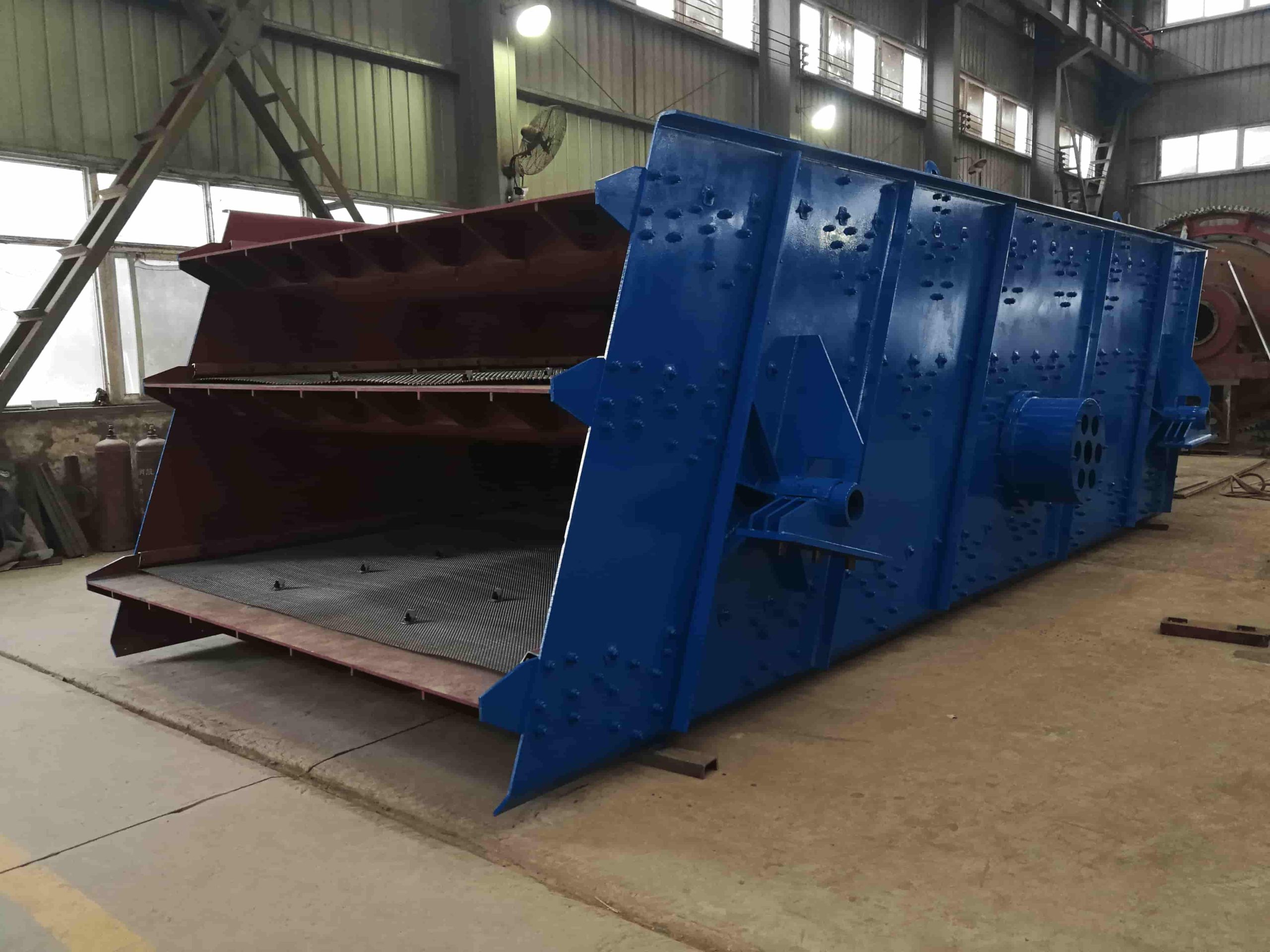
YK Circular Vibrating Screen for Stone, Sand and Ore
Nine sizes, from YK1230 to YK3060, with one to three decks. We supply them to plants that need to size crushed rock, sand, coal or ore, and to send oversize back to the crusher.
- Output range10–550 t/h
- Decks1 to 3
- Aperture4–150 mm
- Motors5.5–37 kW
Figures are indicative. Final parameters are confirmed in the quotation.
Where a vibrating screen fits in your plant
A screen sits after almost every crusher, to sort the product and to protect the next stage.
Before a crusher
A screen ahead of a crusher removes fines and small rock that do not need crushing. This raises output and cuts wear.
After a crusher
The screen sorts the crushed product into sizes. Oversize goes back to the crusher, so the final product stays within spec.
Final grading
For sand and aggregate, screens set the final grading before the product goes to stockpile or to washing.
The number of products is one more than the number of decks: a two-deck screen gives three sizes.
Pick a model by the output you need
Output depends on the material, the aperture and how much of the feed is near the aperture size. Use this as a starting point.
| Target output | Suggested model | Output range | Screen size (mm) |
|---|---|---|---|
| up to about 80 t/h | YK1230 | 10–80 t/h | 1200 × 3000 |
| about 80–150 t/h | YK1530 | 20–150 t/h | 1500 × 3000 |
| about 150–200 t/h | YK1548 | 30–200 t/h | 1500 × 4800 |
| about 200–250 t/h | YK1836 | 40–250 t/h | 1800 × 3600 |
| about 250–300 t/h | YK1848 | 50–300 t/h | 1800 × 4800 |
| about 300–350 t/h | YK1860 | 60–350 t/h | 1800 × 6000 |
| about 350–400 t/h | YK2160 | 80–400 t/h | 2100 × 6000 |
| about 400–450 t/h | YK2460 | 100–450 t/h | 2400 × 6000 |
| about 450–550 t/h | YK3060 | 120–550 t/h | 3000 × 6000 |
Specifications
All nine models of the YK series.
| Model | Screen size W × L (mm) | Area per deck (m²) | Decks | Aperture (mm) | Output (t/h) | Motor (kW) | Approx. weight* |
|---|---|---|---|---|---|---|---|
| YK1230 | 1200 × 3000 | 3.6 | 1–2 | 4–150 | 10–80 | 5.5 | ~2.9 t |
| YK1530 | 1500 × 3000 | 4.5 | 1–3 | 4–150 | 20–150 | 7.5 | ~3.8 t |
| YK1548 | 1500 × 4800 | 7.2 | 1–3 | 4–150 | 30–200 | 11 | ~5 t |
| YK1836 | 1800 × 3600 | 6.5 | 1–3 | 4–150 | 40–250 | 15 | ~5.9 t |
| YK1848 | 1800 × 4800 | 8.6 | 1–3 | 4–150 | 50–300 | 15 | ~7 t |
| YK1860 | 1800 × 6000 | 10.8 | 1–3 | 4–150 | 60–350 | 18.5 | ~8.5 t |
| YK2160 | 2100 × 6000 | 12.6 | 1–3 | 4–150 | 80–400 | 22 | ~10 t |
| YK2460 | 2400 × 6000 | 14.4 | 1–3 | 4–150 | 100–450 | 30 | ~12.3 t |
| YK3060 | 3000 × 6000 | 18 | 1–3 | 4–150 | 120–550 | 37 | ~15.2 t |
*Approximate weight; final weight and dimensions are confirmed in the quotation. Area per deck is width × length. Amplitude is typically in the 4–8 mm range. Figures are indicative; final parameters are confirmed in the quotation.
What decides your real output
The same screen can give very different numbers on two sites. These are the factors we check with you first.
Aperture and near-size material
Rock close to the aperture size is the hardest to separate. The more of it in your feed, the lower the output and the efficiency.
Moisture and clay
Damp, sticky feed blinds the mesh and cuts output sharply. Wet screening, heated decks or a different mesh can help.
Feed rate and spread
An even feed spread across the full deck width gives the best result. A heavy, uneven feed overloads one side.
Number of decks
More decks give more sizes from one machine. Each extra deck lowers the capacity of the lower decks and adds weight.
Is a circular vibrating screen the right choice?
A short honest check before you ask for a price.
Good fit
- Crushed stone, gravel, sand, coal and ore in a size range of 4–150 mm.
- You need up to four sizes in one machine.
- A closed circuit with a crusher where oversize goes back.
- A plant that wants a robust, well-proven screen.
Look at other machines if
- Feed is very wet and sticky: wash or dry it first, or use a wet screen.
- You need very fine screening of damp powder: a different screen type is better.
- You are feeding a crusher at a fixed rate: a feeder with grizzly bars may be enough.
- Headroom is very low: a linear-motion screen is shorter.
What operating one is like
What your maintenance team will deal with.
- Screen mesh: the mesh is the main wear part. Change it as soon as it tears or stretches. Keep spare panels.
- Mesh blinding: check regularly for clogged holes in damp weather.
- Adjustments: inclination, amplitude and frequency can be adjusted to suit the material.
- Mesh changes: the mesh is modular, so a panel can be replaced without taking the whole deck apart.
- Foundation: the larger sizes need a strong support structure and a solid base.
- Dust and noise: plan a dust cover at the screen and check the noise level on site.
What we need to quote
Send what you know on WhatsApp or by email. Rough numbers are enough to start.
- Material and size range of the feed
- The sizes you want to separate (apertures)
- Output required (t/h)
- Number of products you need
- Moisture and clay content
- Where the feed comes from and where each size goes
- Power supply (voltage and frequency)
- Site altitude and destination country
Buying through CNEIG INDUSTRIAL
We are a trading and project-coordination company, not the factory.
- We agree the model and parameters with the manufacturer and write them into your quotation.
- Lead time depends on whether the machine is in stock, has to be produced, or is customised. It is stated in the contract.
- Payment, warranty and delivery terms are set in the contract.
- Read how we handle pre-shipment inspection.
Common questions
How many decks do I need?
One deck gives two products, two decks give three and three decks give four. Choose the number of sizes you need to sell or send on. Tell us the sizes and we will suggest a model.
How do I choose the size of screen?
Start with the output you need, then check the aperture and how much of the feed is near that size. The table above gives a starting point; we check it against your material before quoting.
Why is my screen not reaching the rated output?
The usual causes are damp or sticky feed, too much near-size material, an uneven feed across the deck, or a worn mesh. We can review your case if you send photos and the feed size.
What wears out first?
The screen mesh. How fast depends on the abrasiveness of the material. We can quote spare mesh panels with the machine.
What about lead time, payment and warranty?
They are agreed in the contract before the order is confirmed. Lead time depends on stock, production or customisation.
Machines used with it
Tell us about your project
Send the material, the sizes you want and the output you need. We will come back with a suitable model and a quotation.
Request a Quotation
Tell us the material and the output you want. We reply within 1–2 business days.