
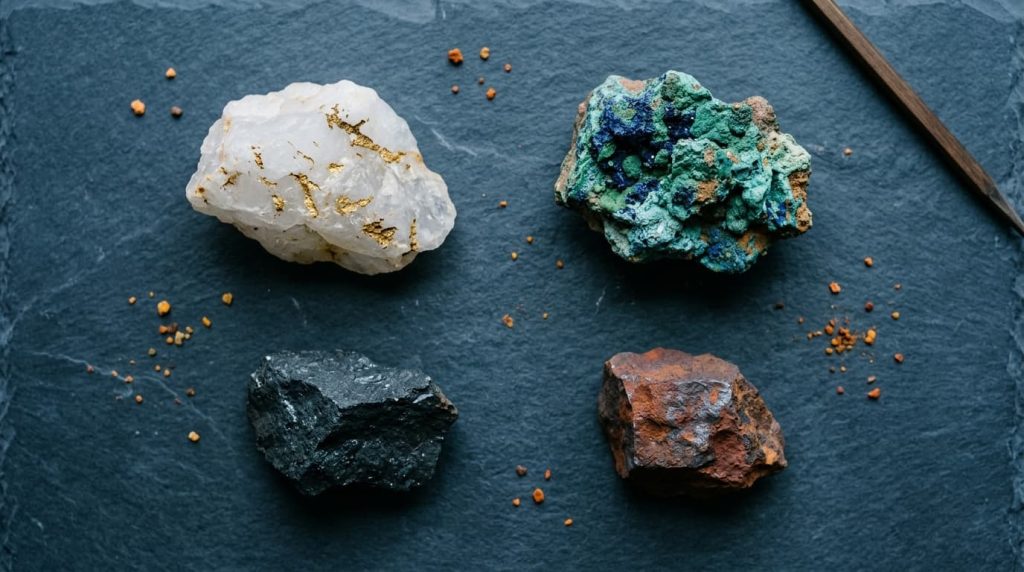
Typical process routes (illustrative). Final flowsheets depend on the client’s metallurgical testwork.
Jump to
Gold
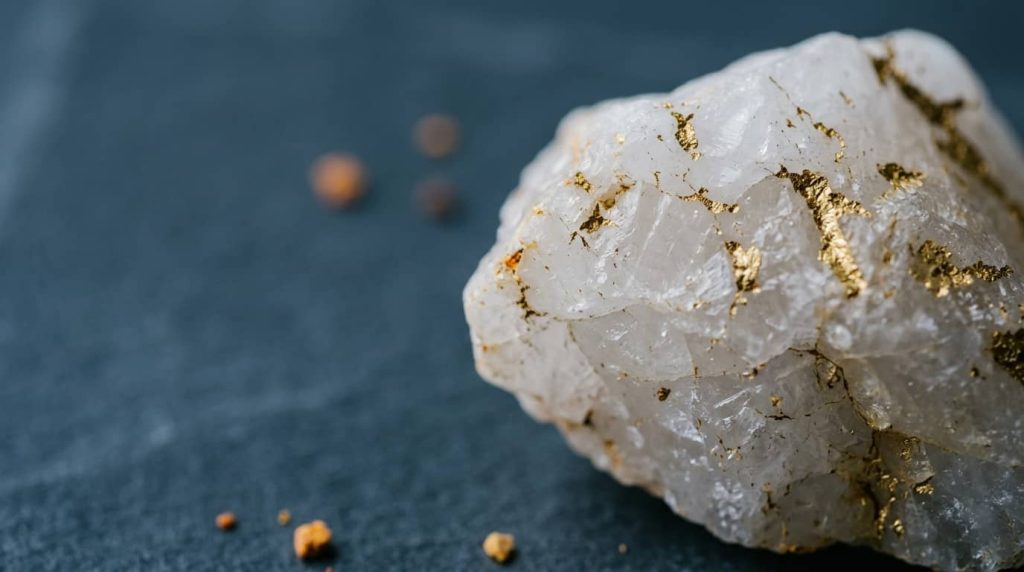
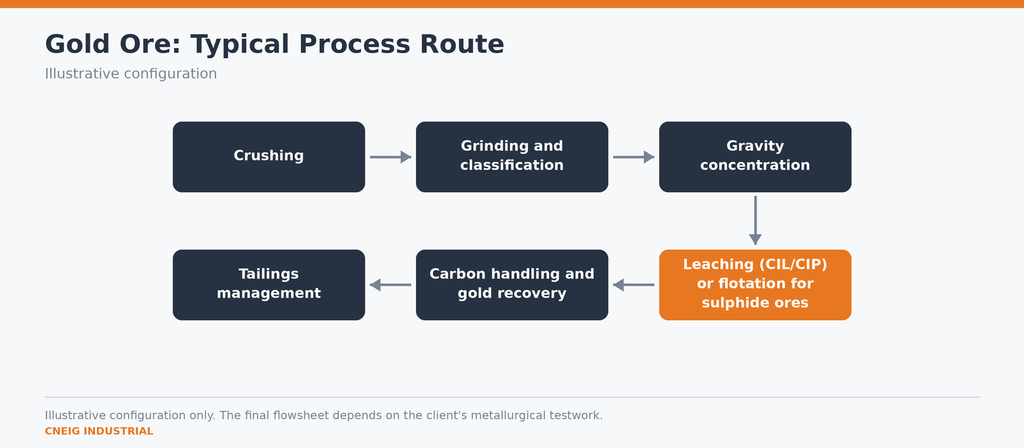
Typical configuration (illustrative): Crushing → Grinding and classification → Gravity concentration → Leaching (CIL/CIP) or flotation for sulphide ores → Carbon handling and gold recovery → Tailings management.
What decides the flowsheet: how the gold occurs (free-milling or refractory), sulphide and carbon content, particle size, clay and moisture, water availability, and local permitting for reagents and tailings.
What we need from you: representative samples and assays, throughput requirement, site, power and water conditions.
Equipment for this route: Crushing · Grinding and Classification · Flotation and Dewatering
See gold processing equipment and plants →
Copper
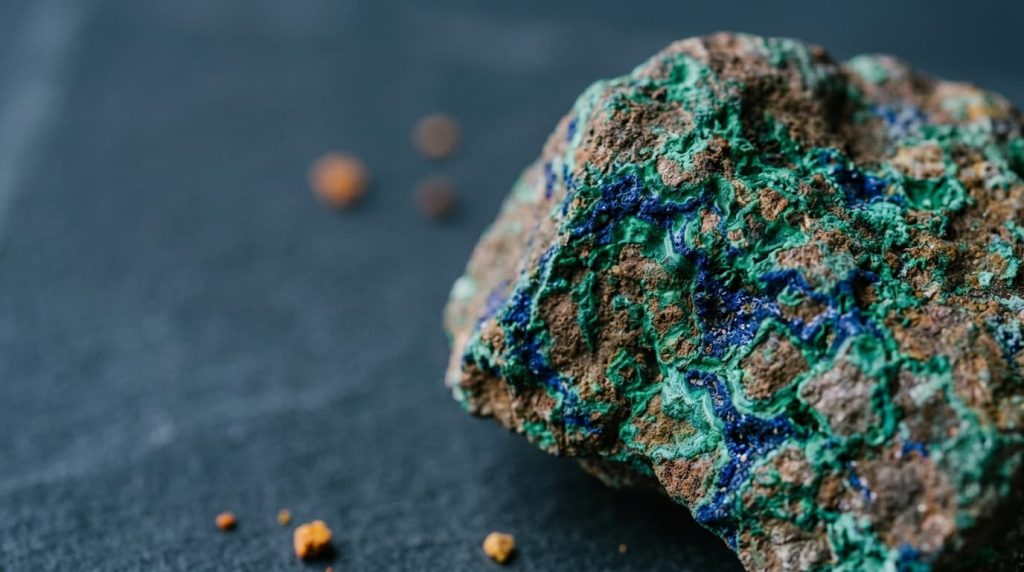
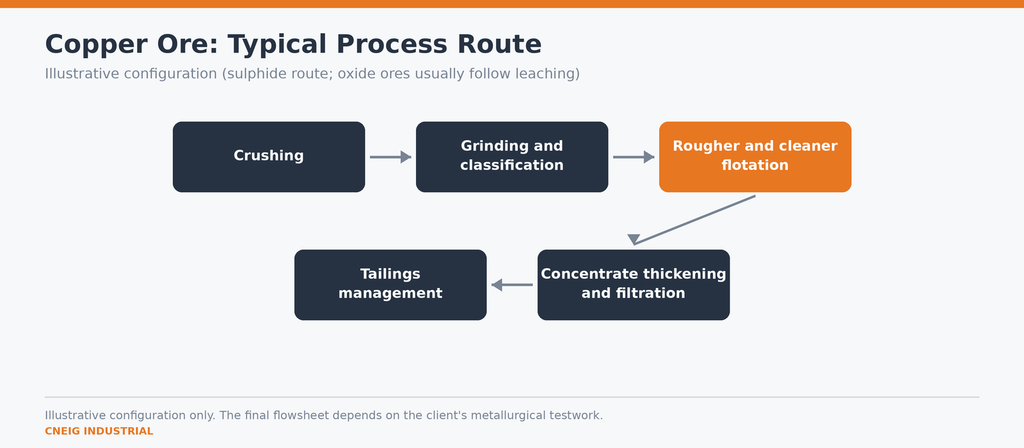
Typical configuration (illustrative): Crushing → Grinding and classification → Rougher and cleaner flotation → Concentrate thickening and filtration → Tailings management. Oxide copper ores usually follow a leaching route rather than flotation.
What decides the flowsheet: oxide or sulphide mineralogy, grind size needed for liberation, clay content, water quality, and the concentrate grade and impurity limits the buyer or smelter accepts.
What we need from you: ore assays and mineralogy, throughput, concentrate specification, site conditions.
Equipment for this route: Crushing · Grinding and Classification · Flotation and Dewatering
Chromite and iron ore
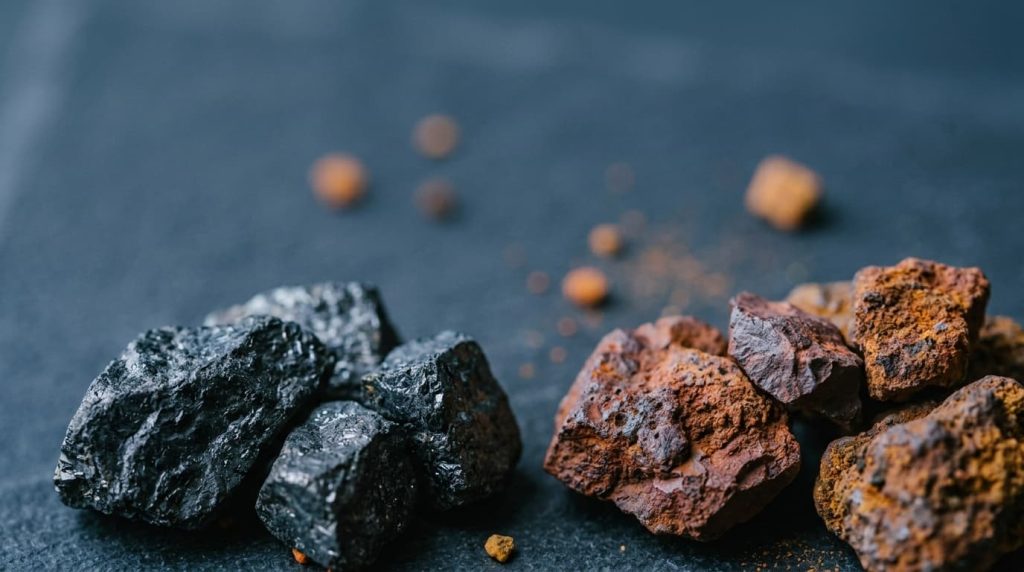
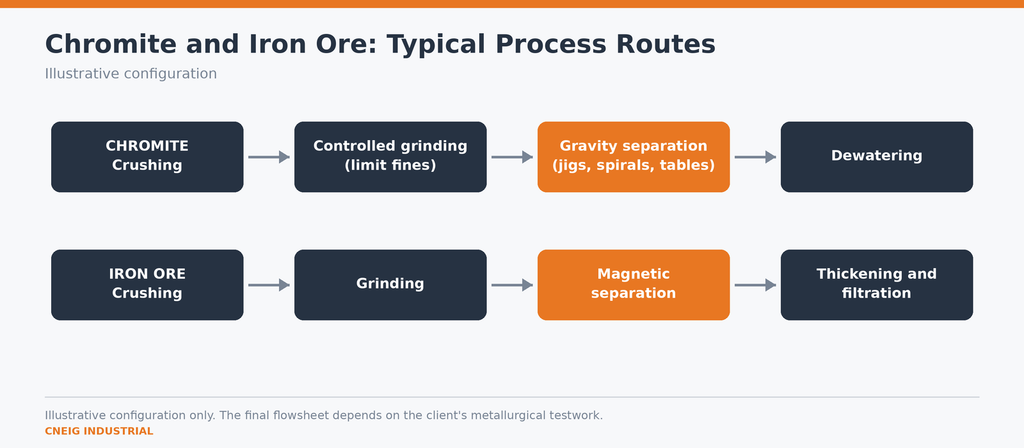
Typical configuration (illustrative): Chromite: Crushing → Controlled grinding (to limit fines) → Gravity separation (jigs, spirals or tables) → Dewatering. Iron ore: Crushing → Grinding → Magnetic separation → Thickening and filtration.
What decides the flowsheet: liberation size, density and magnetic properties of the minerals, fines generation, and the product specification (for example Cr:Fe ratio for chromite, or silica and alumina limits for iron ore).
What we need from you: ore assays, particle size distribution, product specification, throughput, site conditions.
Equipment for this route: Crushing · Grinding and Classification · Gravity, Magnetic Separation and Dewatering
These pages describe general process routes. They do not describe completed projects, and no recovery or capacity figures are implied.
Related reading
Technical notes on choosing a process route and preparing your enquiry.
Why the Same Gold Assay Can Need Two Different Plants
Test the ore before you choose the recovery route.
Read article →Small Scale Gold Processing Plant: How It Is Built
What is in a small gold line, from crushing to recovery.
Read article →Site Conditions Buyers Often Forget to Mention in an RFQ
A checklist of what to send with your enquiry.
Read article →Other Ores
We can also configure lines for other ores. Tell us your material, assay and target capacity.
Related Pages
Send Us Your Ore Details
Ore type, assay, throughput and site conditions are enough to start.
Send a Project Enquiry WhatsApp Us