
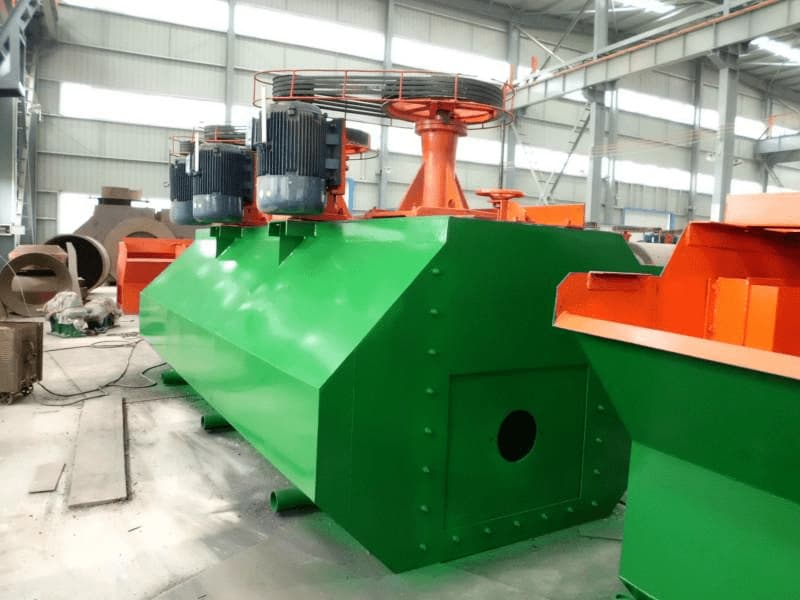
KYF Aerated Flotation Machine
Eight cell sizes, from 1 to 50 m³, with forced-air supply for roughing, cleaning and scavenging. A blower feeds the air, so you control the aeration of each cell. We supply them to mines that need steady, adjustable flotation on difficult or large-volume ores.
- Cell volume1–50 m³
- Pulp capacity per cell0.2–50 m³/min
- Motors4–55 kW
- Air supplyforced air from a blower
Figures are indicative. Final parameters are confirmed in the quotation.
Where a KYF flotation machine fits in your plant
Flotation follows grinding and classification. It separates the valuable mineral from the waste.
1. Conditioning
Reagents are mixed into the ground pulp so the valuable mineral becomes water-repellent.
2. Flotation with forced air
A blower supplies air to the impeller, which spreads it as fine bubbles through the pulp. You adjust the air to suit the ore.
3. Concentrate and tailings
The froth is scraped off as concentrate. The pulp that remains is the tailings. Several cells in series raise the recovery.
KYF cells are often paired with XCF cells at the head of the bank. The XCF cell draws in pulp and air by itself and feeds the KYF cells that follow. We confirm the pairing for your circuit in the quotation.
Pick a cell size by the pulp flow
Pulp capacity is the volume of pulp one cell handles per minute. Use this as a starting point.
| Pulp flow per cell | Suggested model | Cell volume | Pulp capacity |
|---|---|---|---|
| up to about 1 m³/min | KYF-1 | 1 m³ | 0.2–1 m³/min |
| about 1–2 m³/min | KYF-2 | 2 m³ | 0.4–2 m³/min |
| about 2–4 m³/min | KYF-4 | 4 m³ | 1.2–4 m³/min |
| about 4–8 m³/min | KYF-8 | 8 m³ | 3–8 m³/min |
| about 8–16 m³/min | KYF-16 | 16 m³ | 4–16 m³/min |
| about 16–24 m³/min | KYF-24 | 24 m³ | 4.5–24 m³/min |
| about 24–38 m³/min | KYF-38 | 38 m³ | 10–38 m³/min |
| about 38–50 m³/min | KYF-50 | 50 m³ | 10–50 m³/min |
Specifications
All eight models of the KYF series.
| Model | Cell volume (m³) | Pulp capacity (m³/min) | Motor (kW) | Blower air pressure (kPa) | Tank L × W (mm) | Approx. weight per cell* |
|---|---|---|---|---|---|---|
| KYF-1 | 1 | 0.2–1.0 | 4 | ≥ 12.6 | 700 × 700 | ~900–1,060 kg |
| KYF-2 | 2 | 0.4–2.0 | 5.5 | ≥ 14.7 | 850 × 850 | ~1,420 kg |
| KYF-4 | 4 | 1.2–4.0 | 7.5–11 | ≥ 19.8 | 1100 × 1100 | ~2,200 kg |
| KYF-8 | 8 | 3.0–8.0 | 15 | ≥ 21.6 | 1300 × 1300 | ~3,600–4,000 kg |
| KYF-16 | 16 | 4.0–16.0 | 30 | ≥ 25.5 | 1700 × 1700 | ~5,900 kg |
| KYF-24 | 24 | 4.5–24.0 | 30–37 | ≥ 30.4 | 2000 × 2000 | ~7,500–9,800 kg |
| KYF-38 | 38 | 10–38 | 37–45 | ≥ 34.3 | 2200 × 2200 | ~10,300–15,100 kg |
| KYF-50 | 50 | 10–50 | 55 | in quotation | 2400 × 2400 | in quotation |
*Approximate weight; final weight and dimensions are confirmed in the quotation. Motor is the main impeller drive. A small separate motor, about 0.75–1.5 kW, drives the froth scraper on each cell. The blower is supplied separately. Figures are indicative; final parameters are confirmed in the quotation.
What decides your real result
The same machine can give very different recovery and grade on two ores. These are the factors we check with you first.
Ore and reagents
Flotation depends on the ore and the reagents. A test on your ore gives the settings and the reagent plan that work.
Air supply
The right amount of air is key. Too little leaves valuable mineral behind, and too much brings waste into the froth. Forced air lets you set it for each cell.
Grind size and density
The mineral must be freed but not over-ground, and the pulp density must be stable. This is set at the mill and the classifier.
Time in flotation
The ore needs enough time in the cells. This sets how many cells you need in each bank.
Is a KYF flotation machine the right choice?
A short honest check before you ask for a price.
Good fit
- Larger plants and larger cells, up to 50 m³ each.
- Ores that need tight control of the air, such as complex or fine-grained ores.
- You want strong mixing and an even spread of bubbles.
- Abrasive slurry: rubber impellers and stators are available.
Look at other machines if
- You want to avoid a blower and keep the plant simple: an SF self-aspirating machine takes in its own air.
- The ore is magnetic: a magnetic separator is cheaper.
- You cannot manage reagents and wastewater on site.
- You have no air supply and no operator experienced with flotation.
What operating one is like
What your operators and maintenance team will deal with.
- Blower: the blower must give a steady air supply at the pressure shown in the table. It needs its own power and maintenance.
- Impeller and stator: these are the main wear parts. Rubber ones suit abrasive slurry.
- Reagents and wastewater: the process needs reagents and proper treatment of the tailings and water.
- Skilled operation: flotation needs an experienced operator to tune the pulp level, the air and the reagents.
- Energy: the energy use is lower than for many mechanical cells of the same size, but the blower adds to the total.
What we need to quote
Send what you know on WhatsApp or by email. Rough numbers are enough to start.
- Ore type and the mineral you want to recover
- Pulp flow (m³/h or t/h of solids) and pulp density
- Grind size (for example 80% passing 0.074 mm)
- Results of any flotation tests you have
- Number of banks (rougher, cleaner, scavenger), if you know
- Air supply you have or need
- Power supply (voltage and frequency)
- Site altitude and destination country
Buying through CNEIG INDUSTRIAL
We are a trading and project-coordination company, not the factory.
- We agree the model and parameters with the manufacturer and write them into your quotation.
- Lead time depends on whether the machine is in stock, has to be produced, or is customised. It is stated in the contract.
- Payment, warranty and delivery terms are set in the contract.
- Read how we handle pre-shipment inspection.
Common questions
What is the difference between KYF and XCF?
They are a pair. An XCF cell draws in pulp and air by itself and sits at the head of a bank. KYF cells follow it and use forced air from a blower. We confirm the combination for your circuit in the quotation.
KYF or SF: which should I choose?
An SF cell takes in its own air and is simple and compact. A KYF cell uses a blower, which lets you adjust the air for each cell and suits larger plants and more difficult ores. Tell us the ore and we will advise.
How many cells do I need?
That depends on your ore, the pulp flow and the time in flotation. We size the number of cells and the banks from your data, or from a flotation test if you have one.
What wears out first?
The impeller and the stator. How fast depends on how abrasive the slurry is. We can quote spare parts with the machine.
What about lead time, payment and warranty?
They are agreed in the contract before the order is confirmed. Lead time depends on stock, production or customisation.
Machines used with it
Tell us about your project
Send the ore, the pulp flow and the grind size. We will come back with a suitable model and a quotation.
Request a Quotation
Tell us the material and the output you want. We reply within 1–2 business days.