
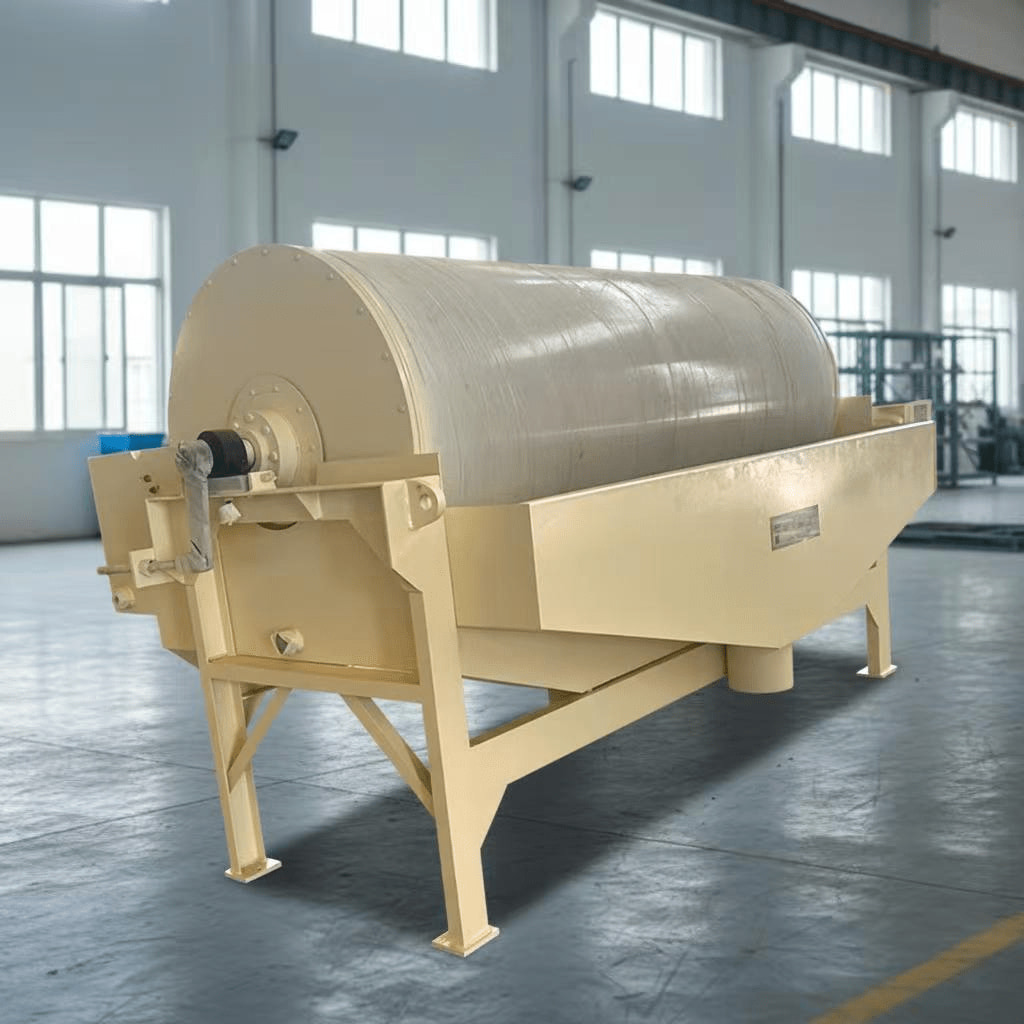
CTB Wet Drum Magnetic Separator
A permanent-magnet drum that pulls magnetic minerals out of a wet slurry. Ten sizes, from 8 to 300 t/h. It needs no excitation power, so running cost stays low. We supply it to mines that process magnetite and other magnetic ores.
- Capacity8–300 t/h
- Feed sizebelow 3 mm
- Drum power1.1–15 kW
- Surface field1,450–1,950 mT
Figures are indicative. Final parameters are confirmed in the quotation.
Where a CTB magnetic separator fits in your plant
It works on ground ore in water, after grinding and classification.
1. Slurry enters the tank
The ground ore, mixed with water, flows into the tank under the drum.
2. The drum picks up magnetic grains
Fixed magnets inside the rotating drum hold the magnetic particles on its surface. The rest of the slurry flows on.
3. Concentrate is washed off
As the drum turns away from the magnets, the concentrate is washed off into a separate launder. The tailings leave through another outlet.
Pick a size by your throughput
Use this as a starting point. Capacity depends on the ore and the feed.
| Your feed rate | Suggested model | Capacity |
|---|---|---|
| up to about 15 t/h | CTB 600 × 600 | 8–15 t/h |
| about 15–25 t/h | CTB 600 × 900 / 600 × 1200 | 10–25 t/h |
| about 25–50 t/h | CTB 750 × 1200 / 900 × 1800 | 18–50 t/h |
| about 50–100 t/h | CTB 1050 × 2400 / 1200 × 3000 | 35–100 t/h |
| about 100–200 t/h | CTB 1500 × 3000 / 1500 × 4500 | 80–200 t/h |
| about 200–300 t/h | CTB 1800 × 5000 | 150–300 t/h |
Specifications
All ten models. Drum size is diameter × length.
| Model (drum mm) | Capacity (t/h) | Drum power (kW) | Surface field (mT) | Approx. weight (t) |
|---|---|---|---|---|
| CTB 600 × 600 | 8–15 | 1.1 | 1,450 | ~0.9 |
| CTB 600 × 900 | 10–20 | 1.1 | 1,450 | ~1.0 |
| CTB 600 × 1200 | 12–25 | 1.1 | 1,450 | ~1.2 |
| CTB 750 × 1200 | 18–35 | 2.2 | 1,550 | ~1.8 |
| CTB 900 × 1800 | 25–50 | 3 | 1,650 | ~2.6 |
| CTB 1050 × 2400 | 35–70 | 4 | 1,750 | ~3.6 |
| CTB 1200 × 3000 | 50–100 | 5.5 | 1,850 | ~4.5 |
| CTB 1500 × 3000 | 80–150 | 7.5 | 1,950 | ~5.8 |
| CTB 1500 × 4500 | 120–200 | 11 | 1,950 | ~7.2 |
| CTB 1800 × 5000 | 150–300 | 15 | 1,950 | ~9.5 |
Feed size below 3 mm. Capacity is for the feed material and conditions stated in the quotation. Approximate weights; final weight and dimensions are confirmed in the quotation. Figures are indicative; final parameters are confirmed in the quotation.
What decides your real result
The same separator can give a different grade and recovery on two ores. These are the factors we check with you first.
How magnetic the ore is
Strongly magnetic minerals, such as magnetite, are recovered well. Weakly magnetic minerals need a stronger field and a different machine.
Feed size and liberation
The magnetic mineral must be freed from the waste rock. Ore that is ground too coarse carries waste into the concentrate.
Pulp density and flow
A stable, not-too-thick pulp gives a cleaner concentrate. A feed that surges lowers the result.
Tank type
The tank can be downstream, counter-current or semi-counter-current. The right type depends on the feed size and the grade you need. We confirm it in the quotation.
Is a CTB magnetic separator the right choice?
A short honest check before you ask for a price.
Good fit
- Magnetite and other strongly magnetic minerals.
- Roasted ore, and iron removal from other products.
- You want no excitation power and low running cost.
- Wet feed below 3 mm.
Look at other machines if
- The valuable mineral is not magnetic. Gold, copper and zinc ores use flotation or leaching.
- The mineral is only weakly magnetic, such as hematite. A stronger-field machine is needed.
- The feed is dry or coarser than 3 mm.
- You cannot supply water to the machine.
What operating one is like
What your operators and maintenance team will deal with.
- Power: only the small drum drive uses electricity. The magnets are permanent and need no excitation power.
- Water: the machine needs a steady supply of wash water, and the slurry and tailings must be handled on site.
- Drum surface: the shell wears over time and is checked and replaced as part of maintenance. We quote wear parts with the machine.
- Tramp metal: large pieces of iron can damage the drum and block the tank. A screen or grid ahead of the machine helps.
What we need to quote
Send what you know on WhatsApp or by email. Rough numbers are enough to start.
- Ore type and the magnetic mineral you want to recover
- Feed rate (t/h) and pulp density
- Feed size (for example 80% passing 0.074 mm)
- Concentrate grade you are aiming for
- Magnetic test results, if you have them
- Number of stages (rougher, cleaner), if you know
- Power supply (voltage and frequency)
- Site altitude and destination country
Buying through CNEIG INDUSTRIAL
We are a trading and project-coordination company, not the factory.
- We agree the model and parameters with the manufacturer and write them into your quotation.
- Lead time depends on whether the machine is in stock, has to be produced, or is customised. It is stated in the contract.
- Payment, warranty and delivery terms are set in the contract.
- Read how we handle pre-shipment inspection.
Common questions
Does the CTB separator need electricity for the magnets?
No. The magnets are permanent. Only the motor that turns the drum uses power.
Can it recover non-magnetic minerals?
No. It recovers magnetic minerals only. For minerals that are not magnetic we use flotation, gravity separation or leaching, depending on the ore.
How do I choose the tank type?
It depends on the feed size and the grade you need. Send us your feed size and target grade, and we will recommend one.
How fine must the feed be?
The feed must be below 3 mm. The finer and better freed the mineral is, the cleaner the concentrate.
What about lead time, payment and warranty?
They are agreed in the contract before the order is confirmed. Lead time depends on stock, production or customisation.
Machines used with it
Tell us about your project
Send the ore, the feed rate and the feed size. We will come back with a suitable model and a quotation.
Request a Quotation
Tell us the material and the output you want. We reply within 1–2 business days.