
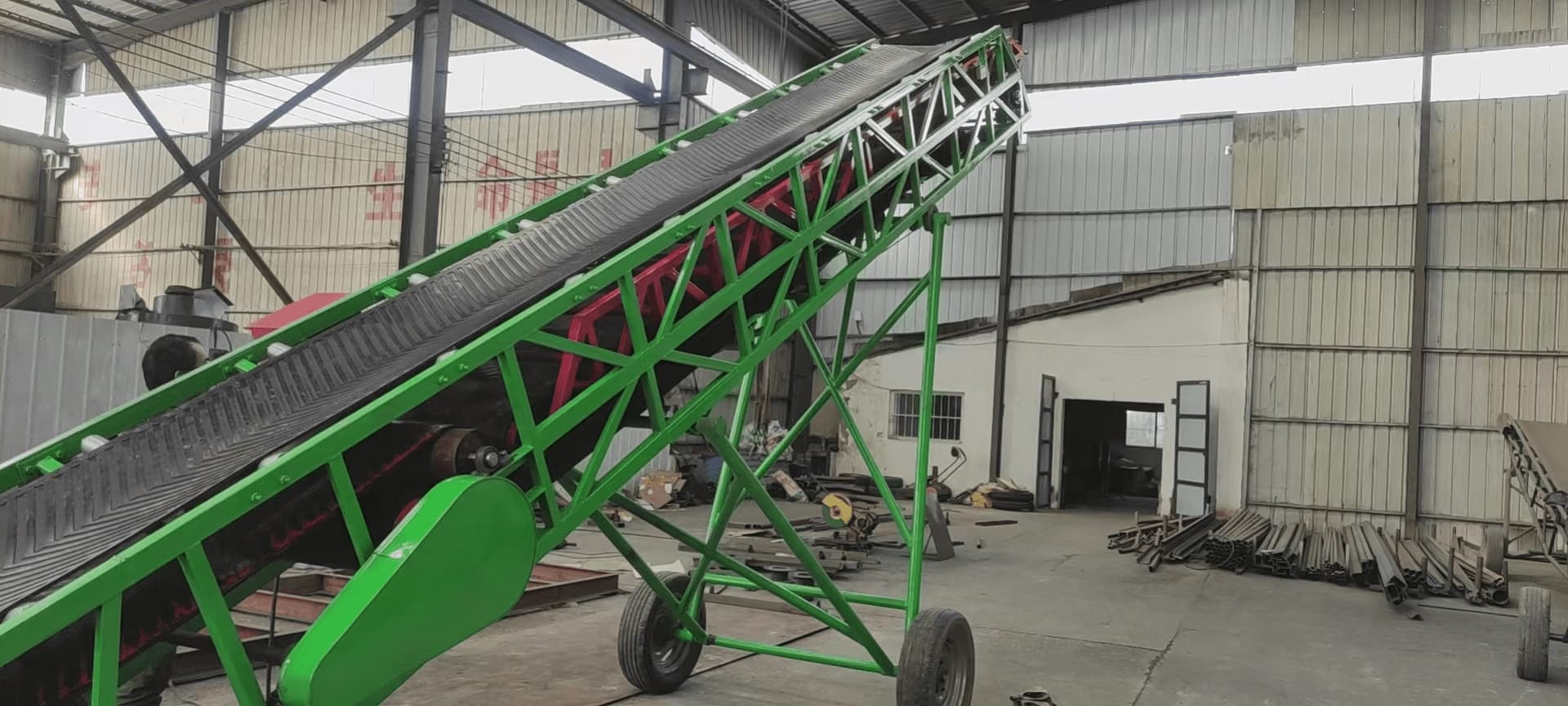
TD Belt Conveyor for Bulk Materials
Seven belt widths, from 400 to 1,400 mm, for carrying crushed rock, ore, sand, coal and finished products between the machines in your plant. We design the layout with you, and the length, lift and motor are sized to your site.
- Output range40–1,200 t/h
- Belt width400–1,400 mm
- Belt speed1.3–2.0 m/s
- Inclineup to about 18° (ordinary belt)
Figures are indicative. Final parameters are confirmed in the quotation.
Where a belt conveyor fits in your plant
Conveyors join every other machine in the line, and they decide how the plant is laid out.
Between machines
A belt carries crusher product to a screen, oversize back to a crusher, and each product size to its own stockpile.
Over distance and height
One belt can cover tens or hundreds of metres, horizontally or on an incline, without handling the material again.
To storage
Belts load stockpiles, silos, bins and rail or truck loadouts from the end of the line.
The capacity of the whole plant can be limited by the weakest conveyor. We check each belt against the machines on both sides of it.
Pick a belt width by the output you need
The belt width sets the capacity. Larger lumps also need a wider belt, so we check your biggest lump as well.
| Target output | Belt width | Output range | Typical use |
|---|---|---|---|
| about 40–80 t/h | 400 mm | 40–80 t/h | light duty |
| about 60–150 t/h | 500 mm | 60–150 t/h | general purpose |
| about 100–280 t/h | 650 mm | 100–280 t/h | standard industrial use |
| about 150–400 t/h | 800 mm | 150–400 t/h | medium capacity |
| about 250–600 t/h | 1000 mm | 250–600 t/h | large capacity |
| about 400–800 t/h | 1200 mm | 400–800 t/h | heavy duty |
| about 600–1,200 t/h | 1400 mm | 600–1,200 t/h | high capacity |
Specifications
All seven belt widths of the TD series.
| Belt width (mm) | Belt speed (m/s) | Output (t/h) | Remark |
|---|---|---|---|
| 400 | 1.3–1.6 | 40–80 | Light duty |
| 500 | 1.3–1.6 | 60–150 | General purpose |
| 650 | 1.3–2.0 | 100–280 | Standard industrial |
| 800 | 1.3–2.0 | 150–400 | Medium capacity |
| 1000 | 1.3–2.0 | 250–600 | Large capacity |
| 1200 | 1.3–2.0 | 400–800 | Heavy duty |
| 1400 | 1.3–2.0 | 600–1,200 | High capacity |
Motor power, length and weight depend on your layout and are given in the quotation. Output ranges are conservative and depend on belt speed, material density and incline. Figures are indicative; final parameters are confirmed in the quotation.
What decides the motor, length and price
A belt conveyor is built around your site, so these are the things we ask for first.
Length and lift
The distance between centres and the height gained set the motor power, the belt strength and the frame. A short, flat belt is far cheaper than a long, steep one.
Material and lump size
Heavy, abrasive or large-lump material needs a stronger belt and impact protection at the loading point.
Incline
An ordinary belt carries material up to about 18°. A patterned belt can climb steeper, about 30–35°, but needs a different belt and a lower speed.
Covers and dust control
Open belts spill and make dust in wind. Covers, skirts and dust suppression cost more but keep the plant clean.
Is a belt conveyor the right choice?
A short honest check before you ask for a price.
Good fit
- Carrying crushed rock, ore, sand, coal or finished products over distance.
- Continuous, high-capacity transport with low running cost.
- A plant that needs a flexible layout, horizontal or on an incline.
- Linking crushers, screens, feeders, mills and silos.
Look at other machines if
- You must lift very steeply or vertically: a bucket elevator is better.
- The material is fine powder that must not make dust: an enclosed screw conveyor suits better.
- The distance is very short and the lumps are small: a chute or a screw may be simpler.
- The route has tight bends: a belt runs straight between pulleys.
What operating one is like
What your maintenance team will deal with.
- Belt and rollers: the belt and the idler rollers wear over time. Plan spares, especially at the loading point.
- Tracking: a belt must run straight. Check the alignment regularly and after each change of load.
- Tension: long belts need a take-up device to keep the right tension.
- Cleaning: scrapers keep the belt clean. Sticky material builds up on the return side.
- Safety: guards and emergency pull cords are normally fitted along the walkway.
- Civil works: long runs need a support frame, walkways and sometimes a gallery. We confirm this in the quotation.
What we need to quote
Send what you know on WhatsApp or by email. Rough numbers are enough to start.
- Material and, if known, bulk density
- Largest lump size
- Output required (t/h)
- Length between centres and the height to be lifted
- Where the material loads and where it unloads
- Open or covered, indoor or outdoor
- Power supply (voltage and frequency)
- Site altitude and destination country
Buying through CNEIG INDUSTRIAL
We are a trading and project-coordination company, not the factory.
- We agree the model and parameters with the manufacturer and write them into your quotation.
- Lead time depends on whether the machine is in stock, has to be produced, or is customised. It is stated in the contract.
- Payment, warranty and delivery terms are set in the contract.
- Read how we handle pre-shipment inspection.
Common questions
How do I choose the belt width?
Start with the output you need and your largest lump. The table above gives the belt width for each output. We check it against your material and the belt speed before quoting.
How steep can a belt conveyor go?
An ordinary belt carries material up to about 18°. With a patterned (anti-skid) belt it can reach about 30–35°. For steeper lifts we suggest a bucket elevator.
How is the motor power decided?
By the belt length, the lift, the load and the belt speed. These depend on your layout, so we give the motor in the quotation, not as a fixed figure in a table.
Can you supply the whole conveyor with frame and rollers?
Yes. We quote the belt, the frame, the idler rollers, the pulleys and the drive. We confirm what is included in the quotation.
What about lead time, payment and warranty?
They are agreed in the contract before the order is confirmed. Lead time depends on stock, production or customisation.
Machines used with it
Tell us about your project
Send the material, the output, and the length and lift of the conveyor. We will come back with a suitable belt and a quotation.
Request a Quotation
Tell us the material and the output you want. We reply within 1–2 business days.