
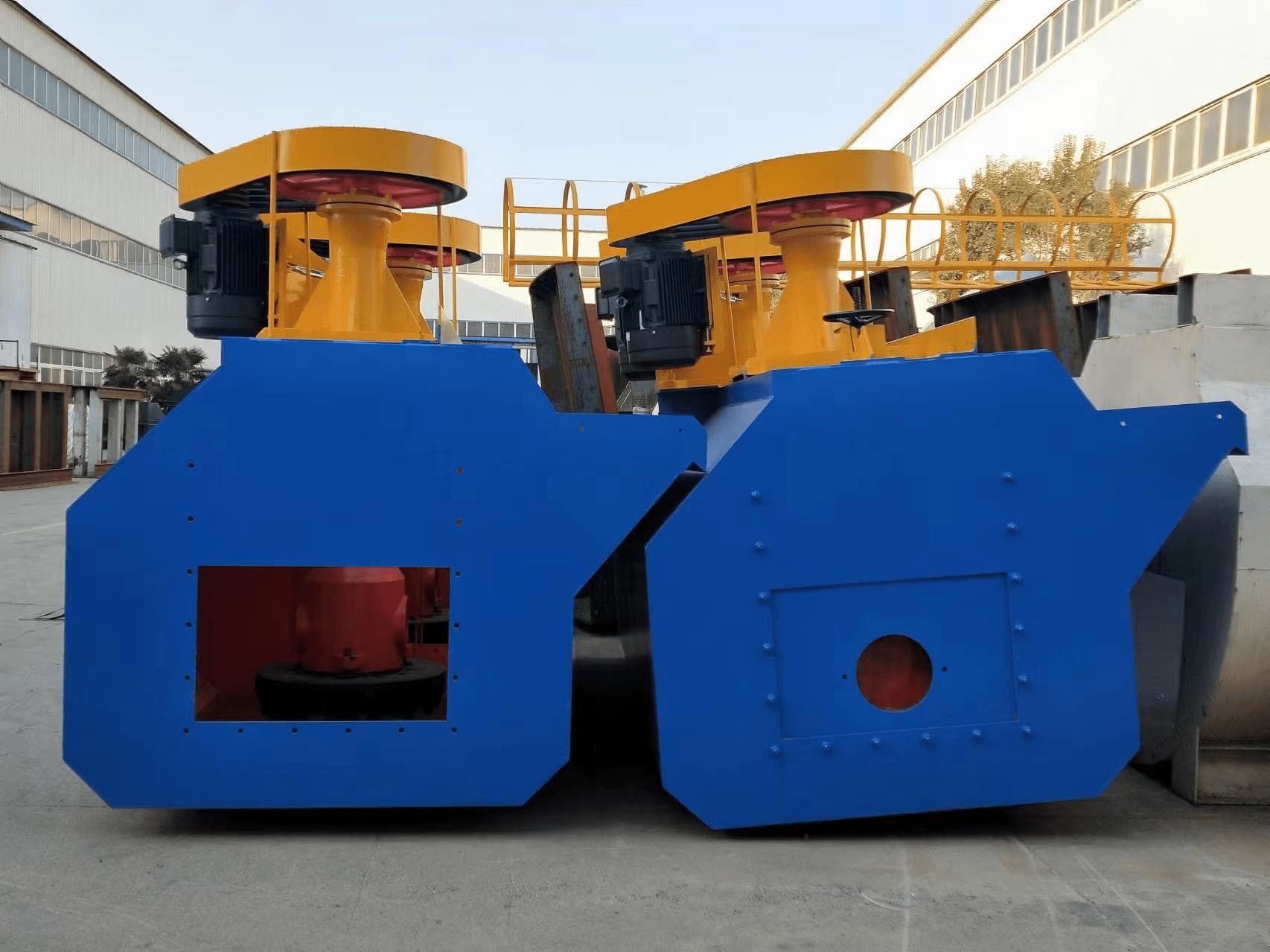
SF Self-Aspirating Flotation Machine
Nine cell sizes, from 0.37 to 20 m³, for roughing, cleaning and scavenging in a flotation circuit. The impeller draws in its own air, so you do not need a blower. We supply them to mines that float sulphide and other ores.
- Cell volume0.37–20 m³
- Pulp capacity per cell0.2–20 m³/min
- Motors1.5–55 kW
- Air supplyself-aspirating
Figures are indicative. Final parameters are confirmed in the quotation.
Where a flotation machine fits in your plant
Flotation follows grinding and classification. It separates the valuable mineral from the waste.
1. Conditioning
Reagents are mixed into the ground pulp so the valuable mineral becomes water-repellent.
2. Flotation
The impeller draws in air and breaks it into fine bubbles. The treated mineral sticks to the bubbles and rises as a froth that is scraped off.
3. Concentrate and tailings
The froth is the concentrate. The pulp that stays behind is the tailings. Several cells in series raise the recovery.
A flotation circuit uses a bank of cells in series. We size the number of cells from your ore, the pulp flow and the time the ore needs in flotation.
Pick a cell size by the pulp flow
Pulp capacity is the volume of pulp one cell handles per minute. Use this as a starting point.
| Pulp flow per cell | Suggested model | Cell volume | Pulp capacity |
|---|---|---|---|
| up to about 0.4 m³/min | SF-0.37 | 0.37 m³ | 0.2–0.4 m³/min |
| about 0.4–0.7 m³/min | SF-0.7 | 0.7 m³ | 0.3–0.7 m³/min |
| about 0.7–1.2 m³/min | SF-1.2 | 1.2 m³ | 0.6–1.2 m³/min |
| about 1.2–3 m³/min | SF-2.8 | 2.8 m³ | 1.5–3 m³/min |
| about 3–4 m³/min | SF-4 | 4 m³ | 2–4 m³/min |
| about 4–8 m³/min | SF-8 | 8 m³ | 4–8 m³/min |
| about 8–10 m³/min | SF-10 | 10 m³ | 5–10 m³/min |
| about 10–16 m³/min | SF-16 | 16 m³ | 8–16 m³/min |
| about 16–20 m³/min | SF-20 | 20 m³ | 10–20 m³/min |
Specifications
All nine models of the SF series.
| Model | Cell volume (m³) | Pulp capacity (m³/min) | Motor (kW) | Tank L × W (mm) | Approx. weight per cell* |
|---|---|---|---|---|---|
| SF-0.37 | 0.37 | 0.2–0.4 | 1.5 | 700 × 700 | ~470 kg |
| SF-0.7 | 0.7 | 0.3–0.7 | 3 | 850 × 850 | ~630–930 kg |
| SF-1.2 | 1.2 | 0.6–1.2 | 5.5 | 1100 × 1100 | ~1,370 kg |
| SF-2.8 | 2.8 | 1.5–3.0 | 11 | 1500 × 1500 | ~1,900–2,130 kg |
| SF-4 | 4 | 2.0–4.0 | 15 | 1700 × 1700 | ~2,580 kg |
| SF-8 | 8 | 4.0–8.0 | 30 | 2100 × 2100 | ~4,130 kg |
| SF-10 | 10 | 5.0–10.0 | 37 | 2200 × 2200 | ~4,500 kg |
| SF-16 | 16 | 8.0–16.0 | 45 | 2400 × 2400 | ~7,400–8,300 kg |
| SF-20 | 20 | 10–20 | 55 | 2500 × 2500 | ~9,800 kg |
*Approximate weight; final weight and dimensions are confirmed in the quotation. Motor is the main impeller drive. A small separate motor, about 0.5–2 kW, drives the froth scraper on each cell. Figures are indicative; final parameters are confirmed in the quotation.
What decides your real result
The same machine can give very different recovery and grade on two ores. These are the factors we check with you first.
Ore and reagents
Flotation depends on the ore and the reagents. A test on your ore gives the settings and the reagent plan that work.
Grind size
The mineral must be freed from the waste, but not ground too fine. A well-controlled cut from the classifier helps.
Pulp density
Pulp that is too thick or too thin lowers the recovery. The density is set at the classifier and checked at the cells.
Time in flotation
The ore needs enough time in the cells. This sets how many cells you need in each bank.
Is an SF flotation machine the right choice?
A short honest check before you ask for a price.
Good fit
- Sulphide ores and other minerals that float well, for roughing, cleaning and scavenging.
- A plant that wants to avoid a blower and a slurry pump between cells.
- Compact plants with several cells in a row.
- Mineral slurry with a stable feed and a clear flotation recipe.
Look at other machines if
- You need strong, adjustable air control per cell: an aerated (KYF) flotation machine gives this.
- The ore is magnetic and easy to recover: a magnetic separator is cheaper.
- You cannot manage reagents and wastewater on site.
- The feed density or ore type changes a lot and cannot be controlled.
What operating one is like
What your operators and maintenance team will deal with.
- Impeller and stator: these are the main wear parts. Wear-resistant impellers and stators, with rubber or stainless lining, are available.
- Reagents and wastewater: the process needs reagents and proper treatment of the tailings and water.
- Skilled operation: flotation needs an experienced operator or a metallurgist to tune the pulp level, the air and the reagents.
- Sensitivity: the result changes with the slurry density and the ore type. Keep the feed steady.
- Levels: the pulp level in each cell can be adjusted by the weirs.
What we need to quote
Send what you know on WhatsApp or by email. Rough numbers are enough to start.
- Ore type and the mineral you want to recover
- Pulp flow (m³/h or t/h of solids) and pulp density
- Grind size (for example 80% passing 0.074 mm)
- Results of any flotation tests you have
- Number of banks (rougher, cleaner, scavenger), if you know
- Lining you prefer (rubber or stainless)
- Power supply (voltage and frequency)
- Site altitude and destination country
Buying through CNEIG INDUSTRIAL
We are a trading and project-coordination company, not the factory.
- We agree the model and parameters with the manufacturer and write them into your quotation.
- Lead time depends on whether the machine is in stock, has to be produced, or is customised. It is stated in the contract.
- Payment, warranty and delivery terms are set in the contract.
- Read how we handle pre-shipment inspection.
Common questions
What does self-aspirating mean?
The impeller draws air in by its own suction, so you do not need a blower or a compressor. It also draws pulp from the cell before it, so cells in a row can work without a pump between them.
How many cells do I need?
That depends on your ore, the pulp flow and the time in flotation. We size the number of cells and the banks (rougher, cleaner, scavenger) from your data, or from a flotation test if you have one.
SF or KYF flotation machine?
An SF cell takes in air by itself and is simple and compact. A KYF cell uses an air supply that you can adjust, which gives finer control for difficult ores. Tell us the ore and we will advise.
What wears out first?
The impeller and the stator. How fast depends on how abrasive the slurry is. We can quote spare parts with the machine.
What about lead time, payment and warranty?
They are agreed in the contract before the order is confirmed. Lead time depends on stock, production or customisation.
Machines used with it
Tell us about your project
Send the ore, the pulp flow and the grind size. We will come back with a suitable model and a quotation.
Request a Quotation
Tell us the material and the output you want. We reply within 1–2 business days.