
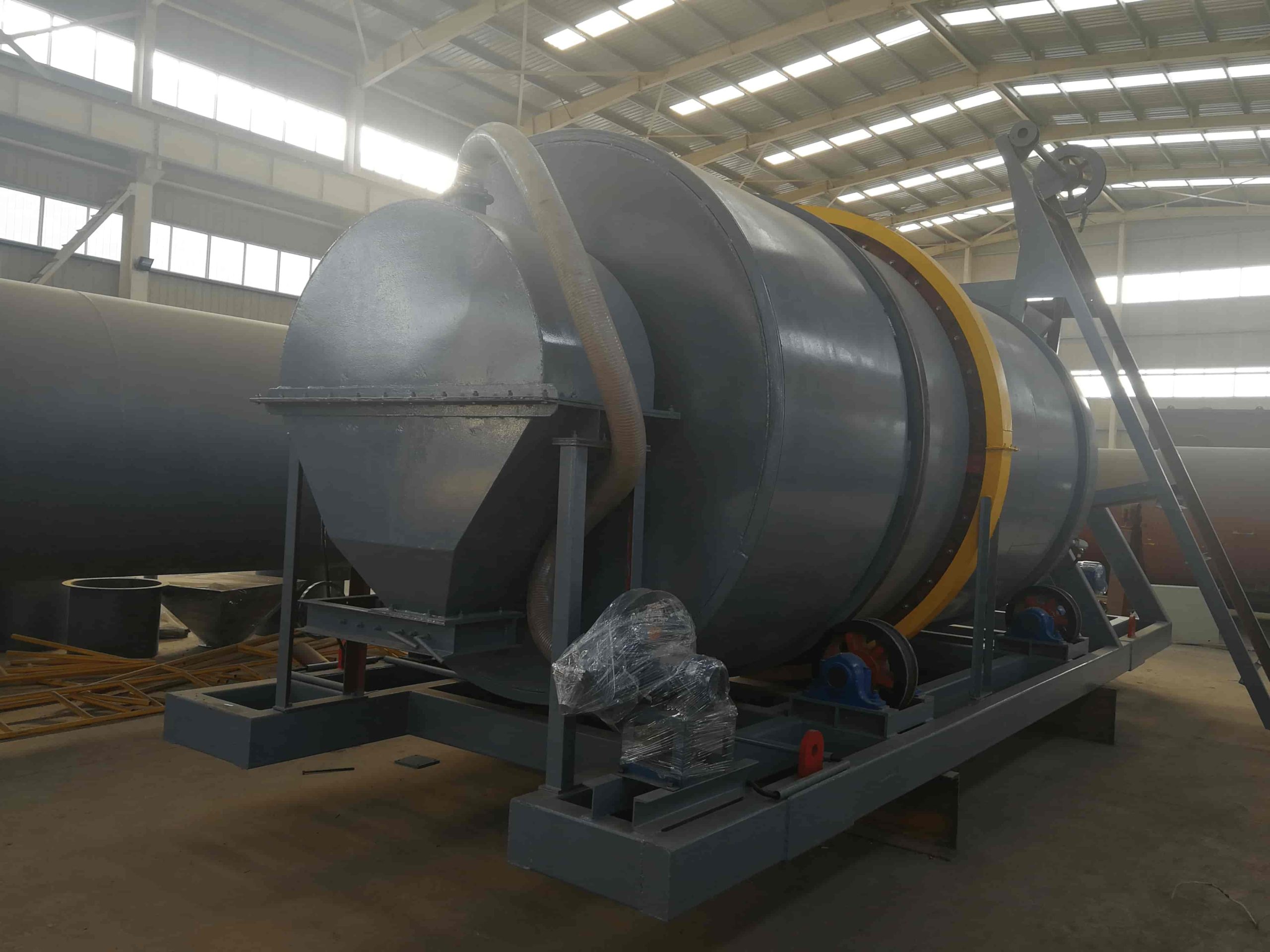
Three-Cylinder Dryer
A rotary dryer with three cylinders nested inside each other. The material travels back and forth through them, so the drying path is long in a short, compact machine. Six sizes, from 15 to 110 t/h depending on the material. It is used for slag, fly ash, river sand and similar bulk material.
- Fly ash15–60 t/h
- Slag20–110 t/h
- River sand20–100 t/h
- SizesØ2.2 × 5.5 to Ø3.8 × 9.0 m
Figures are indicative. Final parameters are confirmed in the quotation.
Where it fits
It takes wet material, dries it, and passes it on. It needs a heat source and a dust collector. If you need a simpler, single-drum dryer, see the rotary drum dryer.
Specifications
All six sizes. Capacity differs by material.
| Size (diameter × length, m) | Motors (kW) | Fly ash (t/h) | Slag (t/h) | River sand (t/h) |
|---|---|---|---|---|
| 2.2 × 5.5 | 4 × 4 | 15–20 | 20–22 | 20–22 |
| 2.5 × 6.5 | 4 × 5.5 | 20–25 | 28–30 | 28–30 |
| 3.0 × 7.0 | 4 × 11 | 25–30 | 38–40 | 35–40 |
| 3.2 × 8.0 | 4 × 11 | 30–35 | 45–50 | 40–45 |
| 3.6 × 8.0 | 4 × 15 | 35–40 | 75–80 | 70–80 |
| 3.8 × 9.0 | 4 × 15 | 50–60 | 100–110 | 90–100 |
Capacity is for the moisture conditions stated in the quotation. Weight and overall dimensions are given in the quotation. Specifications are indicative; final parameters are confirmed in the quotation.
What decides your real capacity
These are the factors we check with you first.
Moisture in and out
The water that must be removed per hour sets the size. Drying from 15% to 1% needs far more than 6% to 1%.
Material
Slag, fly ash and sand dry at different speeds, and fly ash makes more dust. Tell us the material.
Heat source
The fuel or heat you have decides the furnace and the gas temperature.
Dust and exhaust
A dust collector is needed and has to meet your local emission rules.
Is it the right choice?
A short honest check before you ask for a price.
Good fit
- Slag, fly ash and river sand at larger capacity.
- You want to save space and fuel compared with a single drum.
- Continuous drying at a steady rate.
Look at other machines if
- Your capacity is small, or the material is sticky: a rotary drum dryer is simpler.
- The material is heat-sensitive and must stay cool.
- You cannot manage dust, exhaust gas and fuel on site.
What we need to quote
Send what you know on WhatsApp or by email. Rough numbers are enough to start.
- Material to dry
- Dry output you need (t/h)
- Moisture before and after drying
- Feed size and any sticky behaviour
- Heat source or fuel available on site
- Dust and emission rules in your country
- Power supply (voltage and frequency)
- Site altitude and destination country
Buying through CNEIG INDUSTRIAL
We are a trading and project-coordination company, not the factory.
- We agree the model and parameters with the manufacturer and write them into your quotation.
- Lead time depends on stock, production or customisation, and is stated in the contract.
- Payment, warranty and delivery terms are set in the contract.
- Read how we handle pre-shipment inspection.
Common questions
Three-cylinder or single-drum dryer?
A three-cylinder dryer is shorter and uses heat more efficiently for the same capacity. A single-drum dryer is simpler and suits smaller jobs. Send us your numbers and we will advise.
Does it come with a dust collector and furnace?
They are quoted to your project, because they depend on your material, fuel and emission rules.
What about lead time, payment and warranty?
They are agreed in the contract before the order is confirmed.
Machines used with it
Tell us about your project
Send the material, the dry output and the moisture before and after. We will come back with a suitable size and a quotation.
Request a Quotation
Tell us the material and the output you want. We reply within 1–2 business days.