
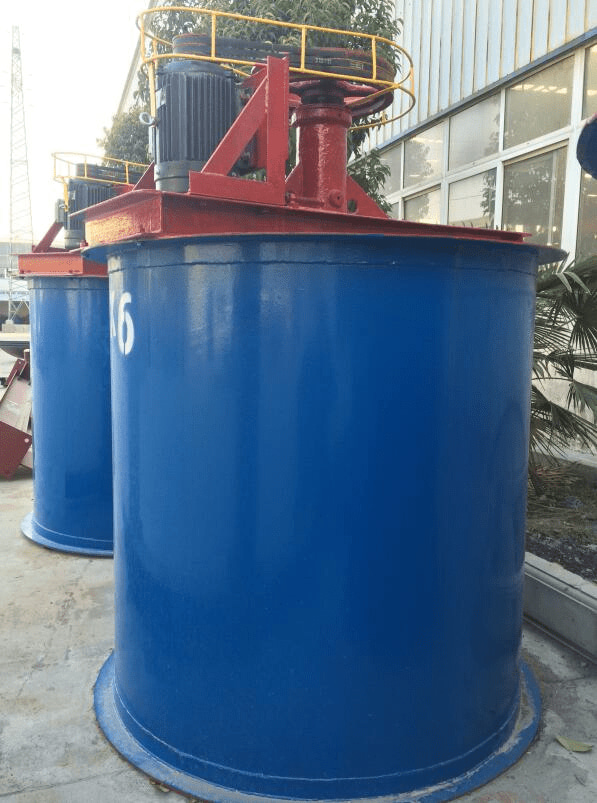
Leaching Agitation Tank
A mixing tank that keeps ground ore and leaching solution in suspension so the reaction runs evenly. Ten sizes, from 0.26 to 35 m³ effective volume. It is used for gold leaching, oxide copper and zinc leaching, and for conditioning the pulp before flotation.
- Effective volume0.26–35 m³
- Tank sizeØ750 × 750 to Ø5000 × 5000 mm
- Motor1.5–30 kW
- Dutiesleaching and conditioning
Figures are indicative. Final parameters are confirmed in the quotation.
Where a leaching tank fits in your plant
It takes ground pulp and holds it, stirred, for the time the reaction needs.
1. Pulp and solution enter
Ground pulp flows in with the leaching solution or reagent. Several tanks in series give the reaction more time.
2. The impeller keeps solids suspended
The impeller stirs the pulp so the solids do not settle and the solution reaches every particle.
3. Pulp moves on
The pulp overflows to the next tank. After the last tank, the dissolved metal is recovered and the tailings are treated.
The same tank, run without leaching reagent, is also used to condition pulp before flotation.
Pick a tank size by the pulp flow and the time
The volume you need is the pulp flow multiplied by the leaching time. Use this as a starting point.
| Effective volume you need | Suggested tank | Effective volume |
|---|---|---|
| up to about 1 m³ | Ø750 to Ø1200 mm | 0.26–1 m³ |
| about 1–4 m³ | Ø1500 to Ø2000 mm | 1.6–3.5 m³ |
| about 4–15 m³ | Ø2500 to Ø3500 mm | 6.8–15 m³ |
| about 15–35 m³ | Ø4000 to Ø5000 mm | 22–35 m³ |
Specifications
All ten sizes. Tank size is diameter × height.
| Tank size (mm) | Effective volume (m³) | Motor (kW) | Approx. weight (kg) |
|---|---|---|---|
| Ø750 × 750 | 0.26 | 1.5 | ~260 |
| Ø1000 × 1000 | 0.58 | 2.2 | ~400 |
| Ø1200 × 1200 | 1 | 4 | ~630 |
| Ø1500 × 1500 | 1.6 | 5.5 | ~960 |
| Ø2000 × 2000 | 3.5 | 7.5 | ~1,350 |
| Ø2500 × 2500 | 6.8 | 11 | ~1,900 |
| Ø3000 × 3000 | 11 | 15 | ~2,600 |
| Ø3500 × 3500 | 15 | 18.5 | ~3,200 |
| Ø4000 × 4000 | 22 | 22 | ~4,200 |
| Ø5000 × 5000 | 35 | 30 | ~5,500 |
Approximate weights; final weight and dimensions are confirmed in the quotation. Lining, impeller type and motor are matched to your slurry and solution. Figures are indicative; final parameters are confirmed in the quotation.
What decides your real result
A tank is only part of a leaching circuit. These are the factors we check with you first.
Leaching time
The ore needs enough time in the tanks. This sets the total volume and the number of tanks in series.
Pulp density and particle size
A thicker pulp or coarser solids need stronger stirring to stay in suspension.
Solution and corrosion
Acid, alkaline or cyanide solutions attack steel in different ways. The lining and the impeller material are chosen for your solution.
Stirring and air
Some leaching reactions need air or oxygen in the pulp. Tell us if your process does.
Is a leaching agitation tank the right choice?
A short honest check before you ask for a price.
Good fit
- Ground ore that must react with a solution, such as gold leaching or oxide copper and zinc leaching.
- Conditioning pulp with reagents before flotation.
- Plants that need several tanks in series for a long reaction time.
Look at other options if
- The ore is low grade and very large in volume. Heap leaching may suit better than grinding and tanks.
- The mineral separates well without chemicals. A magnetic separator or a gravity step may be enough.
- You cannot meet the safety, permit and waste rules for your leaching reagent.
If your process uses cyanide, it needs strict safety controls, containment, a permit and approved waste handling. These are your responsibility on site and are set by your local rules. We do not advise on them in a quotation, but we will ask what reagent you use, so the tank is built for it.
What operating one is like
What your operators and maintenance team will deal with.
- Reagent handling: the solution and its fumes need safe handling, ventilation and spill containment.
- Impeller and lining: these wear from the slurry and the solution. They are checked and replaced as part of maintenance.
- Settling: if the stirring stops, the solids settle. A restart after a power cut needs care and may need the tank emptied.
- Power: motor power rises quickly with tank size, so the number and size of tanks are chosen together.
What we need to quote
Send what you know on WhatsApp or by email. Rough numbers are enough to start.
- Ore type and the metal you want to recover
- Pulp flow (m³/h or t/h of solids) and pulp density
- Leaching time from your tests, if you have them
- Grind size (for example 80% passing 0.074 mm)
- Leaching solution or reagent and its strength
- Number of tanks in series, if you know
- Power supply (voltage and frequency)
- Site altitude and destination country
Buying through CNEIG INDUSTRIAL
We are a trading and project-coordination company, not the factory.
- We agree the model and parameters with the manufacturer and write them into your quotation.
- Lead time depends on whether the tank is in stock, has to be produced, or is customised. It is stated in the contract.
- Payment, warranty and delivery terms are set in the contract.
- Read how we handle pre-shipment inspection.
Common questions
How many tanks do I need?
That depends on your pulp flow and the leaching time. We work out the total volume from those two numbers and then split it into tanks in series.
Can the same tank be used for flotation conditioning?
Yes. Without leaching reagent, the tank mixes reagents into the pulp before flotation.
Can the tank be lined or made of other materials?
Yes. The lining and impeller are matched to your solution and slurry. Tell us the solution and we will confirm the options in the quotation.
Do you supply the whole leaching circuit?
We supply the tanks and the equipment around them, such as mills, classifiers and flotation machines. The process design of the leaching circuit comes from your own tests or your process engineer.
What about lead time, payment and warranty?
They are agreed in the contract before the order is confirmed. Lead time depends on stock, production or customisation.
Machines used with it
Tell us about your project
Send the ore, the pulp flow and the leaching time. We will come back with a suitable tank size and a quotation.
Request a Quotation
Tell us the material and the output you want. We reply within 1–2 business days.