
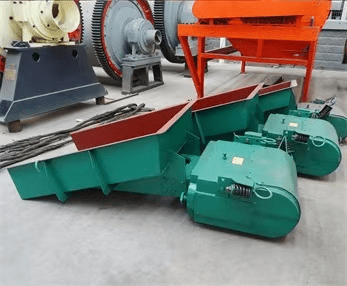
ZG Electromagnetic Vibrating Feeder
A trough that is vibrated by an electromagnet and moves material forward at a steady, adjustable rate. Eight models, from 1 to 150 t/h. It is light, has few moving parts, and suits dry, free-flowing bulk material under hoppers and bins.
- Capacity1–150 t/h
- Trough250 × 800 to 1000 × 3500 mm
- Max feed size50–350 mm
- Exciter power0.02–0.8 kW
Figures are indicative. Final parameters are confirmed in the quotation.
Where it fits
It sits under a hopper or a bin and feeds the next machine at a steady rate: a crusher, a mill, a screen or a conveyor. For heavy, coarse rock straight from a blast pile, use a ZSW vibrating feeder instead.
Specifications
All eight models of the ZG series.
| Model | Trough (mm) | Max feed size (mm) | Capacity (t/h) | Exciter power (kW) | Approx. weight (kg) |
|---|---|---|---|---|---|
| ZG-25 | 250 × 800 | 50 | 1–2 | 0.02 | ~90 |
| ZG-50 | 300 × 1000 | 80 | 3–5 | 0.04 | ~150 |
| ZG-100 | 400 × 1200 | 100 | 6–10 | 0.08 | ~250 |
| ZG-200 | 500 × 1500 | 150 | 15–20 | 0.15 | ~350 |
| ZG-300 | 600 × 2000 | 200 | 30–40 | 0.25 | ~580 |
| ZG-400 | 700 × 2500 | 250 | 40–60 | 0.4 | ~850 |
| ZG-500 | 800 × 3000 | 300 | 60–100 | 0.6 | ~1,100 |
| ZG-600 | 1000 × 3500 | 350 | 80–150 | 0.8 | ~1,400 |
Capacity depends on the material, its density and moisture. Approximate weights; final weight and dimensions are confirmed in the quotation. A control unit for the feed rate is quoted with the feeder. Specifications are indicative; final parameters are confirmed in the quotation.
What decides your real capacity
These are the factors we check with you first.
Material and bulk density
Heavy or light material moves at different rates. Tell us the material and its density.
Lump size
Lumps must stay below the maximum feed size of the model.
Moisture and stickiness
Damp, sticky material clings to the trough and slows the flow.
Setting and mounting
The trough angle and the vibration setting change the rate. The installation drawing sets these.
Is it the right choice?
A short honest check before you ask for a price.
Good fit
- Dry, free-flowing bulk material from hoppers and bins.
- You want a feed rate you can change while running.
- Low noise and few wearing parts.
Look at other machines if
- The material is very wet, sticky or very heavy and coarse: a ZSW vibrating feeder is stronger.
- You feed small flows from a small bin: a pendulum feeder may be simpler.
- The feeder must carry a heavy hopper load of large rock.
What we need to quote
Send what you know on WhatsApp or by email. Rough numbers are enough to start.
- Material, bulk density and maximum lump size
- Capacity needed (t/h)
- Hopper dimensions and discharge point
- Moisture and temperature
- What the feeder will feed
- Power supply (voltage and frequency)
- Site altitude and destination country
- Drawing of the hopper, if you have one
Buying through CNEIG INDUSTRIAL
We are a trading and project-coordination company, not the factory.
- We agree the model and parameters with the manufacturer and write them into your quotation.
- Lead time depends on stock, production or customisation, and is stated in the contract.
- Payment, warranty and delivery terms are set in the contract.
- Read how we handle pre-shipment inspection.
Common questions
Can I change the feed rate while it runs?
Yes. The vibration strength can be changed with the control unit, which changes the flow.
Electromagnetic or ZSW vibrating feeder?
An electromagnetic feeder is light and suits dry, free-flowing material at moderate loads. A ZSW feeder is built for heavy, coarse rock straight from a blast pile.
What wears out first?
The trough liner and the springs. How fast depends on the material. We can quote wear parts with the machine.
What about lead time, payment and warranty?
They are agreed in the contract before the order is confirmed.
Machines used with it
Tell us about your project
Send the material, the capacity and the lump size. We will come back with a suitable model and a quotation.
Request a Quotation
Tell us the material and the output you want. We reply within 1–2 business days.