
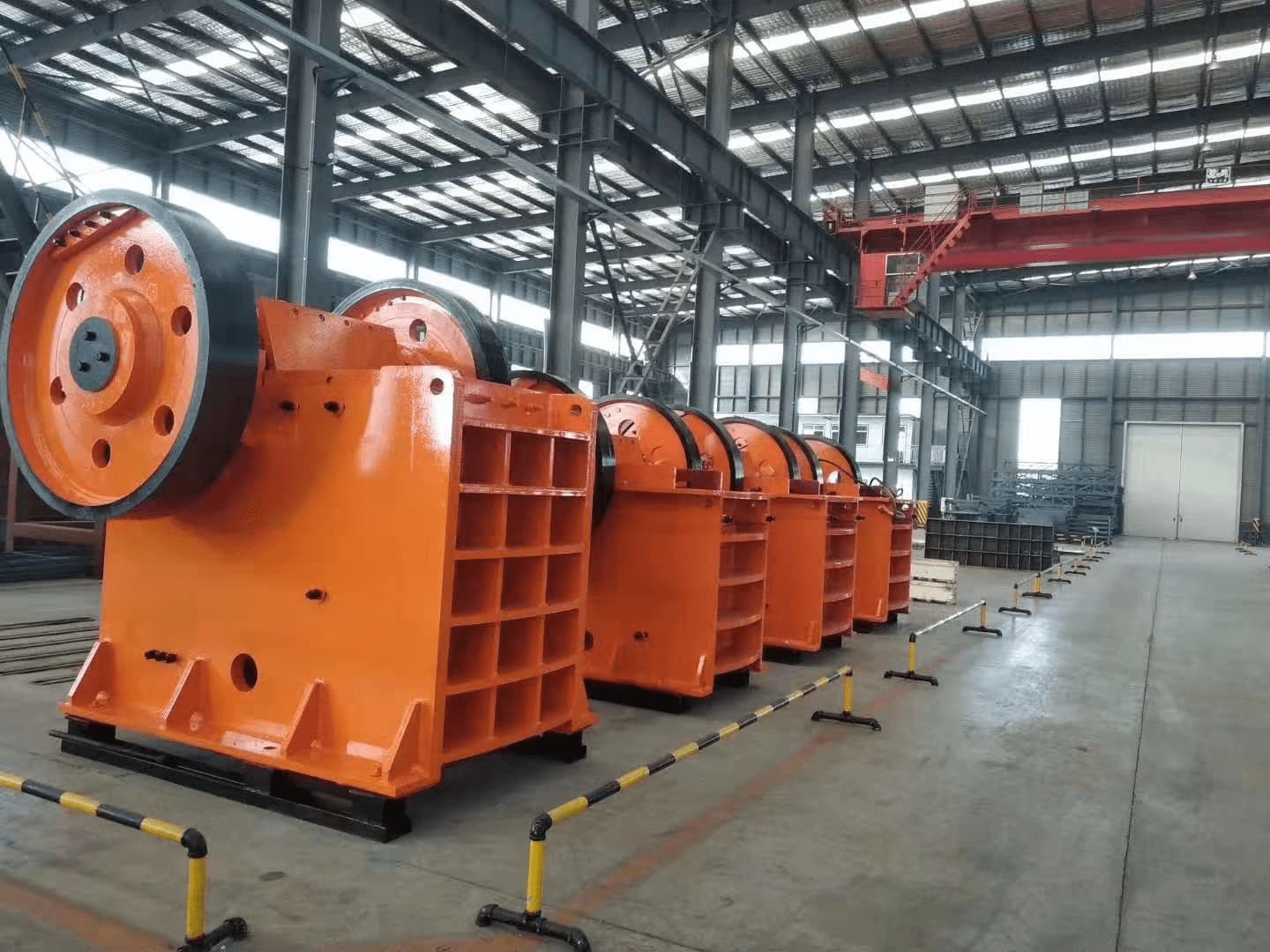
PE Jaw Crusher for Primary Crushing of Hard Rock and Ore
The first crusher in most hard-rock lines. Fifteen sizes in the PE and PEX series take quarry rock and run-of-mine ore from lumps up to 1,200 mm down to a size the next crusher can handle.
- Feed opening250×400 to 1500×1800 mm
- Output3–1,000 m³/h
- Motors7.5–280 kW
- Rock strengthup to 320 MPa
Figures are indicative. Final parameters are confirmed in the quotation.
Where a jaw crusher fits in your plant
A typical primary crushing line, in the order the rock travels.
1. Feeding
A vibrating or chute feeder gives the crusher a steady flow and, with grizzly bars, removes fines and soil before they reach it.
2. Jaw crusher
The jaw crusher breaks the big rock down so it can be carried on a belt and fed to the next stage.
3. Next stages
A belt conveyor takes the product to a cone or impact crusher and screens for secondary crushing.
PE or PEX?
The two series do different jobs.
PE: coarse (primary) crushing
A wide discharge range and a large opening for big rock. Choose PE when your feed lumps are large and the next machine can take a 60–350 mm product.
PEX: fine crushing
A long, narrow opening and a tighter discharge range of about 7–90 mm. Choose PEX as a second stage, or when the first stage feed is already small.
Pick a model by the largest rock you feed
The published maximum feed size for each PE model. Use the next size up if your biggest lumps are close to the limit.
| Largest rock | Model | Feed opening (mm) |
|---|---|---|
| up to 210 mm | PE-250×400 | 250×400 |
| up to 340 mm | PE-400×600 | 400×600 |
| up to 425 mm | PE-500×750 | 500×750 |
| up to 500 mm | PE-600×900 | 600×900 |
| up to 630 mm | PE-750×1060 | 750×1060 |
| up to 750 mm | PE-900×1200 | 900×1200 |
| up to 850 mm | PE-1000×1200 | 1000×1200 |
| up to 1,020 mm | PE-1200×1500 | 1200×1500 |
| up to 1,200 mm | PE-1500×1800 | 1500×1800 |
PE series specifications
Output is published in m³/h. To estimate t/h, multiply by the bulk density of your crushed rock (usually about 1.5–1.7 t/m³).
| Model | Feed opening (mm) | Max feed (mm) | Discharge (mm) | Output (m³/h) | Motor (kW) | Approx. weight* |
|---|---|---|---|---|---|---|
| PE-250×400 | 250×400 | 210 | 20–60 | 5–15 | 15 | ~2.4 t |
| PE-400×600 | 400×600 | 340 | 40–100 | 16–40 | 30 | ~5.8 t |
| PE-500×750 | 500×750 | 425 | 50–120 | 40–90 | 55 | ~9 t |
| PE-600×900 | 600×900 | 500 | 65–200 | 50–180 | 75 | ~16.7 t |
| PE-750×1060 | 750×1060 | 630 | 80–210 | 110–320 | 110 | in quotation |
| PE-900×1200 | 900×1200 | 750 | 80–210 | 110–320 | 110 | in quotation |
| PE-1000×1200 | 1000×1200 | 850 | 95–265 | 180–450 | 160 | in quotation |
| PE-1200×1500 | 1200×1500 | 1020 | 150–350 | 270–600 | 200 | in quotation |
| PE-1500×1800 | 1500×1800 | 1200 | 220–350 | 500–1000 | 280 | in quotation |
PEX series specifications
Fine jaw crushers for second-stage work.
| Model | Feed opening (mm) | Max feed (mm) | Discharge (mm) | Output (m³/h) | Motor (kW) | Approx. weight* |
|---|---|---|---|---|---|---|
| PEX-100×600 | 100×600 | 80 | 7–20 | 3–15 | 7.5 | in quotation |
| PEX-150×750 | 150×750 | 120 | 18–48 | 8–25 | 15 | ~2.8 t |
| PEX-250×750 | 250×750 | 210 | 25–60 | 13–35 | 22 / 30 | in quotation |
| PEX-250×1000 | 250×1000 | 210 | 26–60 | 16–52 | 30 / 37 | ~6.5 t |
| PEX-250×1200 | 250×1200 | 210 | 26–60 | 20–61 | 37 | in quotation |
| PEX-300×1300 | 300×1300 | 250 | 20–90 | 16–105 | 55 | in quotation |
*Approximate weight for machines in this class; actual weight and dimensions are confirmed in the quotation. Figures are indicative; final parameters are confirmed in the quotation.
What decides your real output
The numbers above are a range. Where you land in it depends on these.
Size of the biggest rock
Rock close to the opening size is slow to bite and lowers output. Keeping the largest lumps well below the limit helps.
Discharge setting
A wider setting gives more output and a coarser product. A tighter one gives a finer product and lower output.
Rock hardness and moisture
Harder rock slows the crusher and wears jaw plates faster. Wet clay can pack the chamber and cut output a lot.
Steady feeding
A feeder that spreads the load evenly keeps the crusher working at its best. Uneven feeding wastes capacity.
Is a jaw crusher the right choice?
A short honest check before you ask for a price.
Good fit
- Hard rock and ore up to about 320 MPa: granite, basalt, quartzite, iron ore.
- Large feed: quarry blast rock or run-of-mine ore.
- You want a simple, robust machine with a low purchase price.
- A remote or small site where simple maintenance matters.
Look at other machines if
- Rock is wet and sticky with clay: it can pack the chamber.
- You need a very cubical product from the first stage.
- Output or feed size is very large: look at the CJ European jaw crusher.
- Rock is soft: an impact or hammer crusher may suit it.
What running one is like
What your crew will deal with.
- Jaw plates: the fixed and moving jaw plates are the main wear parts and are turned or replaced when worn.
- Setting changes: the discharge size is adjusted with shims, so changes need a short stop.
- Overload protection: the toggle plate is built to break first if uncrushable steel gets in. Keep a spare.
- Lubrication: bearings need regular greasing or oil checks.
- Product shape: the output contains more flat pieces than a cone or impact crusher gives, and this is usually fixed in the next stage.
- Safety and dust: the flywheels need guards, and the crusher needs dust control on site.
What we need to quote
Send what you know on WhatsApp or by email. Rough numbers are enough to start.
- Rock type and, if known, hardness
- Size of the largest lumps, ideally with a photo
- Output you need (t/h)
- Product size you want
- Moisture and clay content
- Which feeder and conveyor you have or need
- Power supply (voltage and frequency)
- Site altitude and destination country
Buying through CNEIG INDUSTRIAL
We are a trading and project-coordination company, not the factory.
- We agree the model and parameters with the manufacturer and write them into your quotation.
- Lead time depends on whether the machine is in stock, has to be produced, or is customised. It is stated in the contract.
- Payment, warranty and delivery terms are set in the contract.
- Read how we handle pre-shipment inspection.
Common questions
What is the difference between a jaw crusher and a cone crusher?
A jaw crusher takes large rock and is used first. A cone crusher takes smaller rock and gives a more cubical product, so it follows the jaw. Most hard-rock lines use both.
How do I choose the size?
Start with the biggest lump you will feed, then check the output range against what you need. The table above lists the maximum feed for each model.
Why is output given in m³/h?
This is how the manufacturer publishes it for PE jaw crushers. Multiply by the bulk density of your rock to get t/h. We give you a t/h figure in the quotation.
What wears out first?
The jaw plates, and the toggle plate if tramp steel gets in. We can quote a spare set with the machine.
What about lead time, payment and warranty?
They are agreed in the contract before the order is confirmed. Lead time depends on stock, production or customisation.
Machines used with it
Tell us about your project
Send the rock type, the largest lump size and the output you want. We will come back with a suitable model and a quotation.
Request a Quotation
Tell us the material and the output you want. We reply within 1–2 business days.