
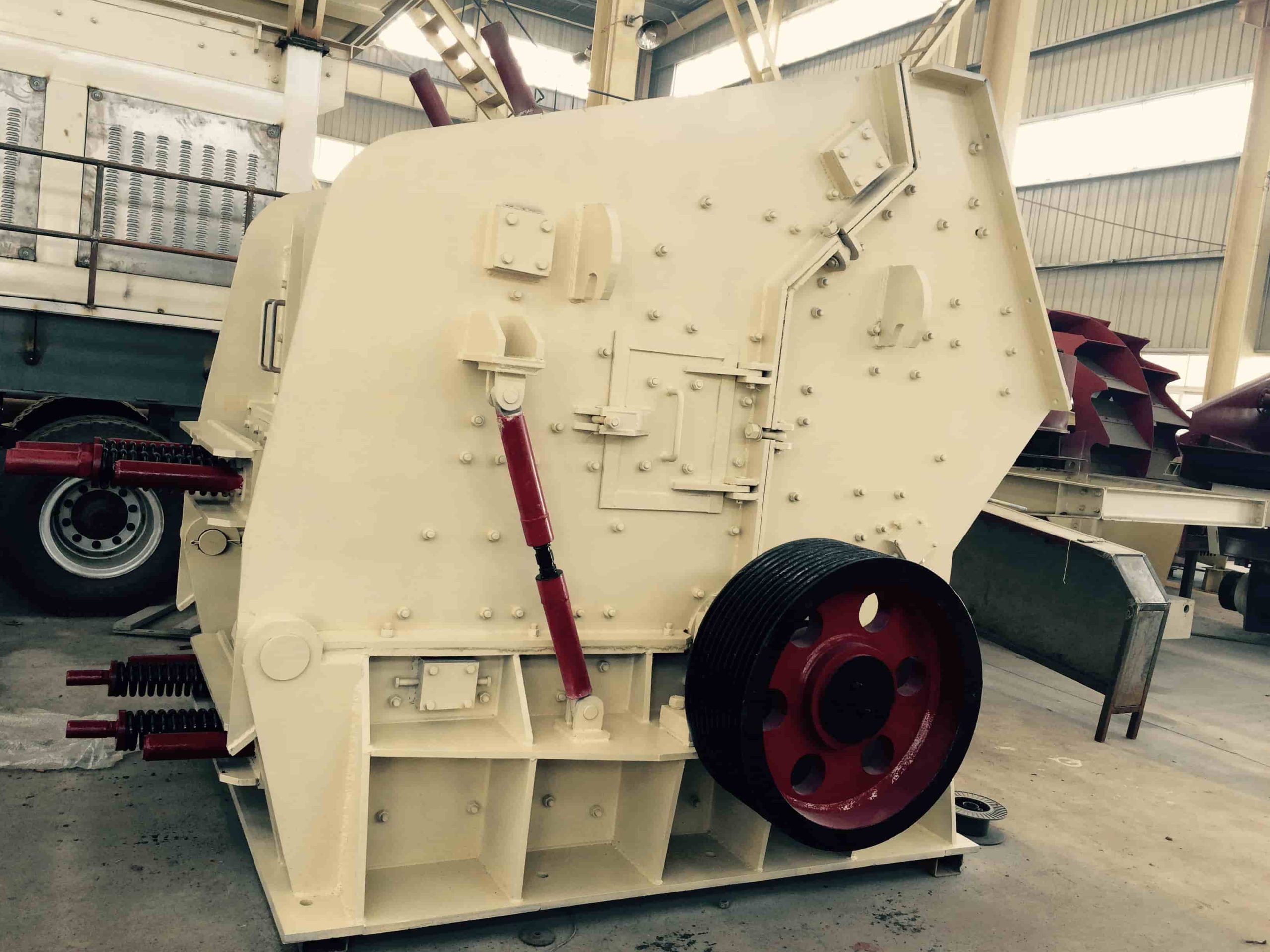
PF Impact Crusher for Limestone and Medium-Hard Rock
Fifteen sizes, from PF-0807 to PF-2027, for secondary crushing of limestone, dolomite and similar rock. We supply them for quarries, cement and aggregate plants, and for recycling concrete and construction waste.
- Output range15–1,400 t/h
- Motors30–1,420 kW
- Max feed edge300–1,500 mm
- Best formedium-hard rock
Figures are indicative. Final parameters are confirmed in the quotation.
Where a PF impact crusher fits in your plant
A typical medium-hard rock line, in the order the rock travels.
1. Primary stage
A jaw crusher breaks the large rock down. For soft rock such as limestone, a large PF can also take blasted rock directly.
2. Impact stage
The PF crusher breaks the rock against its blow bars and impact plates, and gives a rounded, well-shaped product.
3. Screening
Screens sort the product by size and send oversize back to the crusher or to the next stage.
Impact crushers suit medium-hard rock. For hard or very abrasive rock, look at a cone crusher.
Pick a model by the output you need
Based on the published output ranges. Real output depends on your rock, feed grading and setting.
| Target output | Suggested models | Output range |
|---|---|---|
| up to about 50 t/h | PF-0807, PF-1007 | 15–50 t/h |
| about 50–120 t/h | PF-1010, PF-1210 | 50–120 t/h |
| about 100–250 t/h | PF-1214, PF-1310, PF-1315 | 100–250 t/h |
| about 200–300 t/h | PF-1320 | 200–300 t/h |
| about 300–750 t/h | PF-1520, PF-1620, PF-1623 | 310–750 t/h |
| above 500 t/h | PF-1820, PF-1823, PF-2023, PF-2027 | 500–1,400 t/h |
Specifications
All fifteen models of the PF series.
| Model | Rotor Ø × width (mm) | Feed opening (mm) | Max feed edge (mm) | Output (t/h) | Motor (kW) | Approx. size L×W×H (mm) |
|---|---|---|---|---|---|---|
| PF-0807 | 850 × 700 | 400 × 730 | 300 | 15–30 | 30–45 | 2210 × 1490 × 2670 |
| PF-1007 | 1000 × 700 | 400 × 730 | 300 | 30–50 | 37–55 | 2400 × 1558 × 2660 |
| PF-1010 | 1000 × 1050 | 400 × 1080 | 350 | 50–80 | 55–75 | 2400 × 2250 × 2620 |
| PF-1210 | 1250 × 1050 | 400 × 1080 | 350 | 70–120 | 110–132 | 2690 × 2338 × 2890 |
| PF-1214 | 1250 × 1400 | 400 × 1430 | 350 | 100–180 | 132–160 | 2690 × 2688 × 2890 |
| PF-1310 | 1300 × 1050 | 490 × 1170 | 400 | 100–220 | 110–160 | 2780 × 2478 × 2890 |
| PF-1315 | 1320 × 1500 | 860 × 1520 | 500 | 120–250 | 180–260 | 3096 × 3273 × 2667 |
| PF-1320 | 1320 × 2000 | 860 × 2000 | 500 | 200–300 | 260–320 | 3096 × 3273 × 2667 |
| PF-1520 | 1500 × 2000 | 860 × 2000 | 600 | 310–580 | 315–400 | 3580 × 3545 × 3272 |
| PF-1620 | 1600 × 2000 | 1200 × 2000 | 700 | 350–700 | 2 × 220 | 4290 × 3495 × 4175 |
| PF-1623 | 1600 × 2300 | 1200 × 2300 | 750 | 400–750 | 2 × 250 | 4290 × 3495 × 4175 |
| PF-1820 | 1800 × 2000 | 1670 × 2050 | 1000 | 500–800 | 2 × 315 HV | 4770 × 4340 × 4850 |
| PF-1823 | 1800 × 2300 | 1670 × 2350 | 1000 | 500–950 | 800 HV | 4770 × 4340 × 4850 |
| PF-2023 | 2000 × 2300 | 1840 × 2340 | 1500 | 500–1,200 | 1120 HV | 5350 × 5150 × 5460 |
| PF-2027 | 2000 × 2700 | 1840 × 2740 | 1500 | 1,100–1,400 | 1420 HV | 5400 × 5450 × 5460 |
HV: high-voltage motor. Machine weight and foundation drawings are provided with the quotation. Figures are indicative; final parameters are confirmed in the quotation.
What decides your real output
The same machine can give very different numbers on two sites. These are the factors we check with you first.
Rock hardness and silica
The harder and more abrasive the rock, the faster the blow bars wear and the lower the output. This is the main limit of an impact crusher.
Moisture and clay
Wet, clay-rich feed sticks in the chamber and on the plates. Wash or scalp it first.
Feed size
Feed well inside the maximum edge gives steady output. Very large lumps slow the rotor and raise wear.
Impact plate setting
The gap between the blow bars and the impact plates sets the product size. A tighter gap gives finer product and lower output.
Is an impact crusher the right choice?
A short honest check before you ask for a price.
Good fit
- Limestone, dolomite and other medium-hard rock.
- Concrete, brick and construction waste for recycling.
- You want a rounded, cubical product for aggregate.
- You need a high reduction ratio in a single stage.
Look at other machines if
- Rock is hard or high in silica, such as granite, basalt or iron ore: use a cone crusher.
- Feed is wet and sticky with clay.
- Wear cost is a bigger concern than product shape.
- Feed is large run-of-mine rock: start with a jaw crusher.
What operating one is like
What your maintenance team will deal with.
- Wear parts: the blow bars and impact plates are the main consumables. On abrasive rock they wear quickly, so plan spare sets.
- Changing blow bars: the rotor and its fixings are designed so bars can be changed without long downtime. We confirm the layout for your model in the quotation.
- Adjusting size: the gap to the impact plates is adjusted to change product size.
- Dust: impact crushing makes more fines and dust than a jaw or cone crusher. Plan dust control at the feed and discharge.
- Foundation and power: the larger models need a solid foundation, lifting equipment and, for the biggest, high-voltage supply.
- Operators: check the rotor, bearings and lubrication on a regular schedule.
What we need to quote
Send what you know on WhatsApp or by email. Rough numbers are enough to start.
- Rock type and, if known, hardness and silica content
- Feed size, ideally with a photo
- Product size you want
- Output required (t/h)
- Moisture and clay content
- What crusher comes before it
- Power supply (voltage and frequency)
- Site altitude and destination country
Buying through CNEIG INDUSTRIAL
We are a trading and project-coordination company, not the factory.
- We agree the model and parameters with the manufacturer and write them into your quotation.
- Lead time depends on whether the machine is in stock, has to be produced, or is customised. It is stated in the contract.
- Payment, warranty and delivery terms are set in the contract.
- Read how we handle pre-shipment inspection.
Common questions
What rock can a PF impact crusher handle?
Medium-hard rock such as limestone and dolomite, and also concrete and construction waste. Very hard or high-silica rock wears the blow bars quickly, and we would point you to a cone crusher instead.
How large can the feed be?
The maximum feed edge runs from about 300 mm on the PF-0807 to about 1,500 mm on the PF-2023 and PF-2027. We check your biggest lumps before choosing a size.
Impact crusher or cone crusher?
An impact crusher costs less up front and gives a good product shape on medium-hard rock. A cone crusher is better on hard, abrasive rock, where it has lower wear cost per ton. Tell us the rock and we will say which suits you.
What wears out first?
The blow bars, then the impact plates. How fast depends on how abrasive the rock is. We can quote wear parts together with the machine.
What about lead time, payment and warranty?
They are agreed in the contract before the order is confirmed. Lead time depends on stock, production or customisation.
Machines used with it
Tell us about your project
Send the rock type, feed size and the output you want. We will come back with a suitable model and a quotation.
Request a Quotation
Tell us the material and the output you want. We reply within 1–2 business days.