
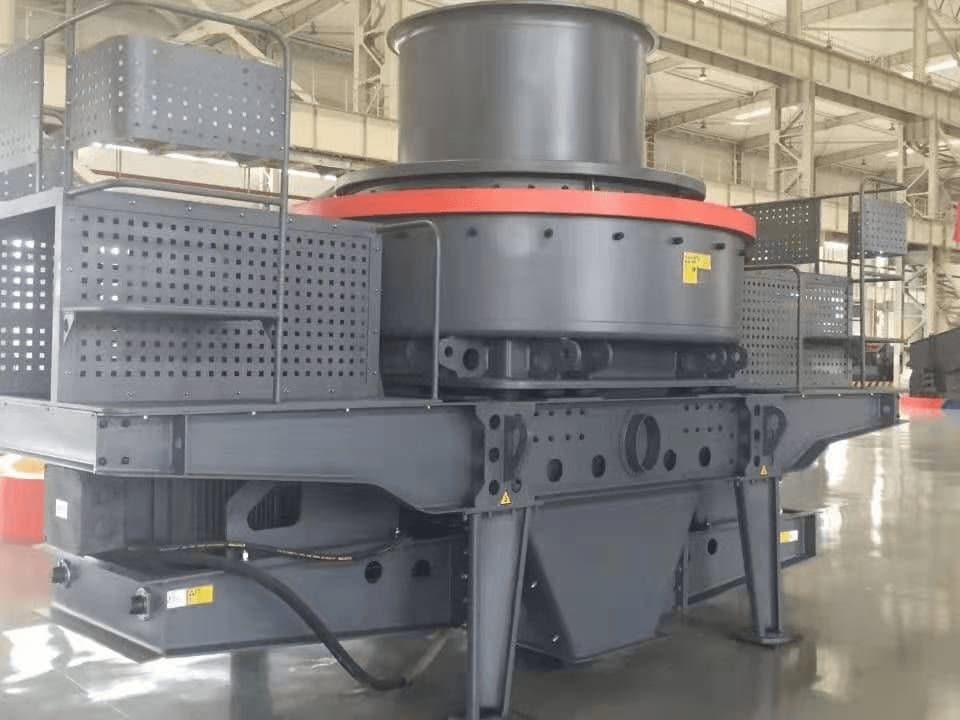
VSI Vertical Shaft Impact Crusher for Manufactured Sand
Ten sizes, from VSI7611 to VSI1263, for making sand and shaping aggregate from small, pre-crushed rock. We supply them to plants that need manufactured sand where river sand is scarce or restricted.
- Output range60–850 t/h
- Motors2 × 55 to 2 × 315 kW
- Best feed size30–60 mm
- Rotor speed900–1,890 r/min
Figures are indicative. Final parameters are confirmed in the quotation.
Where a VSI fits in your plant
It is a final-stage machine. It needs small feed from the crushers before it.
1. Crushing ahead
Jaw and cone crushers reduce the rock to small, screened feed. A VSI is not a primary crusher.
2. Sand making
Rock is thrown at high speed against other rock or against anvils. It breaks into rounded, well-graded particles.
3. Grading and washing
A screen sets the sand grading. Washing removes fine dust if your specification needs it.
Two ways to run it
Most VSI crushers can work in two modes. Which one you use depends on the rock and the product you want.
Rock on rock
Material is thrown against a bed of rock that builds up in the chamber. Wear on the machine is lower and there is little metal contamination. It suits abrasive rock such as granite and river pebbles.
Rock on iron
Material is thrown against metal anvils. It crushes more strongly and suits softer, less abrasive rock such as limestone. Anvils wear faster.
We confirm which modes your chosen model supports in the quotation.
Pick a model by the output you need
Output with feed through the centre and around the rotor (cascade). Feed through the centre only gives a lower output, shown in the table below.
| Target output | Suggested model | Output range |
|---|---|---|
| up to about 180 t/h | VSI7611 | 120–180 t/h |
| about 180–260 t/h | VSI8518 | 200–260 t/h |
| about 260–380 t/h | VSI9526 | 300–380 t/h |
| about 380–490 t/h | VSI9528 | 380–490 t/h |
| about 450–570 t/h | VSI9532 or VSI1140 | 450–570 t/h |
| about 500–600 t/h | VSI1150 | 500–600 t/h |
| about 500–850 t/h | VSI1245, VSI1250 or VSI1263 | 500–850 t/h |
Specifications
All ten models of the VSI series.
| Model | Output, centre and cascade feed (t/h) | Output, centre feed only (t/h) | Best feed, soft / hard rock (mm) | Rotor speed (r/min) | Motor (kW) | Approx. size L×W×H (mm) | Approx. weight* |
|---|---|---|---|---|---|---|---|
| VSI7611 | 120–180 | 60–90 | 35 / 30 | 1700–1890 | 2 × 55 | 3700 × 2150 × 2100 | ~7.8 t |
| VSI8518 | 200–260 | 100–130 | 40 / 35 | 1520–1690 | 2 × 90 | 4140 × 2280 × 2425 | ~10.3 t |
| VSI9526 | 300–380 | 150–190 | 45 / 40 | 1360–1510 | 2 × 132 | 4560 × 2447 × 2778 | ~16 t |
| VSI9528 | 380–490 | 175–225 | 45 / 40 | 1360–1510 | 280† | 4560 × 2447 × 2778 | in quotation |
| VSI9532 | 450–570 | 225–285 | 45 / 40 | 1360–1510 | 2 × 160 | 4560 × 2447 × 2778 | in quotation |
| VSI1140 | 450–520 | 225–260 | 50 / 45 | 1180–1310 | 2 × 200 | 5000 × 2700 × 3300 | ~25.6 t |
| VSI1150 | 500–600 | 200–300 | 50 / 45 | 1180–1310 | 2 × 250 | 5100 × 2700 × 3300 | in quotation |
| VSI1245 | 500–700 | 210–385 | 60 / 50 | 900–1200 | 2 × 220 | 5500 × 2980 × 4190 | in quotation |
| VSI1250 | 510–750 | 255–420 | 60 / 50 | 900–1200 | 2 × 250 | 5560 × 2980 × 4190 | in quotation |
| VSI1263 | 700–850 | 280–480 | 60 / 50 | 900–1200 | 2 × 315 | 5700 × 2980 × 4190 | in quotation |
*Approximate weight for machines in this class; actual weight and dimensions are confirmed in the quotation. †Motor arrangement is confirmed in the quotation. Figures are indicative; final parameters are confirmed in the quotation.
What decides your real output
The same machine can give very different numbers on two sites. These are the factors we check with you first.
Feed size
The best feed is small, about 30–60 mm depending on the model and the rock. Oversize pieces cut output and raise wear.
Rock type
Hard, abrasive rock wears the rotor parts faster. Softer rock gives more fines and a different grading.
Steady feeding
The rotor works best with a constant, even feed. A feeder or a surge bin ahead of the VSI helps.
Rotor speed and mode
A higher speed gives finer sand. Rock-on-rock and rock-on-iron modes give different particle shape and wear.
Is a VSI the right choice?
A short honest check before you ask for a price.
Good fit
- Making manufactured sand from granite, basalt, river pebbles, limestone or similar rock.
- Recycling concrete and construction waste into sand and fine aggregate.
- Shaping crushed aggregate to a rounder, more cubical product.
- Your plant already has crushers and screens ahead of it.
Look at other machines if
- Feed is large: crush it first with a jaw crusher and a cone crusher.
- You need a primary crusher: a VSI cannot take run-of-mine rock.
- Feed is wet and sticky with clay.
- You only need coarse aggregate with no sand: an impact or cone crusher is enough.
What operating one is like
What your maintenance team will deal with.
- Wear parts: the rotor tips, distributor parts and lining are the main consumables. Plan spare sets.
- Feed control: a steady, correctly sized feed protects the rotor and keeps output stable.
- Lifting and access: the top of the machine opens for servicing. Plan lifting equipment on site.
- Monitoring: models can be fitted with vibration monitoring and lubrication protection. We confirm the options in the quotation.
- Dust: sand making produces fine dust. Plan dust control and collection.
- Power: two motors run the larger models. Check your power supply and starting method.
What we need to quote
Send what you know on WhatsApp or by email. Rough numbers are enough to start.
- Rock type and, if known, hardness
- Feed size, ideally with a photo
- Sand grading or product size you want
- Output required (t/h)
- Moisture and clay content
- The crushers and screens you already have
- Power supply (voltage and frequency)
- Site altitude and destination country
Buying through CNEIG INDUSTRIAL
We are a trading and project-coordination company, not the factory.
- We agree the model and parameters with the manufacturer and write them into your quotation.
- Lead time depends on whether the machine is in stock, has to be produced, or is customised. It is stated in the contract.
- Payment, warranty and delivery terms are set in the contract.
- Read how we handle pre-shipment inspection.
Common questions
What is a VSI used for?
Making manufactured sand and shaping aggregate. It takes small, pre-crushed rock and breaks it into rounded, well-graded particles.
How large can the feed be?
The best feed is about 30–60 mm, depending on the model and on whether the rock is soft or hard. The table above lists the best feed for each model.
Can a VSI replace river sand?
Manufactured sand from a VSI is widely used where river sand is scarce or restricted. The grading and fines content depend on your rock and on the screens and washing after the VSI. We discuss your specification before quoting.
Rock on rock or rock on iron?
Rock on rock wears the machine less and suits abrasive rock. Rock on iron crushes harder and suits softer rock. Tell us the rock and we will say which suits you.
What about lead time, payment and warranty?
They are agreed in the contract before the order is confirmed. Lead time depends on stock, production or customisation.
Machines used with it
Tell us about your project
Send the rock type, feed size and the output you want. We will come back with a suitable model and a quotation.
Request a Quotation
Tell us the material and the output you want. We reply within 1–2 business days.