
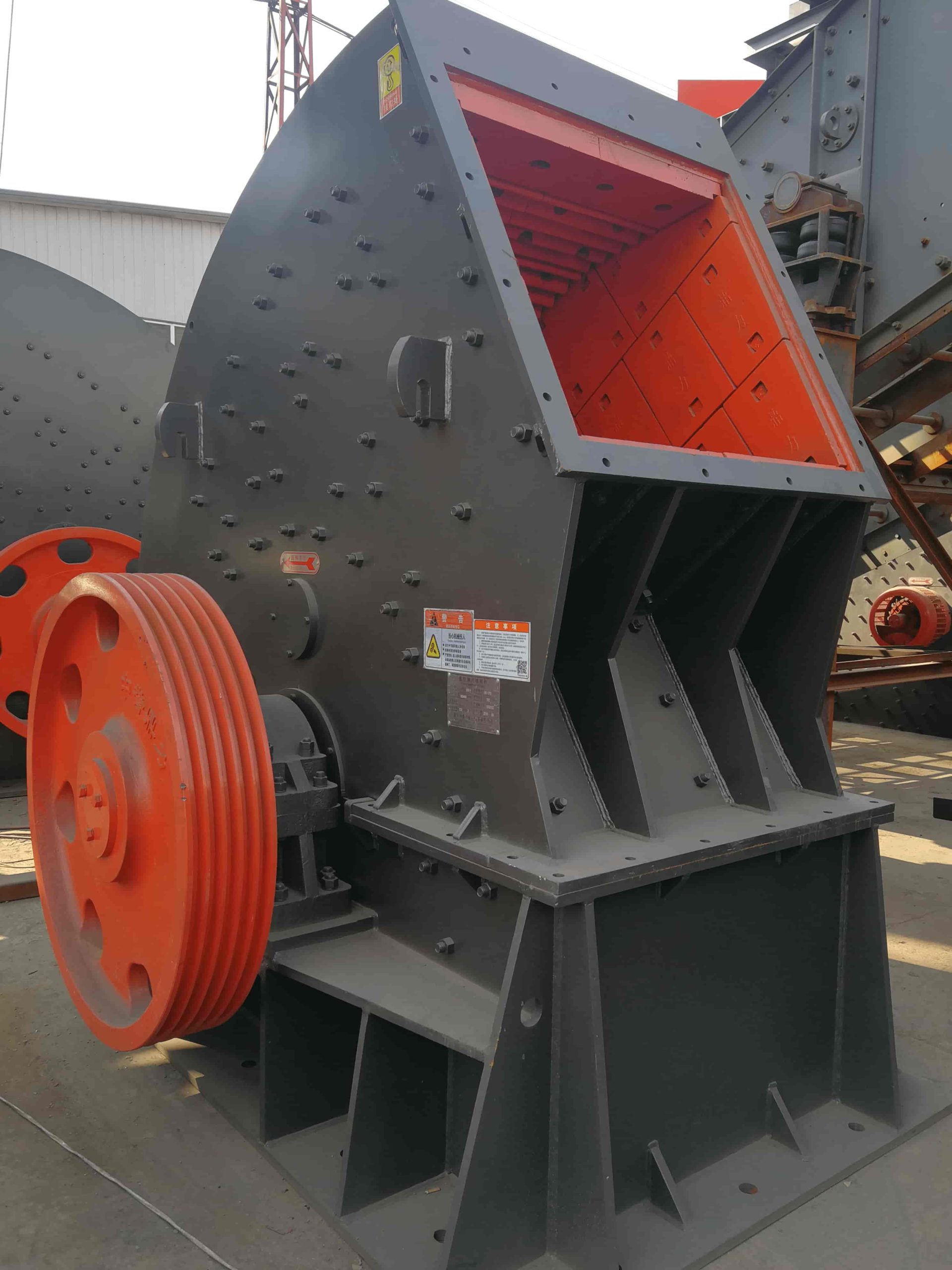
PCZ Heavy Hammer Crusher for Limestone and Coal
Seven sizes, from PCZ1308-III to PCZ2125-III, for high-output crushing of brittle, medium-hard material. We supply them for cement plants, limestone quarries and coal handling, where a large feed and a high crushing ratio are needed.
- Output range100–2,500 t/h
- Motors132–1,250 kW
- Largest feed600–1,600 mm
- Best forbrittle, medium-hard material
Figures are indicative. Final parameters are confirmed in the quotation.
Where a heavy hammer crusher fits in your plant
With a large feed opening, it can take quarry rock directly and replace a separate primary crusher for soft, brittle material.
1. Feeding
A heavy-duty feeder gives the crusher an even flow. A grizzly section removes soil and fines ahead of it.
2. Hammer crushing
Heavy hammers on a fast rotor break large lumps in one pass. Material leaves through the grate at the size you set.
3. Taking it away
A belt conveyor carries the product to storage, a screen, a kiln or a mill.
This design works for brittle, medium-hard material. It does not suit hard, abrasive rock.
Pick a model by the output you need
Based on the output ranges we use for quotations. Real output depends on the material, feed grading and grate setting.
| Target output | Suggested model | Output range | Largest feed |
|---|---|---|---|
| about 100–160 t/h | PCZ1308-III | 100–160 t/h | ≤ 600 mm |
| about 160–210 t/h | PCZ1510-III | 160–210 t/h | ≤ 700 mm |
| about 250–320 t/h | PCZ1512-III | 250–320 t/h | ≤ 750 mm |
| about 360–420 t/h | PCZ1615-III | 360–420 t/h | ≤ 1,000 mm |
| about 800–1,000 t/h | PCZ1620-III | 800–1,000 t/h | ≤ 1,200 mm |
| about 1,000–1,200 t/h | PCZ1820-III | 1,000–1,200 t/h | ≤ 1,200 mm |
| about 2,000–2,500 t/h | PCZ2125-III | 2,000–2,500 t/h | ≤ 1,600 mm |
| 420–800 or 1,200–2,000 t/h | Between two sizes: send us your material and we will recommend one | ||
Specifications
All seven models of the PCZ series.
| Model | Rotor Ø × length (mm) | Feed opening (mm) | Max feed (mm) | Output (t/h) | Motor (kW) | Approx. size L×W×H (mm) | Approx. weight* |
|---|---|---|---|---|---|---|---|
| PCZ1308-III | 1310 × 790 | 850 × 800 | ≤ 600 | 100–160 | 132 | 2818 × 2100 × 2390 | ~15.6 t |
| PCZ1510-III | 1500 × 950 | 1000 × 900 | ≤ 700 | 160–210 | 2 × 132 | 3260 × 2414 × 2750 | ~17.1 t |
| PCZ1512-III | 1500 × 1160 | 1200 × 900 | ≤ 750 | 250–320 | 2 × 160 | 3260 × 2624 × 2750 | ~18.9 t |
| PCZ1615-III | 1650 × 1452 | 1500 × 1200 | ≤ 1,000 | 360–420 | 2 × 200 | 3456 × 2915 × 3185 | ~28 t |
| PCZ1620-III | 1660 × 1900 | 2000 × 1200 | ≤ 1,200 | 800–1,000 | 2 × 315–400 | 3500 × 3100 × 3200 | in quotation |
| PCZ1820-III | 1800 × 1964 | 2000 × 1200 | ≤ 1,200 | 1,000–1,200 | 2 × 450 | 3270 × 3210 × 3520 | in quotation |
| PCZ2125-III | 2100 × 2486 | 2600 × 1680 | ≤ 1,600 | 2,000–2,500 | 1250 | 3728 × 4546 × 4667 | in quotation |
*Approximate weight for machines in this class; actual weight and foundation drawings are confirmed in the quotation. Figures are indicative; final parameters are confirmed in the quotation.
What decides your real output
The same machine can give very different numbers on two sites. These are the factors we check with you first.
Hardness and abrasiveness
Hammers and liners wear quickly on hard or abrasive rock. Soft, brittle material gives the best output and the lowest wear cost.
Moisture and clay
Wet, sticky feed can clog the grate and cut output sharply. Dry the material or scalp it before the crusher.
Grate and hammer gap
The grate opening and the gap between hammers and liners set the product size. A finer setting lowers output.
Feed size and rate
Even feeding keeps the rotor working at its best. Lumps near the maximum size slow the machine and raise wear.
Is a heavy hammer crusher the right choice?
A short honest check before you ask for a price.
Good fit
- Limestone, coal, coal gangue and cement raw materials.
- Large feed where you would like to skip a separate primary crusher.
- High output in one stage with a high crushing ratio.
- A plant that wants a simple, easy-to-maintain machine.
Look at other machines if
- Rock is hard or abrasive, such as granite, basalt or iron ore: use a jaw crusher and a cone crusher.
- Feed is wet and sticky: the grate can clog.
- Output is modest and the rock is limestone: a PF impact crusher may cost less.
- Wear cost matters more than crushing ratio.
What operating one is like
What your maintenance team will deal with.
- Wear parts: the hammer heads, liners and grate are the main consumables. We can quote forged hammers and manganese liners with the machine.
- Adjusting size: the product size is adjusted at the grate and at the hammer-to-liner gap.
- Servicing: the structure is simple, and access doors allow hammer and liner changes. Plan lifting equipment on site.
- Dust: hammer crushing makes dust. Plan dust control at the feed and discharge.
- Foundation and power: these are large machines. The foundation and the power supply need planning early, especially for the largest sizes.
- Operators: check the rotor, bearings and lubrication on a regular schedule.
What we need to quote
Send what you know on WhatsApp or by email. Rough numbers are enough to start.
- Material (limestone, coal, other) and, if known, hardness
- Feed size, ideally with a photo
- Product size you want
- Output required (t/h)
- Moisture and clay content
- What comes before and after the crusher
- Power supply (voltage and frequency)
- Site altitude and destination country
Buying through CNEIG INDUSTRIAL
We are a trading and project-coordination company, not the factory.
- We agree the model and parameters with the manufacturer and write them into your quotation.
- Lead time depends on whether the machine is in stock, has to be produced, or is customised. It is stated in the contract.
- Payment, warranty and delivery terms are set in the contract.
- Read how we handle pre-shipment inspection.
Common questions
What can a heavy hammer crusher handle?
Brittle, medium-hard material such as limestone, coal, coal gangue and cement raw materials. It is not suited to hard, abrasive rock.
Can it replace a primary crusher?
For soft, brittle material it often can, because the feed opening is large and the crushing ratio is high. For harder rock, a jaw crusher should come first. We check your material before advising.
How large can the feed be?
The maximum feed runs from about 600 mm on the PCZ1308-III to about 1,600 mm on the PCZ2125-III. We check your largest lumps before choosing a size.
What wears out first?
The hammer heads, then the liners and the grate. How fast depends on how abrasive the material is. We can quote wear parts together with the machine.
What about lead time, payment and warranty?
They are agreed in the contract before the order is confirmed. Lead time depends on stock, production or customisation.
Machines used with it
Tell us about your project
Send the material, feed size and the output you want. We will come back with a suitable model and a quotation.
Request a Quotation
Tell us the material and the output you want. We reply within 1–2 business days.