
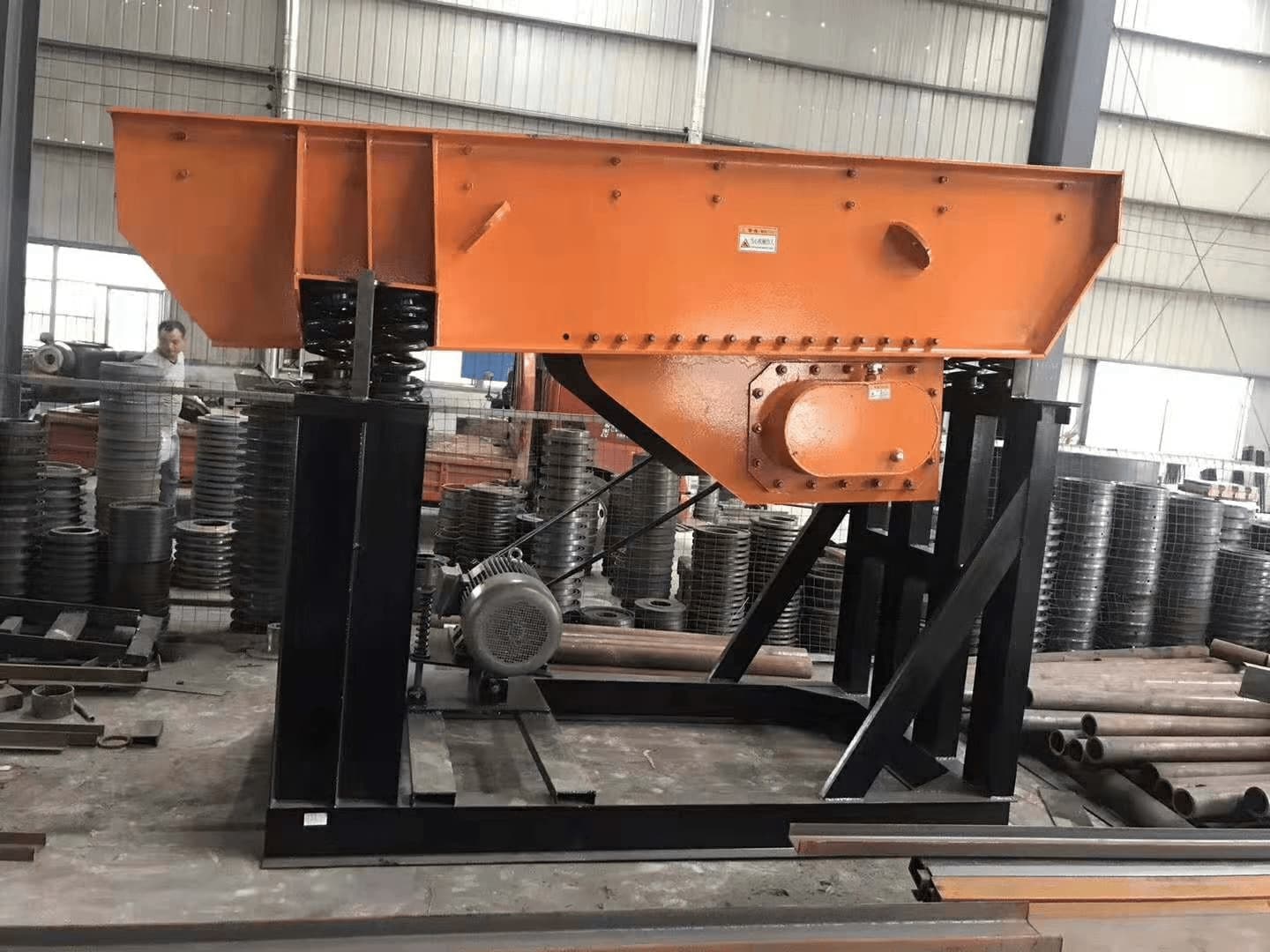
ZSW Vibrating Feeder for Crusher Feeding
Nine sizes, from ZSW380×95 to ZSW800×200, for feeding quarry rock and ore into crushers at an even rate. With grizzly bars it also removes fines before they reach the crusher.
- Output range80–1,200 t/h
- Motors7.5–45 kW
- Largest lump500–1,200 mm
- Drivedual eccentric shaft
Figures are indicative. Final parameters are confirmed in the quotation.
Where a vibrating feeder fits in your plant
It sits at the very start of the line, between the hopper and the first crusher.
1. Receiving
Trucks or a loader tip the rock into a hopper. The feeder takes it from the bottom of the hopper at a rate you can set.
2. Even feeding
The feeder shakes the rock forward in a steady stream. Grizzly bars let fines and soil drop through before the crusher.
3. Fines bypass
The fines that fall through go straight to the conveyor, so the crusher does not waste capacity on them.
A steady feed is one of the cheapest ways to raise a crusher’s real output and to cut its wear.
Pick a model by output and largest lump
Choose the feeder that gives your crusher a little more than its rated output, and that takes your biggest lump.
| Target output | Suggested model | Output range | Largest lump |
|---|---|---|---|
| about 80–120 t/h | ZSW380×95 | 80–120 t/h | ≤ 500 mm |
| about 110–190 t/h | ZSW420×110 or ZSW490×110 | 110–192 t/h | ≤ 500 mm |
| about 200–400 t/h | ZSW590×110 | 200–400 t/h | ≤ 580 mm |
| about 250–350 t/h, larger lumps | ZSW490×130 | 250–350 t/h | ≤ 750 mm |
| about 300–500 t/h | ZSW600×130 | 300–500 t/h | ≤ 750 mm |
| about 400–600 t/h | ZSW600×150 | 400–600 t/h | ≤ 900 mm |
| about 500–800 t/h | ZSW600×180 | 500–800 t/h | ≤ 1,000 mm |
| about 700–1,200 t/h | ZSW800×200 | 700–1,200 t/h | ≤ 1,200 mm |
Specifications
All nine models of the ZSW series. The model name gives the trough size: ZSW380×95 is a 3,800 × 950 mm trough.
| Model | Trough L × W (mm) | Max lump (mm) | Output (t/h) | Motor (kW) | Approx. weight* |
|---|---|---|---|---|---|
| ZSW380×95 | 3800 × 950 | 500 | 80–120 | 7.5–11 | ~3.8–4.1 t |
| ZSW420×110 | 4200 × 1100 | 500 | 110–180 | 11–15 | ~4.1–4.5 t |
| ZSW490×110 | 4900 × 1100 | 500 | 115–192 | 11–15 | ~4.3–4.8 t |
| ZSW490×130 | 4900 × 1300 | 750 | 250–350 | 15 | ~5.3 t |
| ZSW590×110 | 5900 × 1100 | 580 | 200–400 | 15–22 | ~5.8–6.1 t |
| ZSW600×130 | 6000 × 1300 | 750 | 300–500 | 22 | ~6.3–7.8 t |
| ZSW600×150 | 6000 × 1500 | 900 | 400–600 | 30 | ~6.8 t |
| ZSW600×180 | 6000 × 1800 | 1,000 | 500–800 | 37 | ~7.5 t |
| ZSW800×200 | 8000 × 2000 | 1,200 | 700–1,200 | 45 | ~9.5 t |
*Approximate weight for machines in this class. Where a range is shown, the figure varies between suppliers. Actual motor, weight and dimensions are confirmed in the quotation. Figures are indicative; final parameters are confirmed in the quotation.
What decides your real output
The same feeder can give very different numbers on two sites. These are the factors we check with you first.
Lump size and bulk density
Heavier, bigger rock needs a wider trough and a stronger drive. We check your biggest lump and the density of your rock.
Moisture and clay
Wet, sticky feed blinds the grizzly bars and slows the flow. It is the most common reason a feeder underperforms.
Amplitude and slope
The feed rate is adjusted by changing the amplitude. A slightly sloped trough carries material faster.
Hopper design
A well-shaped hopper keeps material flowing to the feeder. A poor one causes arching and uneven feed.
Is a ZSW the right choice?
A short honest check before you ask for a price.
Good fit
- Feeding a jaw crusher with quarry rock or run-of-mine ore.
- Rock with a lot of fines or soil that should skip the crusher.
- A plant that wants a stable, continuous flow into the crusher.
- Large lumps up to 500–1,200 mm.
Look at other machines if
- Lumps are small (under about 100 mm) and output is low: a lighter chute or pendulum feeder is cheaper.
- You need fine, adjustable dosing of light material: an electromagnetic feeder suits better.
- Feed is wet and sticky: the grizzly bars will blind.
- Headroom is tight: the ZSW needs space for its length and for the hopper.
What operating one is like
What your maintenance team will deal with.
- Trough and bars: the trough is wear-resistant, and the grizzly bars are the main wear parts. Keep spare bars.
- Feed rate: the feed rate is adjusted at the drive. Some models can take a frequency drive for stepless control.
- Drive: two eccentric shafts give a stable, straight-line motion. Check the bearings and oil on a regular schedule.
- Foundation: the feeder needs a rigid support structure. A weak frame shakes and cracks.
- Dust and noise: plan dust control at the hopper and the discharge. Noise is lower than for many other feeders.
- Footprint: allow space for its length and for the hopper above it.
What we need to quote
Send what you know on WhatsApp or by email. Rough numbers are enough to start.
- Material and, if known, bulk density
- Largest lump, ideally with a photo
- Output required (t/h)
- The crusher it will feed
- Fines and moisture content
- Hopper size, or whether you need one
- Power supply (voltage and frequency)
- Site altitude and destination country
Buying through CNEIG INDUSTRIAL
We are a trading and project-coordination company, not the factory.
- We agree the model and parameters with the manufacturer and write them into your quotation.
- Lead time depends on whether the machine is in stock, has to be produced, or is customised. It is stated in the contract.
- Payment, warranty and delivery terms are set in the contract.
- Read how we handle pre-shipment inspection.
Common questions
What does the feeder do for the crusher?
It gives the crusher an even, steady flow instead of a stop-start load, and it lets fines drop through before they reach the crusher. This raises the crusher’s real output and cuts wear.
How do I choose the size?
Start with your largest lump and the output you need. The feeder should give the crusher slightly more than its rated output. The table above gives a starting point; we check it against your material before quoting.
Can I adjust the feed rate?
Yes. The feed rate is adjusted at the drive, and some models can also be fitted with frequency control for finer adjustment. We confirm the options in the quotation.
What wears out first?
The grizzly bars and the trough liners. How fast depends on how abrasive the rock is. We can quote spare bars with the machine.
What about lead time, payment and warranty?
They are agreed in the contract before the order is confirmed. Lead time depends on stock, production or customisation.
Machines used with it
Tell us about your project
Send the material, the largest lump and the output you want. We will come back with a suitable model and a quotation.
Request a Quotation
Tell us the material and the output you want. We reply within 1–2 business days.