
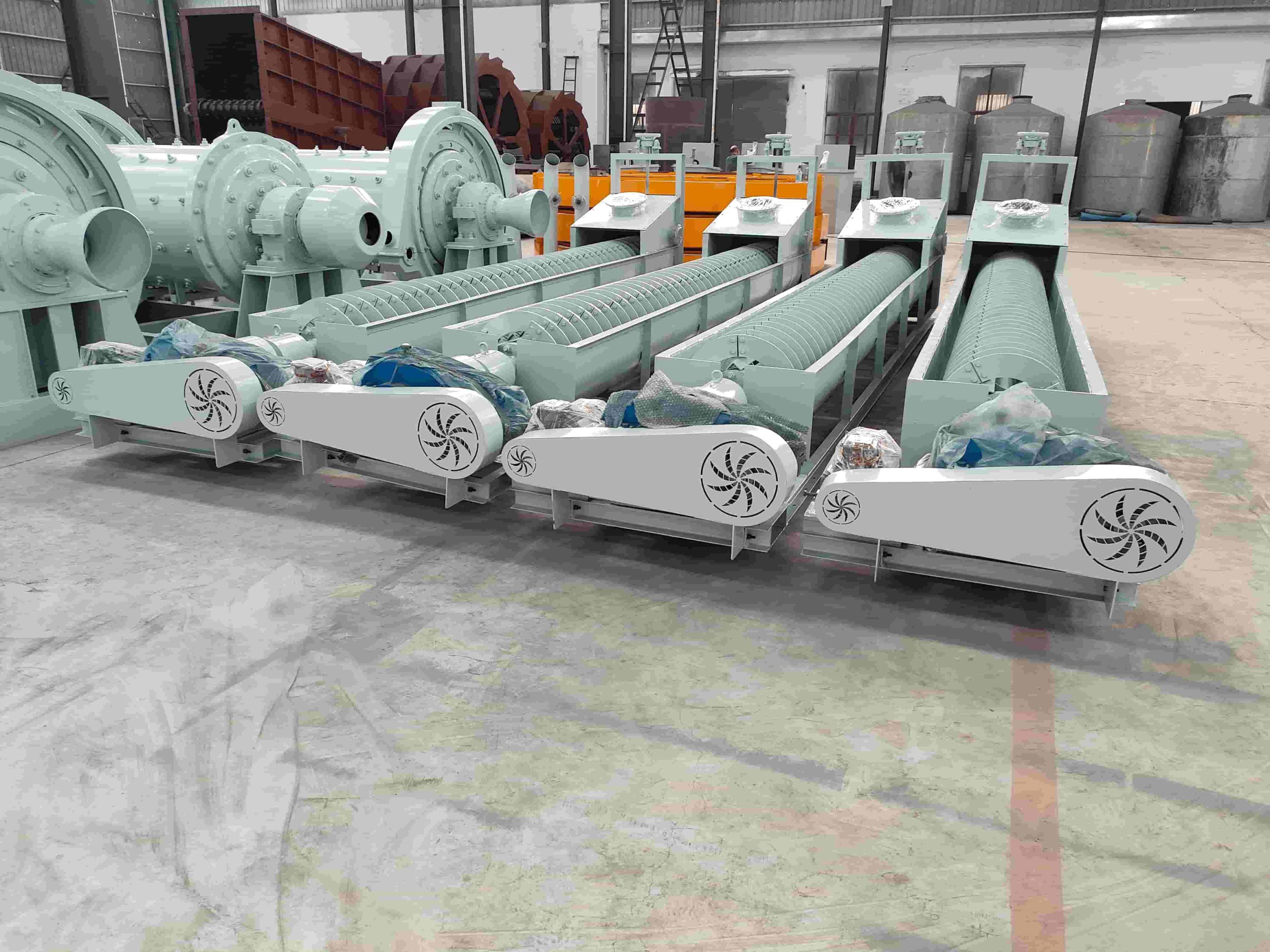
FLG Spiral Classifier for Grinding Circuits
Ten sizes, with single and double spirals from 750 to 3,000 mm, for sorting ground ore pulp into a fine overflow and a coarse sand return. We supply them to plants that run a ball mill in closed circuit.
- Spiral diameter750–3,000 mm
- Overflow31–1,785 t/day
- Drive motors3–30 kW (×2 on double spiral)
- Typeshigh-weir, single and double spiral
Figures are indicative. Final parameters are confirmed in the quotation.
Where a spiral classifier fits in your plant
It sits right after the ball mill, and sends the coarse material back to the mill.
1. Pulp from the mill
The ball mill discharges ground ore mixed with water. It enters the classifier tank.
2. Settling and lifting
Coarse particles settle to the bottom of the sloping tank. A slow-turning spiral lifts them out and returns them to the mill. Fine particles stay in suspension.
3. Overflow
The fine, light pulp flows over the weir and goes to the next process, such as flotation or magnetic separation.
A spiral classifier has no pump and no pressurised parts. It suits a coarser cut than a hydrocyclone.
Pick a size by the fine product you need
Overflow is the fine pulp that goes on to the next process. Sand return is the coarse material the spiral sends back to the mill. Both are in tons per day, and about one-twenty-fourth of that in tons per hour.
| Target overflow | Suggested model | Overflow (t/day) | About (t/h) |
|---|---|---|---|
| up to about 65 t/day | FLG-750 | 31–65 | 1.3–2.7 |
| about 65–100 t/day | FLG-1000 | 85 | 3.5 |
| about 100–180 t/day | FLG-1200 | 150 | 6.3 |
| about 180–280 t/day | FLG-1500 | 235 | 9.8 |
| about 280–450 t/day | FLG-2000, or 2FLG-1500 (double) | 400–470 | 17–20 |
| about 450–650 t/day | FLG-2400 | 580 | 24 |
| about 650–950 t/day | FLG-3000, or 2FLG-2000 (double) | 800–890 | 33–37 |
| about 950–1,800 t/day | 2FLG-3000 (double) | 1,785 | 74 |
Specifications
All ten models of the FLG high-weir series.
| Model | Type | Spiral Ø (mm) | Spiral speed (r/min) | Overflow (t/day) | Sand return (t/day) | Drive motor (kW) | Approx. weight* |
|---|---|---|---|---|---|---|---|
| FLG-750 | single | 750 | 7.8 | 31–65 | 256–654 | 3 | ~2.7 t |
| FLG-1000 | single | 1000 | 6.7 | 85 | 473–1,026 | 5.5 | ~4 t |
| FLG-1200 | single | 1200 | 5 / 6 / 7 | 150 | 1,145–1,600 | 5.5 | ~7.9 t |
| FLG-1500 | single | 1500 | 2.5 / 4 / 6 | 235 | 1,140–2,740 | 7.5 | ~11.8 t |
| FLG-2000 | single | 2000 | 3.6 / 5.5 | 400 | 3,890–5,940 | 11 / 15 | ~20.8 t |
| FLG-2400 | single | 2400 | 3.6 | 580 | 6,800 | 22 | ~24.2 t |
| FLG-3000 | single | 3000 | 3.2 | 890 | 11,625 | 30 | ~42.2 t |
| 2FLG-1500 | double | 1500 | 2.5 / 4 / 6 | 470 | 2,280–5,480 | 2 × 7.5 | ~22.9 t |
| 2FLG-2000 | double | 2000 | 3.6 / 5.5 | 800 | 7,780–11,880 | 2 × 15 | ~34.6 t |
| 2FLG-3000 | double | 3000 | 3.2 | 1,785 | 23,300 | 2 × 30 | ~73 t |
*Approximate weight; final weight and dimensions are confirmed in the quotation. Overflow and sand return depend on the pulp density, the fineness and the slope, and are confirmed in the quotation. Figures are indicative; final parameters are confirmed in the quotation.
What decides your real output
The same classifier can give very different numbers on two sites. These are the factors we check with you first.
Cut size you need
A finer overflow needs a lower pulp density and slower spiral. This lowers the amount of overflow per day.
Pulp density
Dilute pulp settles better and gives a finer overflow. Thick pulp carries more coarse material into the overflow.
Tank slope and weir height
These set how far the particles must travel and settle. We confirm the slope and weir settings for your cut size.
Circulating load
The classifier sends coarse material back to the mill. The sand return must match what the mill and the spiral can handle together.
Is a spiral classifier the right choice?
A short honest check before you ask for a price.
Good fit
- Closed-circuit grinding with a ball mill, with a medium or coarse cut.
- A plant that prefers few moving parts, no pump and simple upkeep.
- Desliming, washing and dewatering of coarse sand.
- Low power use per ton and stable operation.
Look at other machines if
- You need a very fine cut: a hydrocyclone works better and takes less space.
- Space is tight: a spiral classifier needs a large footprint.
- You need very high efficiency at fine sizes.
- You need to change the cut size often: a hydrocyclone is easier to adjust.
What operating one is like
What your maintenance team will deal with.
- Spiral and lifting gear: the spiral blades wear and are replaced. Alloy blades last longer on abrasive sand.
- Drive and bearings: the lower bearing sits in the pulp. Check it and the seals regularly.
- Adjustments: the tank slope, the weir height and the pulp density can be adjusted to move the cut size.
- No pump: there is no pressurised part, so upkeep is simple.
- Foundation: the tank is long and heavy. Plan the support structure and the space early.
What we need to quote
Send what you know on WhatsApp or by email. Rough numbers are enough to start.
- Ore type and the mill that feeds the classifier
- Overflow you need (t/h or t/day)
- Cut size or fineness of the overflow
- Pulp density
- Single or double spiral, if you have a preference
- Space available for the tank
- Power supply (voltage and frequency)
- Site altitude and destination country
Buying through CNEIG INDUSTRIAL
We are a trading and project-coordination company, not the factory.
- We agree the model and parameters with the manufacturer and write them into your quotation.
- Lead time depends on whether the machine is in stock, has to be produced, or is customised. It is stated in the contract.
- Payment, warranty and delivery terms are set in the contract.
- Read how we handle pre-shipment inspection.
Common questions
What is the difference between a spiral classifier and a hydrocyclone?
A spiral classifier uses settling and a slow spiral. It has no pump and suits a medium or coarse cut. A hydrocyclone uses centrifugal force and a pump. It suits a fine cut and takes less space.
What is the difference between single and double spiral?
A double spiral has two spirals in the same tank and roughly twice the capacity of a single spiral of the same diameter. It saves space when you need a high throughput.
How do I choose the size?
Start from the mill output, the cut size you need and the overflow in tons per day. We then check the sand return and the circulating load against your mill. The table above gives a starting point.
What wears out first?
The spiral blades and the lower bearing. How fast depends on how abrasive the sand is. We can quote spare blades with the machine.
What about lead time, payment and warranty?
They are agreed in the contract before the order is confirmed. Lead time depends on stock, production or customisation.
Machines used with it
Tell us about your project
Send the ore, the mill size and the overflow and cut size you want. We will come back with a suitable model and a quotation.
Request a Quotation
Tell us the material and the output you want. We reply within 1–2 business days.