
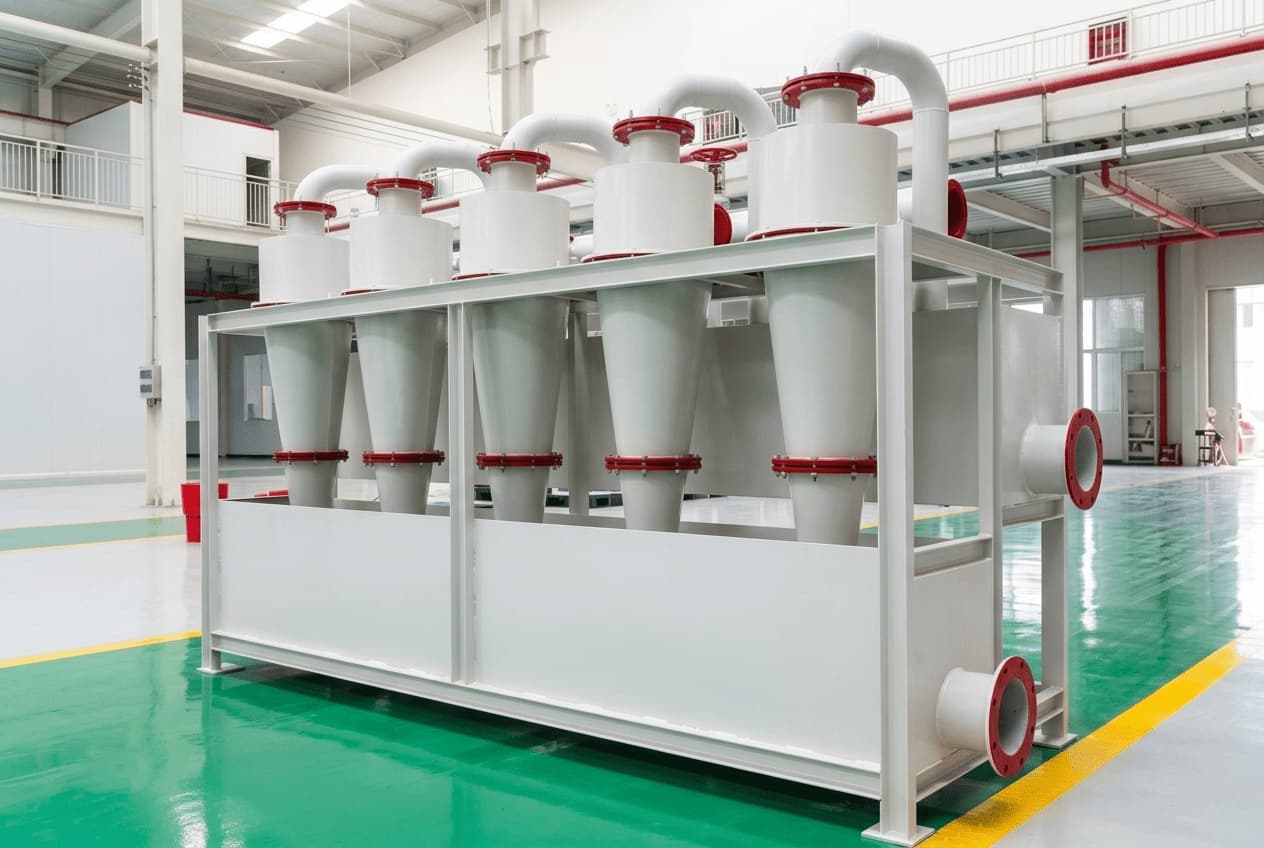
FX Hydrocyclone for Slurry Classification
Six sizes, from 125 to 500 mm, for sorting slurry by particle size, removing slimes and dewatering. We supply them to plants that run a ball mill in closed circuit, and to sand and tailings circuits.
- Cyclone diameter125–500 mm
- Capacity per cyclone3.6–220 m³/h
- Cut size20–120 µm
- Moving partsnone
Figures are indicative. Final parameters are confirmed in the quotation.
Where a hydrocyclone fits in your plant
It sits after the mill, with a pump and a sump, and sends the coarse material back.
1. Pumped feed
A slurry pump feeds the pulp into the cyclone at a steady flow and pressure.
2. Spinning separation
The pulp spins inside the cone. Coarse, heavy particles move to the wall and leave through the bottom. Fine particles leave through the top.
3. Two product streams
The overflow goes on to the next process. The underflow returns to the mill, or goes to dewatering or sand recovery.
A hydrocyclone has no moving parts and takes little space. It is the usual choice for a fine cut.
Pick a size by the flow you need to treat
Capacity is the slurry flow through one cyclone. For higher flows we use several cyclones in a cluster.
| Slurry flow | Suggested model | Capacity (m³/h) | Cut size (µm) |
|---|---|---|---|
| up to about 6 m³/h | FX-125 | 3.6–6.1 | 20–50 |
| about 7–15 m³/h | FX-150 | 7.5–15 | 35–75 |
| about 15–40 m³/h | FX-250 or FX-300 | 10–43 | 40–105 |
| about 70–90 m³/h | FX-350 | 74–90 | 50–110 |
| about 170–220 m³/h | FX-500 | 170–220 | 60–120 |
| higher flows, or flows between sizes | A cluster of several cyclones, or tell us your flow and we will recommend one | ||
Specifications
All six models of the FX series.
| Model | Cyclone diameter (mm) | Cut size (µm) | Capacity (m³/h) | Approx. weight* |
|---|---|---|---|---|
| FX-125 | 125 | 20–50 | 3.6–6.1 | ~57 kg |
| FX-150 | 150 | 35–75 | 7.5–15 | ~128 kg |
| FX-250 | 250 | 40–100 | 10–39 | ~205 kg |
| FX-300 | 300 | 45–105 | 37–43 | ~287 kg |
| FX-350 | 350 | 50–110 | 74–90 | ~430 kg |
| FX-500 | 500 | 60–120 | 170–220 | ~718 kg |
*Approximate weight; final weight and dimensions are confirmed in the quotation. Cut size depends on feed density, pressure and the nozzle sizes. The operating pressure and the pump are set in the quotation. Figures are indicative; final parameters are confirmed in the quotation.
What decides your real cut size
The same cyclone can give very different cut sizes on two sites. These are the factors we check with you first.
Feed pressure
A higher pressure gives a finer cut and a higher flow. The pump and the cyclone must be matched.
Feed density
Thick slurry pushes more coarse material into the overflow. Dilute slurry gives a cleaner cut.
Nozzle sizes
The overflow pipe and the underflow nozzle set the cut size and the split of flow. They can be changed to tune the result.
Particle density
Heavy minerals report to the underflow at a finer size than light ones. We keep this in mind when we set the cut.
Is a hydrocyclone the right choice?
A short honest check before you ask for a price.
Good fit
- Closed-circuit grinding with a ball mill and a fine cut.
- Desliming, thickening and dewatering of slurry or tailings.
- Sand slurry classification and fine sand recovery.
- A plant that wants a small footprint and low maintenance.
Look at other machines if
- You need a coarse cut with no pump: a spiral classifier suits better.
- The feed density or flow changes a lot and you cannot stabilise it.
- The slurry is very abrasive: liner wear will be high, so plan for it.
- You cannot supply a steady pump feed.
What operating one is like
What your maintenance team will deal with.
- Liners and nozzles: the liner, the overflow pipe and the underflow nozzle wear on abrasive slurry. Keep spares, and choose a wear-resistant liner for hard ore.
- Pump and feed: a steady, correctly sized pump is essential. An unstable feed spoils the cut size.
- Adjusting the cut: change the nozzle sizes, the feed density or the pressure.
- Blockages: tramp material can block the nozzles. A screen ahead of the pump helps.
- No moving parts: there is no motor or gearbox on the cyclone itself, so upkeep is simple.
What we need to quote
Send what you know on WhatsApp or by email. Rough numbers are enough to start.
- Ore or material and the particle size in the feed
- Slurry flow (m³/h) or the solids rate (t/h)
- Cut size you need (µm)
- Slurry density
- What the overflow and underflow go to
- Pump size, if you already have one
- Power supply (voltage and frequency)
- Site altitude and destination country
Buying through CNEIG INDUSTRIAL
We are a trading and project-coordination company, not the factory.
- We agree the model and parameters with the manufacturer and write them into your quotation.
- Lead time depends on whether the machine is in stock, has to be produced, or is customised. It is stated in the contract.
- Payment, warranty and delivery terms are set in the contract.
- Read how we handle pre-shipment inspection.
Common questions
What is a hydrocyclone used for?
It sorts slurry by particle size. Common uses are closed-circuit grinding, desliming, dewatering and sand classification.
How do I choose the size?
Start from your slurry flow and the cut size you need. The table above gives the cyclone for each flow. For higher flows we use a cluster of cyclones. We confirm the choice against your slurry before quoting.
Do I need a pump?
Yes. A slurry pump feeds the cyclone at a steady pressure. The pump and the cyclone must be matched to get the cut size you want.
What wears out first?
The liner, the overflow pipe and the underflow nozzle. How fast depends on how abrasive the slurry is. We can quote spare nozzles and liners with the machine.
What about lead time, payment and warranty?
They are agreed in the contract before the order is confirmed. Lead time depends on stock, production or customisation.
Machines used with it
Tell us about your project
Send the slurry, the flow and the cut size you want. We will come back with a suitable model and a quotation.
Request a Quotation
Tell us the material and the output you want. We reply within 1–2 business days.