
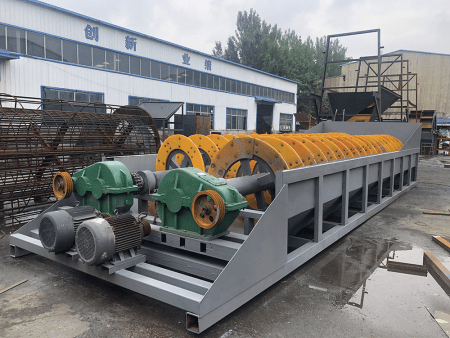
LSX Spiral Sand Washer
A sloped trough with a slowly turning spiral. Sand is carried up and out while water carries clay and dust away. Six models, from 40 to 350 t/h. We supply them to sand and aggregate plants that need cleaner product.
- Capacity40–350 t/h
- Spiral diameter610–1,120 mm
- Motor7.5–2 × 18.5 kW
- Models1 or 2 spirals
Figures are indicative. Final parameters are confirmed in the quotation.
Where a spiral sand washer fits in your plant
It cleans sand after crushing or sand making, before the sand is stored or sold.
1. Sand and water enter
The feed goes into the lower end of the sloped trough, where water fills the tank.
2. The spiral turns
The spiral stirs the sand so clay and dust float free, and at the same time pushes the sand up the slope.
3. Clean sand leaves
Clean sand comes out at the upper end. Dirty water flows over the lower end to settling.
Pick a model by your throughput
Use this as a starting point. Capacity depends on the material and how dirty it is.
| Your feed rate | Suggested model | Capacity |
|---|---|---|
| up to about 50 t/h | LSX610 | 40–50 t/h |
| about 50–75 t/h | LSX762 | 55–75 t/h |
| about 75–100 t/h | LSX920 | 100 t/h |
| about 100–175 t/h | LSX1120 | 175 t/h |
| about 175–200 t/h | 2LSX920 (two spirals) | 200 t/h |
| about 200–350 t/h | 2LSX1120 (two spirals) | 350 t/h |
Specifications
All six models of the LSX series.
| Model | Spirals | Spiral diameter (mm) | Capacity (t/h) | Motor (kW) | Approx. weight (t) |
|---|---|---|---|---|---|
| LSX610 | 1 | 610 | 40–50 | 7.5 | ~3.1 |
| LSX762 | 1 | 762 | 55–75 | 11 | ~5.2 |
| LSX920 | 1 | 920 | 100 | 11 | ~6.2 |
| LSX1120 | 1 | 1,120 | 175 | 18.5 | ~10.9 |
| 2LSX920 | 2 | 920 | 200 | 2 × 11 | ~11.5 |
| 2LSX1120 | 2 | 1,120 | 350 | 2 × 18.5 | ~17.8 |
Approximate weights; final weight and dimensions are confirmed in the quotation. Figures are indicative; final parameters are confirmed in the quotation.
What decides your real result
The same washer can give very different results on two feeds. These are the factors we check with you first.
How much clay and dust
A very dirty feed takes more water and more time in the trough, and can lower the capacity.
Feed size
The washer is made for sand and fine material. Large lumps should be screened out first.
Water supply
The machine needs a steady flow of clean water. Where water is short, plan for recycling.
Fine sand loss
Some fine sand leaves with the dirty water. If fine sand matters to you, plan a recovery step after the washer.
Is a spiral sand washer the right choice?
A short honest check before you ask for a price.
Good fit
- Crushed sand and fine aggregate with clay or dust to remove.
- Plants that need a strong washing action.
- Sand that must meet a clean-product requirement.
Look at other machines if
- You want gentler washing and less loss of fine sand: look at a wheel sand washer.
- You have little water and no way to treat or recycle it.
- The feed has large lumps or very sticky clay balls.
What operating one is like
What your operators and maintenance team will deal with.
- Water and settling: dirty water has to go to settling ponds or a recovery unit. This is part of the plant design.
- Spiral blades: the blades and the bearings wear and are replaced during maintenance. We can quote spares with the machine.
- Even feed: a steady feed gives steady washing. A surging feed lowers quality.
- Moisture of the product: washed sand leaves wet. If you need it drier, plan for dewatering.
What we need to quote
Send what you know on WhatsApp or by email. Rough numbers are enough to start.
- Material (crushed sand, natural sand or other)
- Capacity needed (t/h)
- Feed size and maximum size
- How much clay or dust, if you know
- Water supply you have on site
- Whether you plan fine sand recovery
- Power supply (voltage and frequency)
- Site altitude and destination country
Buying through CNEIG INDUSTRIAL
We are a trading and project-coordination company, not the factory.
- We agree the model and parameters with the manufacturer and write them into your quotation.
- Lead time depends on whether the machine is in stock, has to be produced, or is customised. It is stated in the contract.
- Payment, warranty and delivery terms are set in the contract.
- Read how we handle pre-shipment inspection.
Common questions
Spiral or wheel sand washer: which should I choose?
A spiral washer cleans harder. A wheel washer is gentler and loses less fine sand. Tell us the material and how dirty it is, and we will advise.
Does it lose fine sand?
Some fine sand leaves with the overflow water. If you need to keep it, add a fine sand recovery step after the washer.
How much water does it need?
It depends on the model and the dirt in your feed. We give the water need in the quotation once we know your material.
Can two washers work together?
Yes. The two-spiral models do exactly that in one machine, for higher capacity.
What about lead time, payment and warranty?
They are agreed in the contract before the order is confirmed. Lead time depends on stock, production or customisation.
Machines used with it
Tell us about your project
Send the material, the capacity and the clay content. We will come back with a suitable model and a quotation.
Request a Quotation
Tell us the material and the output you want. We reply within 1–2 business days.