
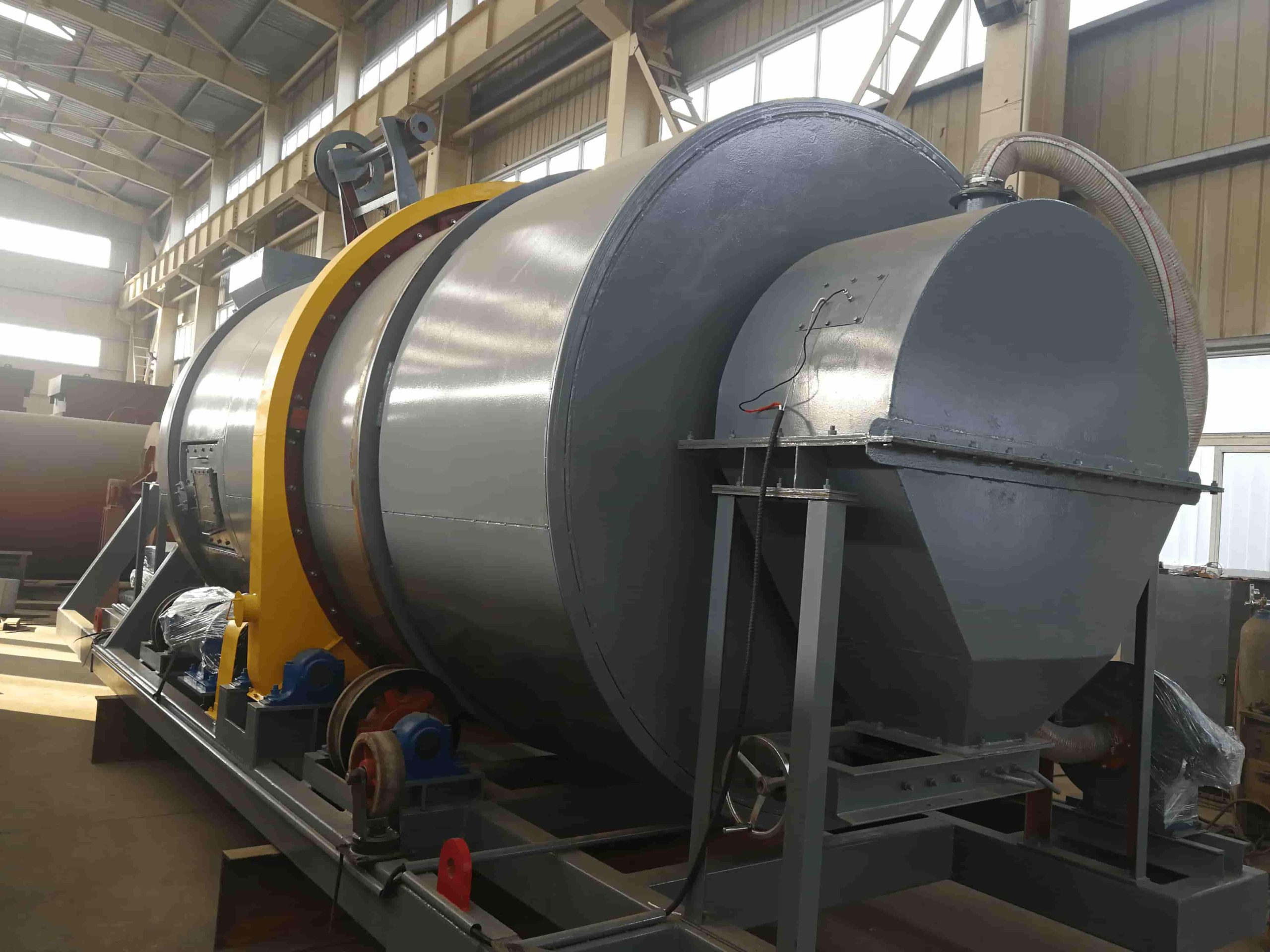
Rotary Drum Dryer
A slightly inclined rotating drum that tumbles wet material through hot gas. It dries sand, ore, slag and other bulk materials. We size each dryer to your material, your moisture and your capacity, so it is quoted to your project.
- Drum sizesD1.0 to D3.0 m
- Drum volume7.85–147 m³
- Motor5.5–185 kW
- Drum incline3–5%
Figures are indicative. Final parameters are confirmed in the quotation.
Where a rotary drum dryer fits in your plant
It takes wet material, dries it and passes it on. It needs a heat source and a dust collector.
1. Wet material enters
The feeder drops wet material into the upper end of the drum. A hot gas stream comes from your heat source.
2. The drum turns
Lifting plates inside the drum raise the material and let it fall through the hot gas. The slight slope moves it toward the outlet.
3. Dry material leaves
Dry material drops out at the lower end. The gas passes through a dust collector before it leaves the plant.
How we size a dryer for you
The drying capacity is not a fixed number. It depends on what you dry and how much water has to come out.
Material
Sand, ore, slag, coal and other materials dry at different speeds and can carry different amounts of dust. Sticky materials need a different drum interior.
Moisture in and out
The water that must be removed per hour decides the size. Drying from 12% to 1% needs far more than 5% to 1%.
Capacity you need
Send the dry-material output in t/h. Together with the moisture, this sets the drum size.
Heat source
The type of fuel or heat you have decides the burner or furnace and the gas temperature. Tell us what is available on site.
Specifications
Eight common sizes. Other sizes are available on request.
| Drum (diameter × length) | Drum volume (m³) | Speed (r/min) | Motor (kW) | Overall size L × W × H (mm) | Approx. weight (t) |
|---|---|---|---|---|---|
| D1.0 × 10 m | 7.85 | 6.73 | 5.5 | 10000 × 1876 × 2069 | ~7.6 |
| D1.2 × 8 m | 9.1 | 5.8 | 5.5 | 8000 × 2159 × 2475 | ~9.9 |
| D1.5 × 12 m | 21.2 | 4.8 | 15 | 12000 × 2655 × 2895 | ~17.1 |
| D1.8 × 14 m | 35.1 | 4.59 | 18.5 | 14000 × 3060 × 2980 | ~20.9 |
| D2.2 × 18 m | 68.4 | 4.9 | 30 | 18000 × 3620 × 3570 | ~36.2 |
| D2.4 × 24 m | 109 | 3.85 | 45 | 24500 × 3860 × 3760 | ~54.8 |
| D2.5 × 20 m | 123 | 3.6 | 45 | 23600 × 3860 × 4800 | ~55.9 |
| D3.0 × 20 m | 147 | 3.2 | 185 | 25000 × 4900 × 5000 | ~103.8 |
Drying capacity (t/h) depends on the material and the moisture before and after drying, so it is given in the quotation. The dryer is supplied with the drum, drive and supports; the heat source and the dust collector are quoted to your project. Approximate weights; final weight and dimensions are confirmed in the quotation. Figures are indicative; final parameters are confirmed in the quotation.
Is a rotary drum dryer the right choice?
A short honest check before you ask for a price.
Good fit
- Sand, ore, slag and other bulk materials that dry without breaking down in heat.
- Continuous drying at a steady rate.
- Plants that need a simple, robust dryer that can take lumps and varied feed.
Look at other options if
- The material is heat-sensitive and must stay below a low temperature.
- The material is very sticky or forms hard lumps that block the drum. A different interior or pre-treatment is needed.
- The moisture is already low and the volume is small. A simpler solution may be enough.
- You cannot manage dust, exhaust gas and fuel on site.
What operating one is like
What your operators and maintenance team will deal with.
- Fuel and heat: the heat source is the largest running cost. Its type and fuel supply should be settled before you order.
- Dust and exhaust: the exhaust gas carries dust. A dust collector is needed and must meet your local emission rules.
- Drum interior: lifting plates wear and may need replacement. The rollers and gears also need regular checks.
- Even feed: a steady feed of steady moisture gives a steady dry product.
- Foundation: the dryer is heavy and long. The foundation and supports need to be built to the drawing.
What we need to quote
Send what you know on WhatsApp or by email. Rough numbers are enough to start.
- Material you want to dry
- Dry-material output you need (t/h)
- Moisture before and after drying
- Feed size and any sticky or lumpy behaviour
- Heat source or fuel available on site
- Dust and emission rules in your country
- Power supply (voltage and frequency)
- Site altitude and destination country
Buying through CNEIG INDUSTRIAL
We are a trading and project-coordination company, not the factory.
- We agree the model and parameters with the manufacturer and write them into your quotation.
- Lead time depends on whether the machine is in stock, has to be produced, or is customised. It is stated in the contract.
- Payment, warranty and delivery terms are set in the contract.
- Read how we handle pre-shipment inspection.
Common questions
Why is there no capacity in t/h in the table?
The drying capacity depends on the material and on how much water has to be removed. Two jobs with the same drum can have very different outputs. We give the capacity in the quotation once we know your material and moisture.
What heat sources can it use?
That depends on what you have on site. Tell us the fuel or heat available, and we will match a furnace or burner to it in the quotation.
Does it come with a dust collector?
The dust collector is quoted to your project, because it depends on your material and your emission rules.
Can you make a size that is not in the table?
Yes. The table shows common sizes. Other sizes are available on request, and we confirm them with the manufacturer.
What about lead time, payment and warranty?
They are agreed in the contract before the order is confirmed. Lead time depends on stock, production or customisation.
Machines used with it
Tell us about your project
Send the material, the dry output and the moisture before and after. We will come back with a suitable dryer and a quotation.
Request a Quotation
Tell us the material and the output you want. We reply within 1–2 business days.