
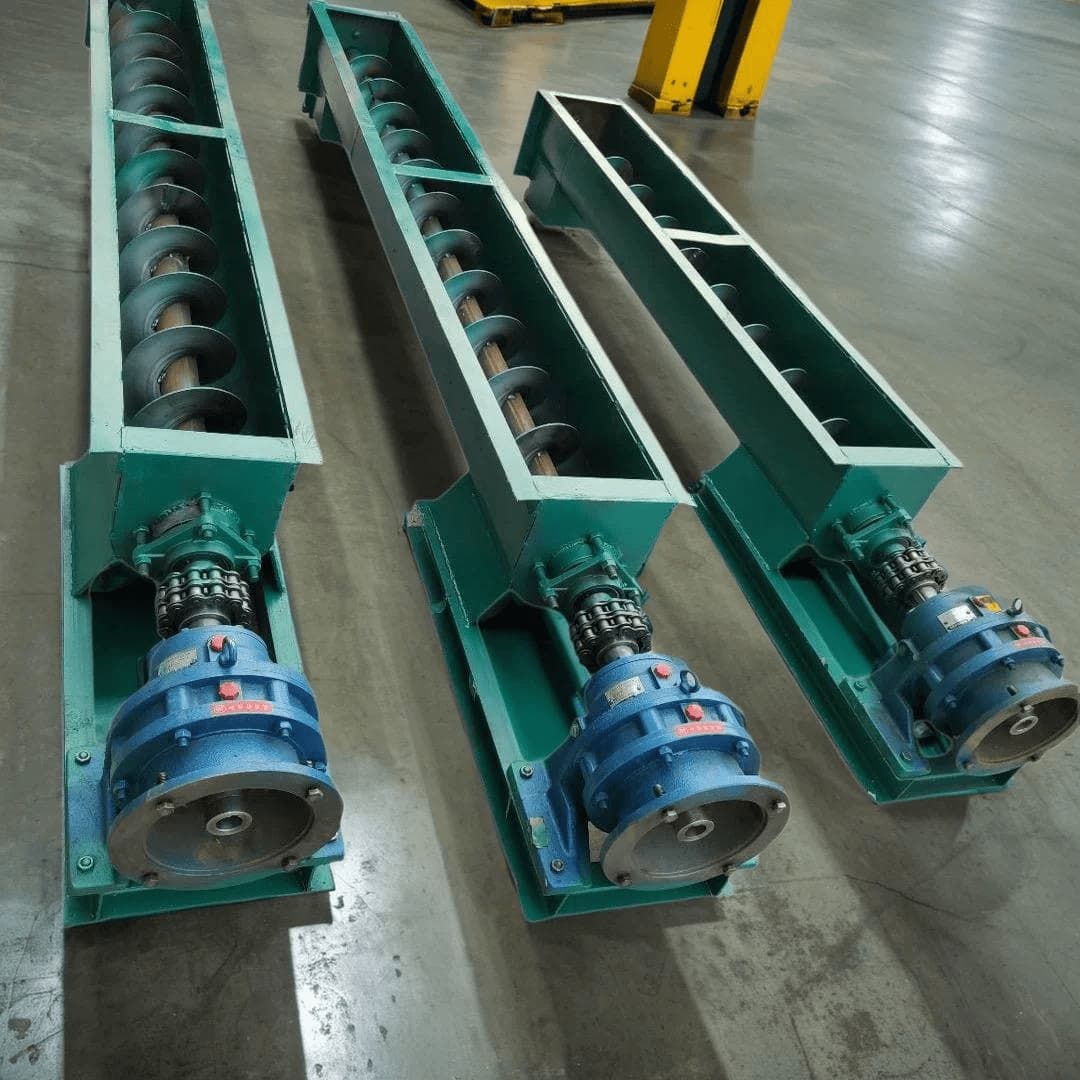
LS Screw Conveyor
An enclosed trough with a turning screw that pushes material along. Ten models, from 100 to 1,000 mm in diameter, for powder, fine ore and small granular material. It is dust-tight and fits short runs inside a plant.
- Capacity1–150 t/h
- Screw diameter100–1,000 mm
- Max length12–40 m
- Motor1.5–22 kW
Figures are indicative. Final parameters are confirmed in the quotation.
Where a screw conveyor fits
It moves fine material over short distances, such as under a hopper, a screen or a mill, or between two machines. For long distances and larger lumps, use a belt conveyor. To lift material, use a bucket elevator.
Specifications
All ten models of the LS series.
| Model | Screw diameter (mm) | Capacity (t/h) | Max length (m) | Motor (kW) |
|---|---|---|---|---|
| LS100 | 100 | 1–3 | 12 | 1.5 |
| LS160 | 160 | 3–8 | 14 | 2.2 |
| LS200 | 200 | 6–12 | 16 | 3 |
| LS250 | 250 | 10–18 | 18 | 4 |
| LS315 | 315 | 15–25 | 20 | 5.5 |
| LS400 | 400 | 20–35 | 25 | 7.5 |
| LS500 | 500 | 30–60 | 30 | 11 |
| LS630 | 630 | 45–80 | 30 | 15 |
| LS800 | 800 | 60–120 | 35 | 18.5 |
| LS1000 | 1,000 | 80–150 | 40 | 22 |
Capacity depends on the material, its density and the angle of the conveyor. Weight is given in the quotation. Specifications are indicative; final parameters are confirmed in the quotation.
What decides your real capacity
The same screw conveyor moves very different amounts of different materials.
Material and bulk density
Light, free-flowing powder moves faster than heavy or damp material. Tell us the material and its density.
Angle
Capacity drops as the conveyor tilts upward. Tell us the angle and the length.
Lump size and abrasiveness
Large lumps jam the screw, and abrasive material wears it quickly. Keep to fine and small granular material.
Moisture and stickiness
Wet or sticky material builds up on the screw and the trough. Tell us how wet it is.
Is it the right choice?
A short honest check before you ask for a price.
Good fit
- Powder, fine ore, sand and small granular material.
- Short, enclosed transfer where dust must stay in.
- Feeding or discharging from a hopper at a steady rate.
Look at other machines if
- You move large lumps or run a long distance: a belt conveyor is better.
- You need a high lift: use a bucket elevator.
- The material is very abrasive, hot or very sticky.
What we need to quote
Send what you know on WhatsApp or by email. Rough numbers are enough to start.
- Material, bulk density and maximum lump size
- Capacity needed (t/h)
- Conveying length and angle
- Moisture, temperature and abrasiveness
- Inlet and outlet positions
- Power supply (voltage and frequency)
- Site altitude and destination country
- Whether it must be dust-tight
Buying through CNEIG INDUSTRIAL
We are a trading and project-coordination company, not the factory.
- We agree the model and parameters with the manufacturer and write them into your quotation.
- Lead time depends on stock, production or customisation, and is stated in the contract.
- Payment, warranty and delivery terms are set in the contract.
- Read how we handle pre-shipment inspection.
Common questions
Can a screw conveyor run on an incline?
Yes, but capacity drops as the angle goes up. Give us the angle and we will size the model to match.
Screw conveyor or belt conveyor?
A screw conveyor suits fine material over short, enclosed runs. A belt conveyor suits long runs and larger lumps.
What wears out first?
The screw blades and the bearings. Abrasive material wears them faster. We can quote wear parts with the machine.
What about lead time, payment and warranty?
They are agreed in the contract before the order is confirmed.
Machines used with it
Tell us about your project
Send the material, the capacity and the length. We will come back with a suitable model and a quotation.
Request a Quotation
Tell us the material and the output you want. We reply within 1–2 business days.