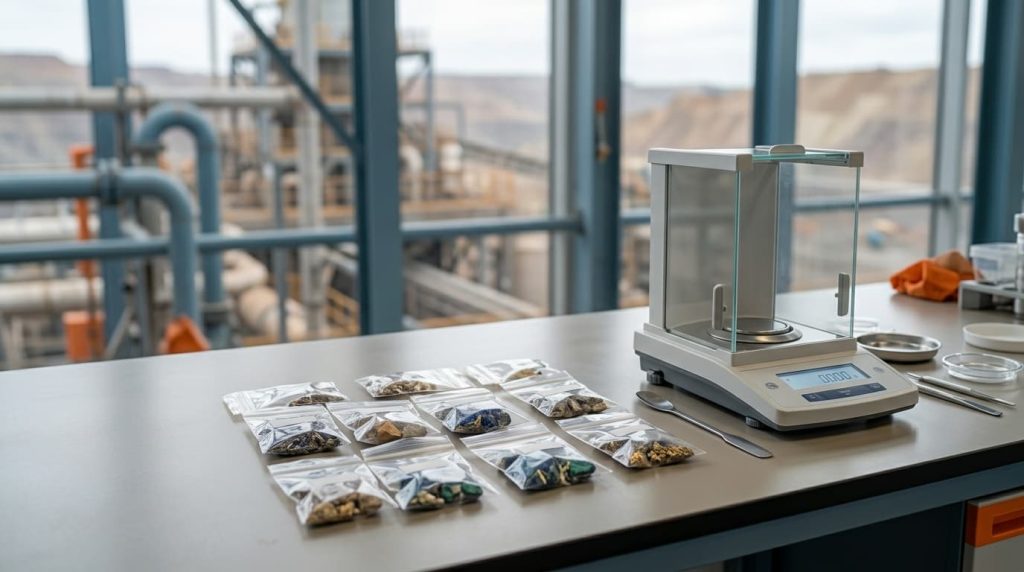
Two ore samples can report the same gold grade and still call for different plants. The assay tells you how much gold is in the rock. It does not tell you how the gold can be recovered.
Where the gold sits
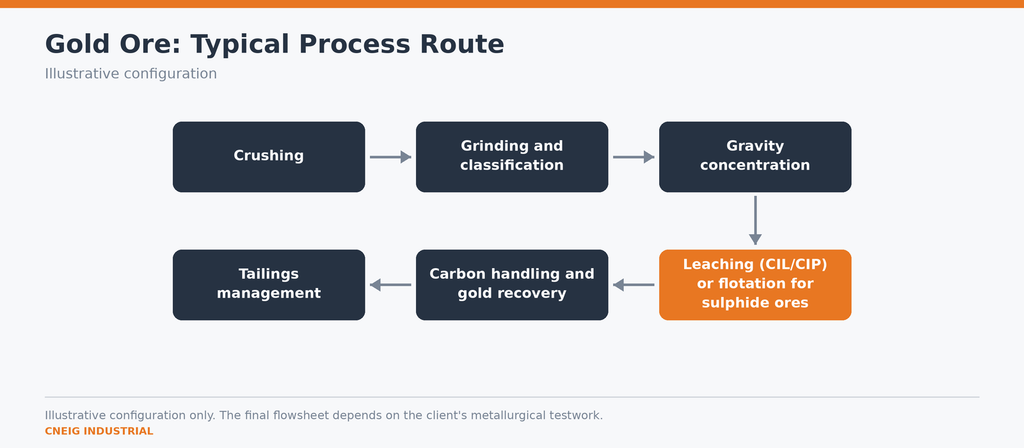
In free-milling ore, gold is exposed once the rock is ground, and a gravity circuit followed by leaching is often enough. In sulphide ores, gold can be locked inside pyrite or arsenopyrite. Grinding alone does not free it, and the plant may need flotation, oxidation or another pre-treatment step before leaching.
What else is in the ore
Copper, arsenic and some carbonaceous material can raise reagent consumption or interfere with gold recovery in leaching. These are found by testwork, not by assay alone.
Grind size matters
The target grind affects both the mill size and the leaching or flotation results. It is usually fixed after testwork, because a finer grind raises energy cost.
What this means for equipment selection
Choosing a crusher and a mill before the testwork is back means the rest of the plant may have to be changed later. We ask for the testwork first. If a client does not have it, we say what is needed before proposing a flowsheet.
Five checks before you choose equipment
- Mineralogy. Ask the lab whether the gold is free and visible, or locked inside pyrite or arsenopyrite.
- Gravity recovery test. A high share of gold in the gravity concentrate points to free-milling ore and a simpler flowsheet.
- Bottle-roll cyanide leach. Compare the gold in solution with the head grade. Low extraction usually means locked gold or interference.
- Interfering elements. Ask the lab to report sulphide sulphur, arsenic, copper and carbonaceous material.
- More than one grind size. Recovery often changes with fineness, and the grind size sets the mill size and power.
What the results usually point to
- High gravity and leach recovery: gravity plus CIL/CIP is often a reasonable starting point.
- Low leach recovery with high sulphides: flotation, roasting or oxidation may be needed before leaching.
- High copper or carbon content: reagent consumption and the flowsheet need a closer look.
A small testwork programme costs far less than redesigning a plant after it is built. If you have an assay, a sample description or any lab report, send it through the Contact page and we will tell you what is still missing and what to test next.
This note describes general principles. Actual process routes depend on the metallurgical testwork of each ore.