
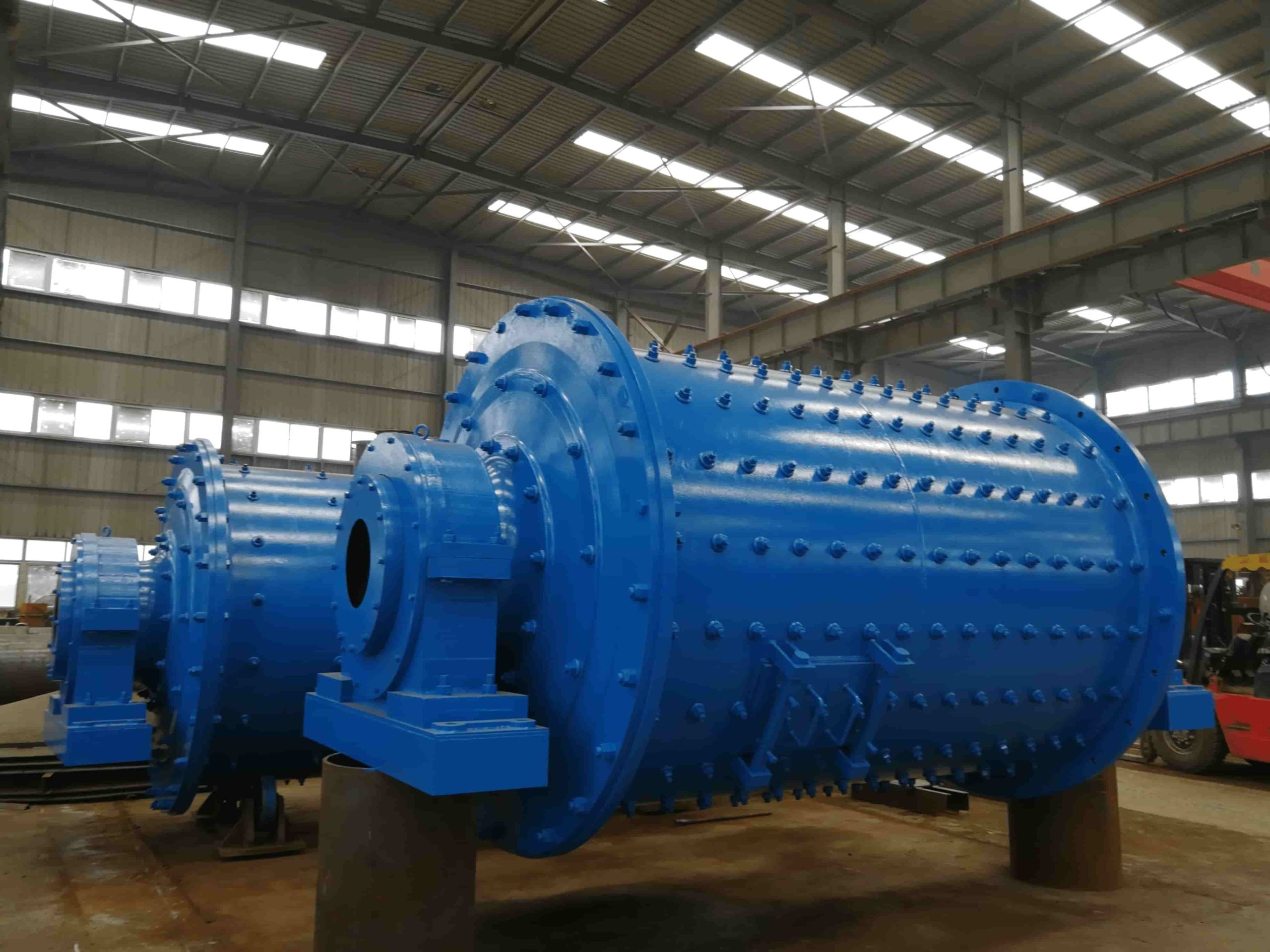
MQY Overflow Ball Mill for Fine Ore Grinding
Twelve sizes, from MQY900×1800 to MQY3600×6000, for fine and secondary grinding of metal ores and industrial minerals. We supply them to mines and plants that grind to a fine, even size ahead of flotation, magnetic separation or leaching.
- Output range0.65–140 t/h
- Motors18.5–1,000 kW
- Feed sizeup to 25 mm
- Product size0.074–0.3 mm
Figures are indicative. Final parameters are confirmed in the quotation.
Where an overflow ball mill fits in your plant
The mill sits after the crushers and ahead of separation. It usually works in a loop with a classifier.
1. Feed to the mill
Crushers and screens bring the ore under 25 mm. A feeder gives the mill a steady load.
2. Grinding
Steel balls tumble in a rotating drum and grind the ore against each other. The ground slurry overflows out of the discharge end.
3. Classifying
A classifier sorts the slurry. Fine material goes on to separation, and coarse material returns to the mill.
An overflow mill works best in closed circuit with a classifier. This keeps the product size stable and stops over-grinding.
Overflow ball mills are also used for wet grinding in gold plants. See how a small gold processing plant is built.
Pick a model by the output you need
Output depends on the ore, the feed size and the fineness you want. Use this as a starting point.
| Target output | Suggested model | Output range |
|---|---|---|
| up to about 2 t/h | MQY900×1800 | 0.65–2 t/h |
| about 2–5 t/h | MQY1200×2400 | 1.5–4.8 t/h |
| about 5–6 t/h | MQY1500×3000 | 2–6 t/h |
| about 6–10 t/h | MQY1830×3000 | 4–10 t/h |
| about 10–17 t/h | MQY1830×4500 | 7.5–17 t/h |
| about 17–40 t/h | MQY2100×3600 or MQY2100×4500 | 8–45 t/h |
| about 40–65 t/h | MQY2400×3600 or MQY2400×4500 | 15–65 t/h |
| about 65–95 t/h | MQY2700×4500 | 25–95 t/h |
| about 95–115 t/h | MQY3200×4500 | 36–115 t/h |
| about 115–140 t/h | MQY3600×6000 | 50–140 t/h |
Specifications
All twelve models of the MQY series.
| Model | Cylinder Ø × length (mm) | Feed size (mm) | Output (t/h) | Motor (kW) | Approx. weight* |
|---|---|---|---|---|---|
| MQY900×1800 | 900 × 1800 | ≤ 25 | 0.65–2 | 18.5–22 | ~5.9 t |
| MQY1200×2400 | 1200 × 2400 | ≤ 25 | 1.5–4.8 | 30–55 | ~13.5 t |
| MQY1500×3000 | 1500 × 3000 | ≤ 25 | 2–6 | 55–95 | ~17.9 t |
| MQY1830×3000 | 1830 × 3000 | ≤ 25 | 4–10 | 155 | ~32.5 t |
| MQY1830×4500 | 1830 × 4500 | ≤ 25 | 7.5–17 | 155 | ~34.4 t |
| MQY2100×3600 | 2100 × 3600 | ≤ 25 | 8–40 | 210 | ~47.7 t |
| MQY2100×4500 | 2100 × 4500 | ≤ 25 | 11–45 | 245 | ~52.6 t |
| MQY2400×3600 | 2400 × 3600 | ≤ 25 | 15–60 | 280 | ~72.1 t |
| MQY2400×4500 | 2400 × 4500 | ≤ 25 | 18–65 | 320 | ~78.6 t |
| MQY2700×4500 | 2700 × 4500 | ≤ 25 | 25–95 | 450 | ~102.6 t |
| MQY3200×4500 | 3200 × 4500 | ≤ 25 | 36–115 | 630–800 | ~125 t |
| MQY3600×6000 | 3600 × 6000 | ≤ 25 | 50–140 | 1000 | ~169.5 t |
*Approximate weight; final weight and dimensions are confirmed in the quotation. Where a motor range is shown, the value depends on the drive and liner design and is confirmed in the quotation. Figures are indicative; final parameters are confirmed in the quotation.
What decides your real output
The same mill can give very different numbers on two sites. These are the factors we check with you first.
Ore hardness
Harder ore needs more grinding energy. It lowers output and raises liner and ball wear.
Feed size
A finer feed grinds faster. A good crushing and screening stage ahead of the mill often pays for itself.
Product fineness
Grinding from 0.3 mm to 0.074 mm takes far more energy than grinding to 0.3 mm. We check the size your separation stage really needs.
Ball charge and speed
The amount and size of balls and the mill speed decide the grinding action. We confirm the recommended charge in the quotation.
Is an overflow ball mill the right choice?
A short honest check before you ask for a price.
Good fit
- Fine and secondary grinding of metal ores such as gold, copper, iron and lead-zinc.
- You need an even product with little coarse material.
- A closed circuit with a hydrocyclone or spiral classifier.
- A wet process feeding flotation, magnetic separation or leaching.
Look at other machines if
- You need a higher throughput from the same size of mill: a grate ball mill discharges faster.
- You only need a coarse grind: a rod mill gives less over-grinding.
- The product must be iron-free: a ceramic ball mill is the right type.
- Feed is coarser than 25 mm: crush it first.
What operating one is like
What your maintenance team will deal with.
- Liners and balls: the liners and the grinding balls are the main wear parts. A corrugated liner lowers energy use. Plan spare liner sets and a regular ball top-up.
- Liner changes: the liners are designed to be replaced without taking the mill apart. Plan lifting equipment.
- Energy: grinding is the largest energy use in most plants. Close-circuit operation with a classifier keeps it under control.
- Foundation: the mill is very heavy. The foundation and the power supply need planning early.
- Lubrication and drive: the bearings, the gearbox and the motor need regular checks.
- Noise: ball mills are noisy. Plan a guarded area and ear protection.
What we need to quote
Send what you know on WhatsApp or by email. Rough numbers are enough to start.
- Ore type and, if known, hardness (Bond work index)
- Feed size
- Product size you need (for example 80% passing 0.074 mm)
- Output required (t/h)
- Wet or dry grinding
- The classifier and the process after the mill
- Power supply (voltage and frequency)
- Site altitude and destination country
Buying through CNEIG INDUSTRIAL
We are a trading and project-coordination company, not the factory.
- We agree the model and parameters with the manufacturer and write them into your quotation.
- Lead time depends on whether the machine is in stock, has to be produced, or is customised. It is stated in the contract.
- Payment, warranty and delivery terms are set in the contract.
- Read how we handle pre-shipment inspection.
Common questions
What is the difference between an overflow and a grate ball mill?
An overflow mill lets the slurry flow out through the discharge trunnion. It gives a finer, more even product. A grate mill has a grate that moves the slurry out faster, so it has higher throughput but a coarser product.
How do I choose the size of mill?
Start from your ore, the feed size, the product size you need and the output. We then calculate the grinding energy and pick the model. The table above gives a starting point.
Do I need a classifier?
For the best result, yes. A hydrocyclone or spiral classifier in closed circuit returns coarse material to the mill. This keeps the size stable and avoids over-grinding.
What wears out first?
The liners and the balls. How fast depends on how hard and abrasive your ore is. We can quote spare liners and a first ball charge with the machine.
What about lead time, payment and warranty?
They are agreed in the contract before the order is confirmed. Lead time depends on stock, production or customisation.
Machines used with it
Tell us about your project
Send the ore, the feed size and the fineness and output you want. We will come back with a suitable model and a quotation.
Request a Quotation
Tell us the material and the output you want. We reply within 1–2 business days.