
Most gold processing plant inquiries we receive start the same way: “I want to build a plant. What is the price?” The honest answer is that nobody can price a plant responsibly without knowing the ore. Two mines that both say “2,000 tons per day” can need very different circuits, and the difference can be several million dollars.
This checklist is what we ask for before we propose a flowsheet. Doing this work first saves you months and protects your budget.
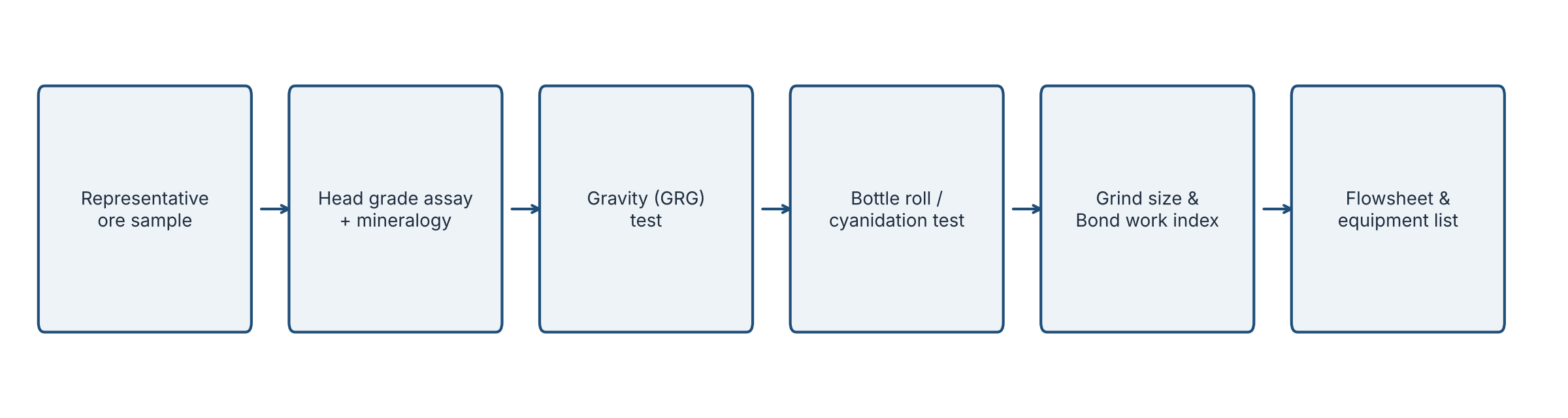
1. Start with a sample that represents the orebody
A few handpicked rocks tell you very little. Take material from different depths and zones, and keep weathered (oxide) ore separate from fresh (sulphide) ore. They behave differently and often need different treatment. If you will mix them in production, test the blend, not each one alone.
2. Get a head grade assay and basic mineralogy
The assay tells you how much gold is in the rock. Mineralogy tells you where it sits: free gold, gold locked in pyrite, or gold tied to arsenic or copper. Locked gold often means finer grinding or oxidation before cyanide works. Copper and sulphides can also burn through cyanide and raise operating cost.
3. Run a gravity recovery test
Coarse free gold can be recovered cheaply with gravity equipment before any chemicals are used. A gravity test shows how much of your gold is recoverable this way. For many alluvial and some hard rock deposits, gravity plus a small cleaning step may be all you need, and that changes the whole budget.
A common lab method for this is the gravity recoverable gold (GRG) test. Ask your lab whether it can run one on your sample.
4. Test leaching: bottle roll first, column or CIL tests next
A bottle roll test is the fast, low cost way to see how well your ore responds to cyanide. It gives recovery, reagent consumption and leach time. If results are promising, a lab can follow with more detailed CIL or CIP tests. Reagent consumption feeds directly into your operating cost, so ask the lab to report it.
If your plant will use cyanide, plan for safe handling and storage from the start. The International Cyanide Management Code sets the industry reference for this.
5. Find the right grind size and ore hardness
Grinding is usually the biggest power consumer in the plant. Ask the lab for a grind size versus recovery curve and a Bond work index. These two numbers decide the mill size and the motor size. Without them, the mill is a guess.
6. Write down your real throughput and feed conditions
Be specific: tons per day or per hour, hours of operation, maximum rock size delivered to the plant, moisture, and the share of fines already in the feed. A feed with a lot of clay or fines may need pre-screening or a scrubber before crushing. Tell your supplier about it up front.
What to send your plant supplier
- Ore type and location of the site
- Assay and test reports (original PDF files, not photos of paper)
- Required capacity and operating hours
- Maximum feed size and fines percentage
- Power supply: grid or generator, and available capacity
- Water source and tailings plan
- Mining licence status and planned timeline
A supplier who receives this can give you a flowsheet, an equipment list and a budget range that mean something. A supplier who quotes without it is guessing, and you will pay for the guess later.
A note on plant size and phasing
If your budget is limited, do not build the full plant on day one. Many operations start with crushing, screening and gravity recovery, then add milling and CIL once the ore body and cash flow are proven. Ask your supplier to design the layout so that the next stage can be added without rebuilding the first.
Next step
If you already have an assay and test results, send them with your target capacity, and our technical team will prepare an initial flowsheet and budget range. If you are still at the sampling stage, tell us the ore type and location and we can suggest which tests to order first.
Contact: email info@cneigindustrial.com or message us on WhatsApp at +86 191 3748 3029.
See also: our crushing equipment (jaw, impact and cone crushers, VSI sand makers) and screening and feeding equipment. For the gold plant itself, read Small Scale Gold Processing Plant: How It Is Built.