
CIL/CIP Gold Processing Plant
CIL and CIP plants recover fine gold that gravity cannot catch. The ore is ground and leached with cyanide solution, the dissolved gold is captured on activated carbon, then stripped, electrowon and smelted into doré. We supply the complete line for plants from about 50 t/d.
- Plant size50–200 t/d
- Total retention24–36 h typical
- Target grind75–150 µm
- RouteCyanide leaching + carbon
Figures are indicative. Final parameters are confirmed in the quotation.
CIL or CIP?
Both use carbon to capture the dissolved gold. The difference is where the carbon sits.
CIL: carbon-in-leach
Activated carbon is added in the same tanks where the gold is leached. Leaching and adsorption happen together, which keeps the circuit short.
CIP: carbon-in-pulp
The ore is leached first in separate tanks, then the solution passes through adsorption tanks that hold the carbon.
CIL is common for small and medium plants because it needs fewer tanks. CIP suits ores where carbon should be kept out of the leach, or where leaching needs more time. The choice is confirmed by test work.
When CIL/CIP is the right route
A short honest check before you ask for a price.
Good fit
- The gold is fine, or locked in the rock, and a gravity circuit alone leaves too much in the tailings.
- The ore responds to cyanide in a laboratory leach test.
- You plan at least 50 t/d, or you want to leach the tailings of an existing gravity plant.
Look more carefully if
- The ore has high sulphide or carbonaceous material, or uses a lot of cyanide. It needs careful test work before any design is fixed.
- Most of your gold is free and coarse: a gravity plant may be enough, at lower cost.
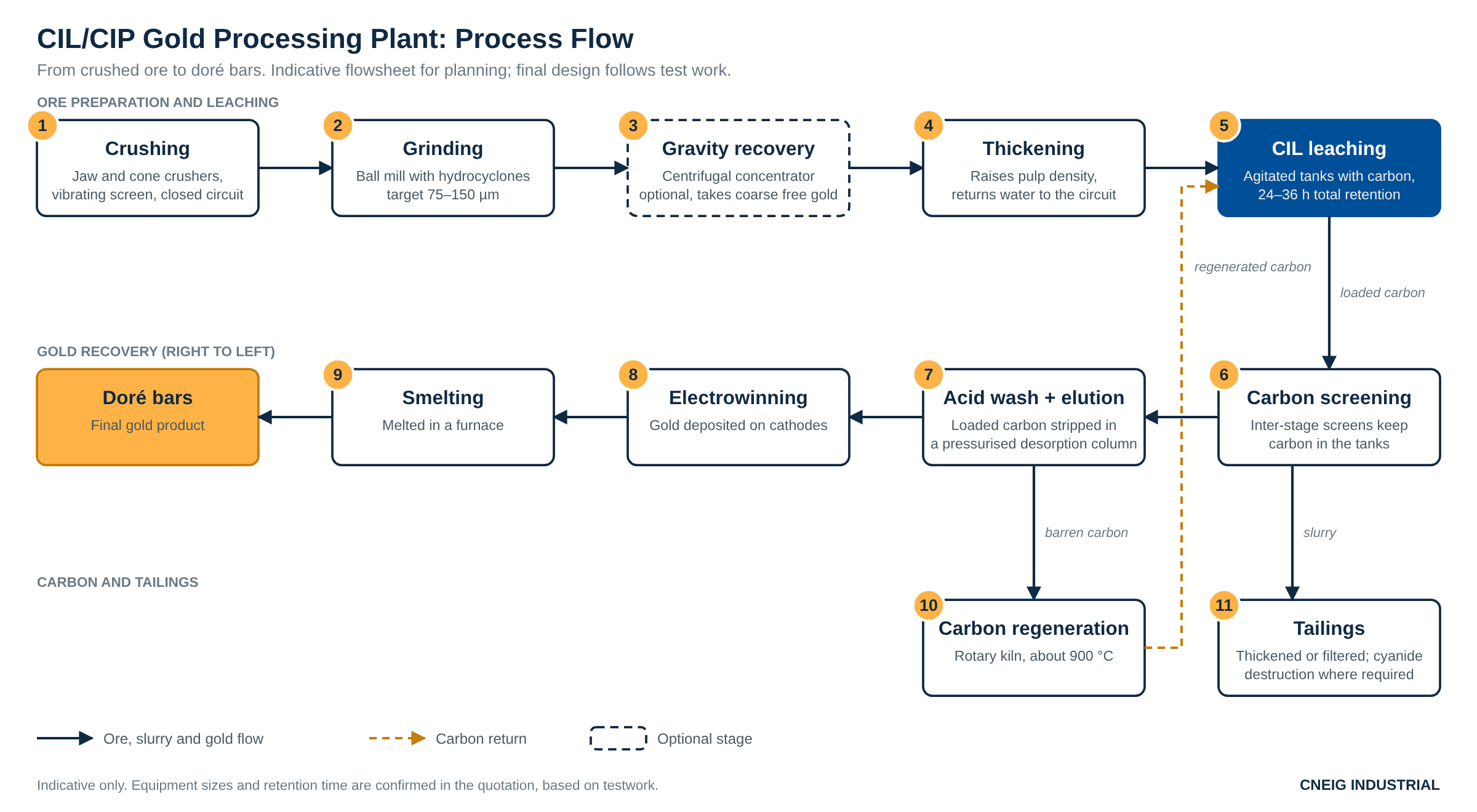
Process flow
The main stages of a CIL/CIP plant, from crushed ore to doré.
- Crushing: jaw crusher and cone crusher with a vibrating screen in closed circuit.
- Grinding and classification: ball mill with hydrocyclones; a typical target is 75–150 µm.
- Gravity recovery (optional): a centrifugal concentrator on the cyclone underflow takes coarse free gold before leaching.
- Thickening: raises the pulp density before leaching and returns water to the circuit.
- Leaching and adsorption: a series of agitated tanks; carbon moves counter-current to the pulp. Typical total retention is 24–36 hours, fixed by the leach test.
- Carbon screening and transfer: inter-stage screens keep the carbon in the tanks; air-lift or pumps move it between stages.
- Acid wash and elution: loaded carbon is stripped in a pressurised desorption column.
- Electrowinning and smelting: gold is deposited on cathodes, then smelted to doré.
- Carbon regeneration: barren carbon is reactivated and returned to the circuit.
- Tailings: thickened or filtered, with cyanide destruction where required by local regulation.
Indicative plant sizes
For planning only: 24 h total retention, 40% solids, ore SG 2.7, 90% tank fill. Final design follows test work and engineering confirmation. The layout drawing and delivery time are given in the quotation.
| Item | 50 t/d | 100 t/d | 200 t/d |
|---|---|---|---|
| Jaw crusher | PE250×400 (5–20 t/h, 15 kW) | PE250×400 (5–20 t/h, 15 kW) | PE400×600 (15–60 t/h, 30 kW) |
| Ball mill | Φ1200×2400 (30 kW) | Φ1500×3000 (75 kW) | Φ1830×4500 (155 kW) |
| Leach / CIL tanks | 6 × about 19 m³ | 7 × about 30 m³ | 10 × about 46 m³ |
| Agitator power (total) | about 110 kW | about 155 kW | about 300 kW |
| Thickener | NZ-6, 6 m dia. | NZ-9, 9 m dia. | NZ-12, 12 m dia. |
| Desorption-electrolysis unit | GKJD-200 | GKJD-200 | GKJD-300 |
| Main-equipment power (crusher, mill, agitators, thickener) | about 160 kW | about 250 kW | about 490 kW |
Figures are indicative. Final parameters are confirmed in the quotation.
Main equipment
Ranges for the main machines in the line.
| Equipment | Range / specification |
|---|---|
| Agitated leaching tank | 19.1 m³ (3000×3000 mm, 18.5 kW, 4.9 t) to 30 m³ (3550×3550 mm, 22 kW, 7.3 t); impeller 700–850 mm, 210–230 r/min; larger tanks up to 46 m³ for 200 t/d |
| Carbon screen | Stainless-steel inter-tank screen retaining −6/+10 mesh carbon (about 1.7–3.35 mm); air-lift or pump carbon transfer |
| Desorption column + electrowinning cell | Column φ300×2000 (0.14 m³) to φ900×4200 (3 m³); electric heater 18–48 kW; electrolytic cell 0.2–1 m³, 0–1000 A, 0–6 V; operating at 150 ±2 °C, 0.5 MPa, pH ≥ 13.5 |
| Center-drive thickener | NZ-6: 6 m dia., 14–62 t/d, 1.1 kW; NZ-9: 9 m, 32–150 t/d, 3 kW; NZ-12: 12 m, up to 250 t/d, 3 kW |
| Carbon regeneration kiln | Rotary kiln, about 900 °C, 30 min retention |
| Filter press / tailings thickener | Chamber filter press or tailings thickener, sized to the tailings flow |
| Control and dosing | Cyanide and lime metering pumps; pH and free-cyanide monitoring |
Figures are indicative. Final parameters are confirmed in the quotation.
What we need to quote
Send what you know on WhatsApp or by email. Rough numbers are enough to start.
- Ore description and daily tonnage
- Assay or test results, including a cyanide leach test if available
- Maximum feed size and target grind
- Site power (voltage and frequency) and water supply
- New plant or expansion, and your planned start date
- Site location and destination country
What you receive from CNEIG
What is included in the quotation and the order.
- Preliminary flowsheet and equipment list
- Budgetary quotation with delivery time
- Engineering drawings and production follow-up
- Packing, documents and sea freight
- Installation and commissioning support: drawings and guidance are included, and on-site engineers can be arranged on request
Buying through CNEIG INDUSTRIAL
We are a trading and project-coordination company, not the factory.
- We work directly with our manufacturing partner in China. We agree the model and parameters with them and write them into your quotation.
- We do not quote a gold recovery without a test on your ore.
- Lead time, payment, warranty and delivery terms are set in the contract.
- Read how we handle pre-shipment inspection.
Common questions
How long does leaching take?
Usually between 24 and 36 hours in total, but the exact time comes from your leach test. It sets the number and size of the tanks.
What gold recovery can I expect?
It depends entirely on the ore. We do not quote a recovery without a test. A bottle roll or column test on your sample is the starting point.
Do I need a permit to use cyanide?
In most countries yes, and tailings handling is regulated. The owner is responsible for permits. We design the layout so containment and tailings handling can be added.
Can I start with gravity and add CIL later?
Yes. A gravity line can be built first and the leaching section added when the tonnage or the ore justifies it.
What power supply do you design for?
We size to your local supply, including 50 Hz or 60 Hz. Tell us the voltage and frequency with the enquiry.
Related equipment
Tell us about your project
Send your ore details and the capacity you want. We reply with a preliminary configuration and a list of what we still need.