
Small-Scale Gold Gravity Processing Plant
A gravity plant is the simplest way to start recovering gold from hard rock or alluvial material. It uses water and density, not cyanide, and it can be built in modular sections that move with the mine. We supply small-scale gravity lines for contractors, cooperatives and small mine owners.
- Standard sizes1, 2 and 5 t/h
- ChemicalsNo cyanide
- RecoversFree and coarse gold
- BuildModular sections
Figures are indicative. Final parameters are confirmed in the quotation.
Who it is for
Four typical buyers of a small gravity line.
Starting small mines
Small mine owners and cooperatives starting production.
Alluvial contractors
Contractors treating alluvial or eluvial material.
Pilot plant first
Operators who want a pilot plant before investing in a CIL/CIP circuit.
Free or coarse gold
Owners with free or coarse gold in the ore.
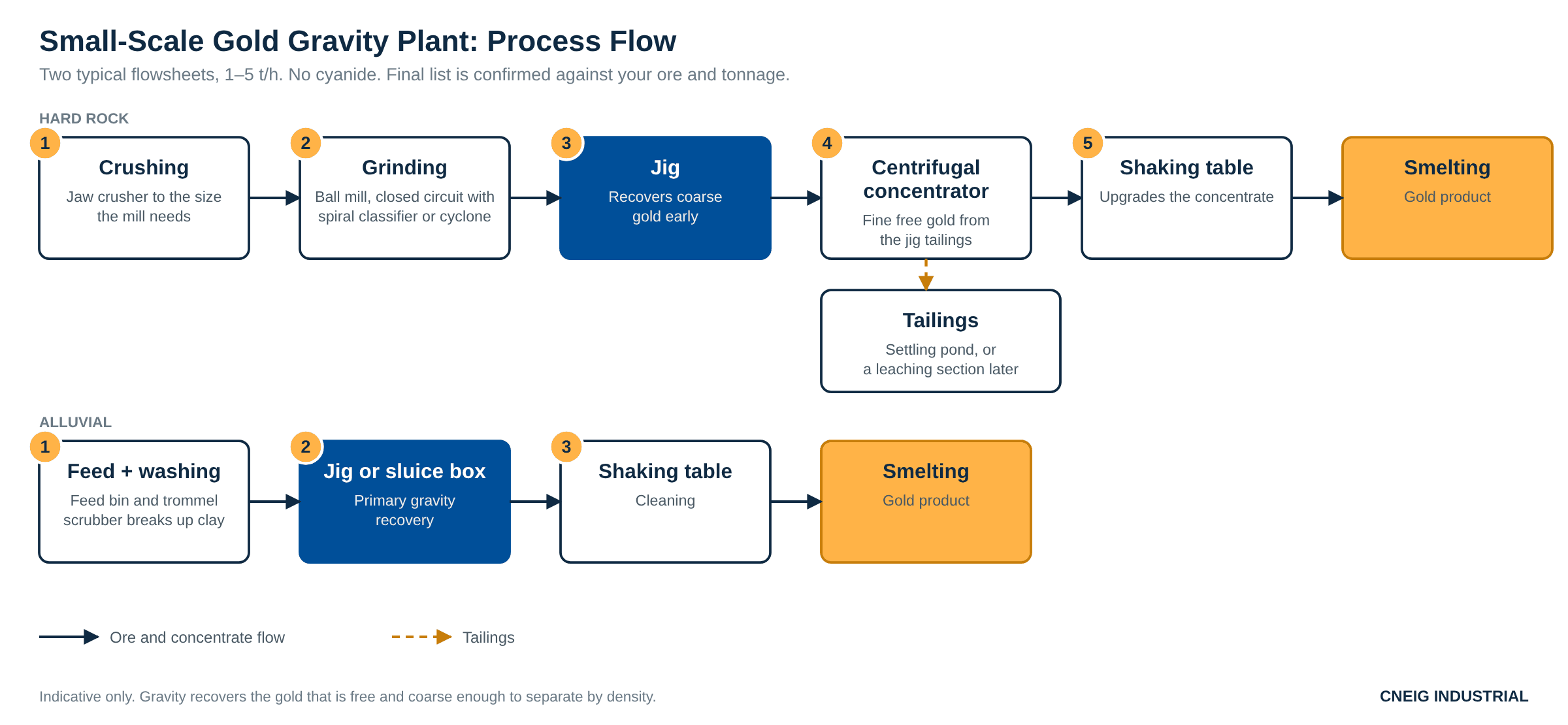
Typical flowsheet: hard rock
The gold is released by grinding and then caught by density.
Tailings go to a settling pond, or to a leaching section later.
Typical flowsheet: alluvial
Washing first, because clay hides the gold.
Configurations
A typical selection from standard equipment sizes. The final list is confirmed against your ore and tonnage.
| Item | 1 t/h | 2 t/h | 5 t/h |
|---|---|---|---|
| Jaw crusher | PE150×250 (1–4 t/h, 5.5 kW) | PE150×250 (1–4 t/h, 5.5 kW) | PE250×400 (5–20 t/h, 15 kW) |
| Ball mill | Φ900×1800 (0.65–2 t/h, 18.5 kW) | Φ900×3000 (1.1–3.5 t/h, 22 kW) | Φ1200×4500 (1.6–5.8 t/h, 55 kW) |
| Spiral classifier | FG-5 (3 kW) | FG-5 (3 kW) | FG-12 (5.5 + 2.2 kW) |
| Jig | JT-0.57 (1–2.5 t/h, 1.5 kW, 1–2 m³/h water) | JT1-1 (2–3 t/h, 2.2 kW, 2–3 m³/h water) | JT2-2 (4–8 t/h, 3 kW, 2–4 m³/h water) |
| Centrifugal concentrator | STLB30 (2–3 t/h, 1.5 kW) | STLB30 (2–3 t/h, 1.5 kW) | STLB60 (8–12 t/h, 4 kW) |
| Shaking table | 1 × 6-S (1.1 kW) | 1 × 6-S (1.1 kW) | 2 × 6-S (2.2 kW) |
| Connected load of these machines | about 31 kW | about 35 kW | about 87 kW |
Connected load excludes water pumps; size the generator with margin. Figures are indicative. Final parameters are confirmed in the quotation.
What affects recovery
Gravity recovers the gold that is free and coarse enough to separate by density.
How much of your gold that is depends on your ore, and only a test can tell you. Grind size, feed rate, water balance and the way the concentrate is cleaned all change the result.
If a test shows a lot of fine or locked gold in the tailings, the plant can be extended later with a leaching section.
Why choose a gravity plant first
- No cyanide permit and no chemical handling
- Lower investment than a leaching plant
- Modular, so sections can be added or moved
- A fast way to learn how your ore behaves before a larger investment
What we need to quote
Send what you know on WhatsApp or by email. Rough numbers are enough to start.
- Ore type: hard rock, alluvial or eluvial
- Tonnage per hour you want to treat
- Maximum feed size and, if known, gold grade
- Site location and destination country
- Power: grid or generator, voltage and frequency
- Water availability
Buying through CNEIG INDUSTRIAL
We are a trading and project-coordination company, not the factory.
- We work directly with our manufacturing partner in China. We agree the model and parameters with them and write them into your quotation.
- We do not quote a gold recovery without a test on your ore.
- Lead time, payment, warranty and delivery terms are set in the contract.
- Read how we handle pre-shipment inspection.
Common questions
What is the smallest plant you can supply?
Our standard configurations start at 1 t/h.
How much gold will it recover?
It depends on how much of your gold is free. We do not quote a recovery without a test on your ore.
Is power from a generator enough?
Usually yes for small plants. We give you the connected load in the configuration so the generator can be sized correctly. The connected load of the machines above is about 31 kW (1 t/h), 35 kW (2 t/h) and 87 kW (5 t/h), excluding water pumps; size the generator with margin.
Can I add leaching later?
Yes. The tailings can be sent to a CIL/CIP section; see the CIL/CIP page.
Do you help with installation?
Yes. Installation drawings and commissioning guidance are provided, and on-site engineers can be arranged on request.
Machines used with it
Tell us about your project
Send your ore description and the tonnage per hour you want to treat. We reply with a recommended configuration.