
Gold Shaking Table
A shaking table separates fine gold from lighter minerals using a thin film of water and a differential shaking motion. It needs no chemicals and is one of the most common ways to clean gravity concentrate or to recover fine gold from sized feed.
- Deck area7.6 m²
- Capacity0.3–1.8 t/h by deck
- Motor1.1 kW, 380 V
- Feed size0.02–2 mm
Figures are indicative. Final parameters are confirmed in the quotation.
How it works
A thin water film and a slow-forward, fast-return motion do the separating.
1. Feed and wash water
Pulp is fed onto an inclined deck and wash water flows across it.
2. Shaking motion
The deck moves slowly forward and returns quickly. This carries the heavy gold particles along the riffles to the concentrate end.
3. Three products
Lighter minerals wash down the slope into the tailings. A middlings band between them can be returned to the circuit.
Separation depends on the difference in density, so the table works best on feed that has been sized into narrow ranges.
Where it fits in a gold plant
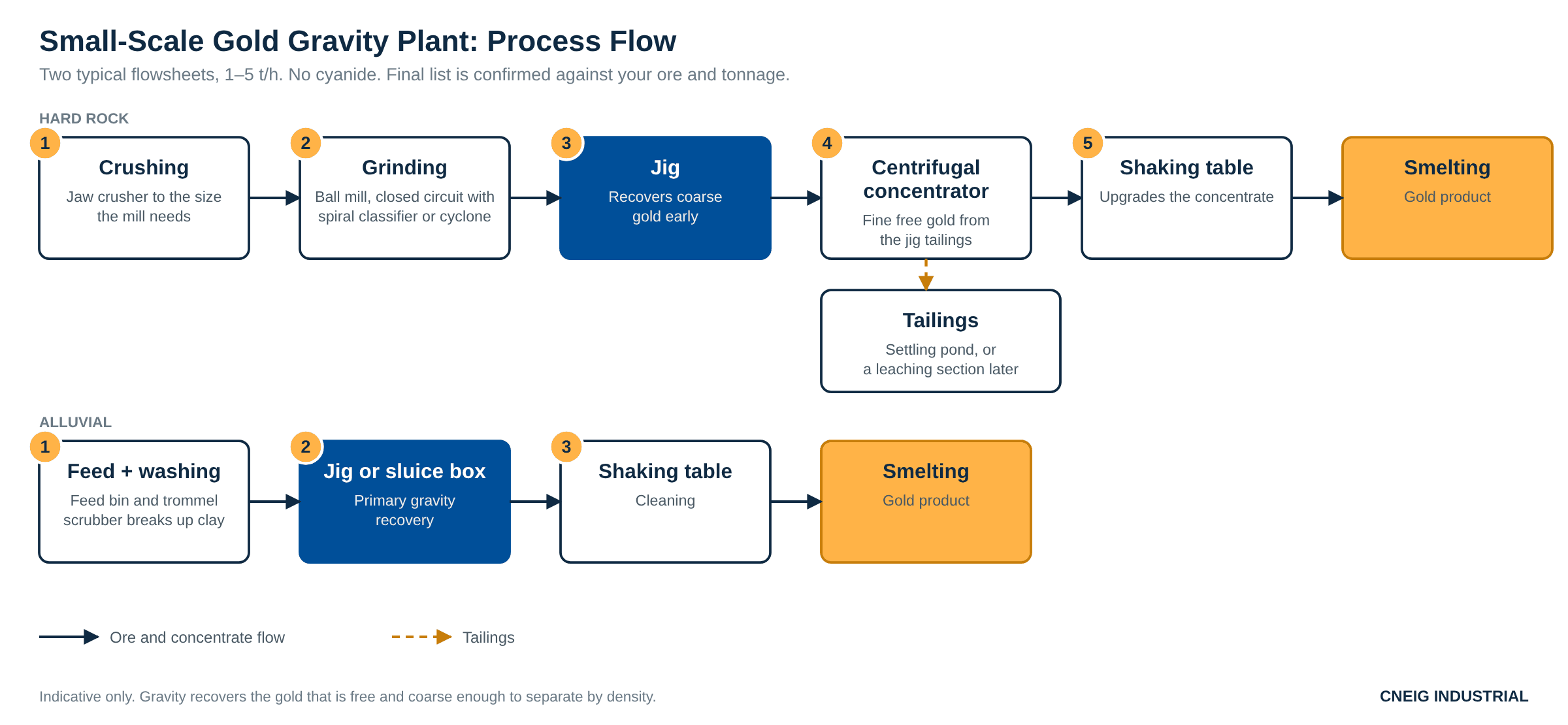
Usually the cleaning step after a jig or a centrifugal concentrator.
- Cleaning concentrate from a jig, a centrifugal concentrator or a spiral.
- Rougher stage on classified fine material, typically below about 2 mm.
- Scavenging tailings from other gravity or flotation circuits.
- Laboratory and sampling work, using a small bench-size table.
A table does not replace leaching. Gold that is very fine, locked in sulphides or coated needs a CIL/CIP circuit.
Specification (6-S type)
The 6-S table with a 7.6 m² deck. Stroke, speed and capacity depend on the deck type.
| Item | Specification |
|---|---|
| Deck area | 7.6 m² |
| Deck length | 4,500 mm |
| Deck width, feed end / concentrate end | 1,850 mm / 1,550 mm |
| Stroke | 8–22 mm, adjustable (coarse deck 16–22, fine deck 11–16, slime deck 8–16) |
| Strokes per minute | 220–280 (coarse 220, fine 250, slime 280) |
| Feed size | 0.02–2 mm (coarse 0.5–2, fine 0.074–0.5, slime 0.02–0.074) |
| Feed density | 15–30% solids |
| Capacity | 0.3–1.8 t/h, depending on the deck |
| Wash water | 0.4–1 m³/h, depending on the deck |
| Bed slope | 0–10° adjustable |
| Motor | 1.1 kW, 380 V |
| Deck and frame | Fibreglass deck, carbon steel frame |
| Weight | about 1 t |
| Overall dimensions | about 4,450 × 1,855 × 1,546 mm (L × W × H) |
Figures are indicative. Final parameters are confirmed in the quotation.
Deck types
Choose the deck by feed size. Stroke and speed are adjustable.
| Deck | Feed size | Use |
|---|---|---|
| Coarse sand deck | up to about 2 mm | Rougher on coarse feed |
| Fine sand deck | up to about 0.5 mm | Fine sand cleaning |
| Slime deck | up to about 0.074 mm | Fine and slime fractions |
Tips for good results
What your operators should do from the first day.
Classify the feed first
One table treats one size range well.
Keep feed steady
Keep the feed rate and the pulp density steady.
Test on your own ore
Adjust wash water, slope and stroke on a sample of your own ore. Small changes matter.
Sample the products
Take samples of concentrate, middlings and tailings so you can see where the gold goes.
What we need to quote
Send what you know on WhatsApp or by email. Rough numbers are enough to start.
- Ore type and the size of the feed
- Tonnage you want to treat (t/h)
- Whether the feed is classified
- Where the table fits in your plant
- Power supply (voltage and frequency)
- Destination country
Buying through CNEIG INDUSTRIAL
We are a trading and project-coordination company, not the factory.
- We work directly with our manufacturing partner in China. We agree the model and parameters with them and write them into your quotation.
- We do not quote a gold recovery without a test on your ore.
- Lead time, payment, warranty and delivery terms are set in the contract.
- Read how we handle pre-shipment inspection.
Common questions
How much ore can one table treat?
A full-size table with a 7.6 m² deck treats about 0.3 t/h on a slime deck and up to about 1.8 t/h on a coarse sand deck.
Do I need mercury or chemicals?
No. A shaking table works with water only.
What power and water does it need?
A 1.1 kW motor (380 V) and a steady water supply of about 0.4–1 m³/h, depending on the deck.
Can I run several tables together?
Yes. Several tables are installed in parallel to raise the throughput, fed through a distributor.
Do you supply spare parts?
Yes. A wear and spare parts list is supplied with the equipment, and parts can be re-ordered from us.
Machines used with it
Tell us about your project
Send your ore size and the tonnage you want to treat. We reply with a recommended table configuration.