
A small gold plant is a chain of machines, and each one has to suit the ones on either side of it. If the crusher gives the mill the wrong size, or the mill grinds too coarse, the recovery stage cannot make up for it. This note walks through a typical layout from crushing to gravity recovery and lists what we need from you to put together a flowsheet and equipment list. It covers gravity recovery only, not cyanide leaching.
For the full plant layout and the other recovery routes, see Small Scale Gold Processing Plant: How It Is Built.
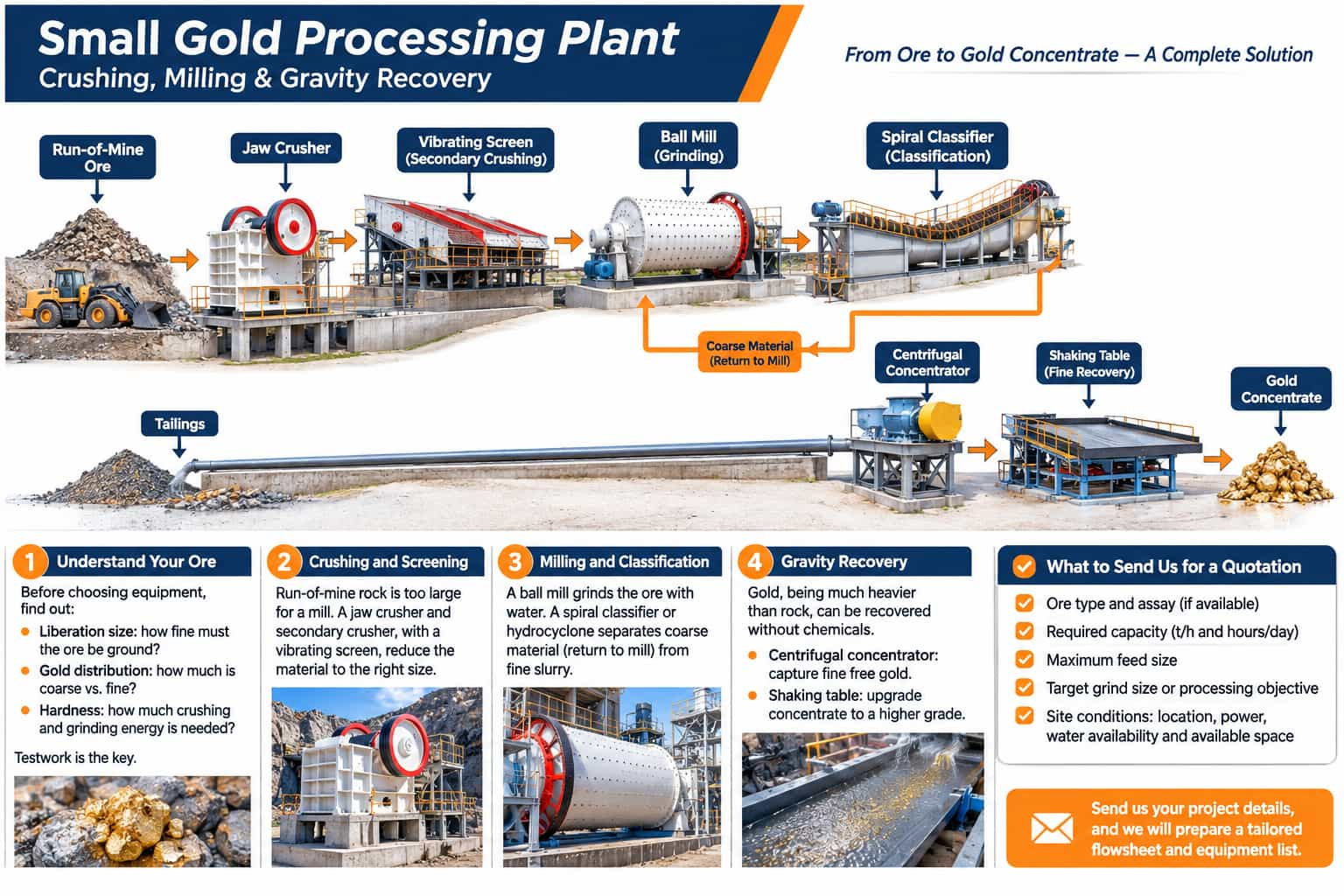
Start with the ore
Choose the equipment after you know how the gold occurs in the rock. Two deposits with the same capacity can need quite different plants. Four things matter most: how fine the ore must be ground before the gold is freed, whether the gold is coarse, fine or tied up in sulphide minerals, how hard the ore is, and how much of the gold gravity can recover.
You get these answers from testwork on a representative sample. A catalogue or the look of the rock will not give them. We work from your sample information and test results, and we do not replace laboratory testing.
Step 1: Crushing and screening
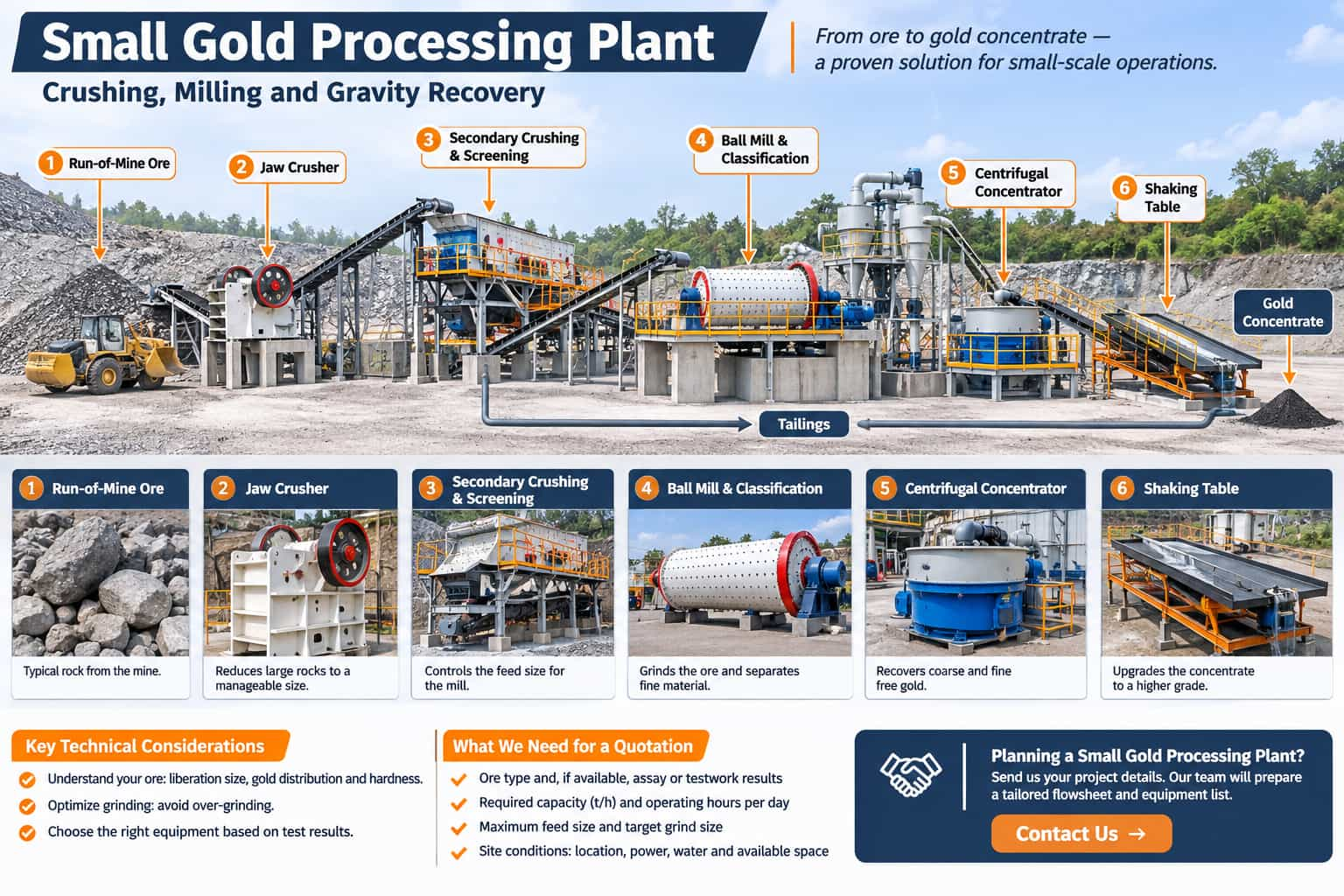
Run-of-mine rock is too big to go straight into a mill, so it is crushed first. A jaw crusher usually takes the first pass. A second crusher brings the ore down to the size the mill needs, and a vibrating screen between them sends oversize back for another pass.
How many stages you need depends on the largest rock coming in, the size the mill wants and your capacity in tonnes per hour. A steady feed makes the mill, and the whole plant, easier to run. See our crushing and screening equipment and the PE jaw crusher.
Step 2: Milling and classification
After crushing, a ball mill grinds the ore with water into a slurry. The aim is to grind just fine enough to free the gold. Going finer costs more power, and with some ores it hurts recovery, because soft native gold can be flattened into thin flakes that are harder to catch.
A spiral classifier or a hydrocyclone sits after the mill. Coarse material goes back to the mill and fine material moves on to recovery. The target size should come from how the gold is freed in your ore, not from a number picked in advance. See our grinding equipment.
Step 3: Gravity recovery
Gold is far heavier than most rock, so it can be separated from the slurry without chemicals. Small plants usually use two machines.
A centrifugal concentrator spins the slurry in a fast-rotating bowl. The heavy gold is held in the bowl while lighter material washes away. It is good at picking up fine free gold that other gravity equipment tends to miss, and it can be placed at different points in the mill circuit depending on the ore.
A shaking table has a slightly tilted deck that moves back and forth while water flows across it. Gold and waste leave the deck in different zones. It is normally used to clean up a concentrate, not to treat the whole feed.
A common setup is to take a rough concentrate with the centrifugal concentrator and clean it on the shaking table. The final arrangement depends on your ore and your test results.
What gravity recovery cannot do
Gravity works when the gold is freed from the rock and large enough to be caught. If much of it is extremely fine, or locked inside sulphide minerals, some will end up in the tailings. Testwork may then point to flotation or leaching. Whether those suit your project depends on the ore, the economics, environmental rules and the permits at your site.
Expect recovery figures only from testwork on your own ore, not from the machine alone.
What to send us
To prepare a flowsheet and equipment list, please send:
- your ore type, and any assay or test reports
- the capacity you need in tonnes per hour, and operating hours per day
- the largest feed size
- the grind size you are aiming for, or what you want the plant to achieve
- the project country and location, power supply, water supply and space available
If you have no testwork yet, send the ore type, location and rough capacity anyway. We will tell you what is missing and whether testwork should come first.
To get started, fill in the short form below, or see what to send for an RFQ first.
Send Us Your Gold Plant Project
Tell us the ore type, capacity and feed size. Testwork results and site conditions help us quote accurately, but send what you have.